
Homework Answers
Add Answer to:
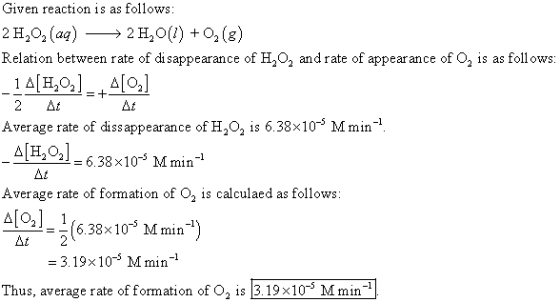
gei n diat im bydtai H20,(aq)2 H,0)+02(8) the average rate of disappearance of H,0, over the...
For the decomposition of ammonia on a platinum surface at 856 °C 2 NH3-N2 + 3...
 For the decomposition of ammonia on a platinum surface at 856 °C 2 NH3-N2 + 3 H2 the average rate of disappearance of NH3 over the time period from t=0 s to t = 6293 s is found to be 1.50X100 Ms? The average rate of formation of H, over the same time period is Ms. For the decomposition of hydrogen peroxide in dilute sodium hydroxide at 20 °C 2 H2O2(aq) +2 H2O(1) + O2(g) the average rate of disappearance...
For the gas phase decomposition of dinitrogen pentoxide at 335 K 2 N205 4 NO2 +...
 For the gas phase decomposition of dinitrogen pentoxide at 335 K 2 N205 4 NO2 + O2 the following data have been obtained: 0.173 [N2O3], M time, s 9.75x10⁻² 122 5.50x10⁻² 244 3.10x10² 366 Ms! The average rate of disappearance of N,Os over the time period from t=0 stot - 122 sis Submit Answer Retry Entire Group 9 more group attempts remaining For the gas phase decomposition of hydrogen iodide at 700 K 2 HI -H2 +12 the following data...
For the decomposition of dinitrogen pentoxide in carbon tetrachloride solution at 30 °C 2 N2O54 NO2...
For the decomposition of dinitrogen pentoxide in carbon tetrachloride solution at 30 °C 2 N2O54 NO2 + O2 the average rate of disappearance of N2O5 over the time period from t = 0 min to t = 169 min is found to be 2.20×10⁻³ M min-1. The average rate of formation of O2 over the same time period is ______M min-1.
For the gas phase decomposition of nitrogen dioxide at 383 °C 2 NO22 NO + O2...
For the gas phase decomposition of nitrogen dioxide at 383 °C 2 NO22 NO + O2 the average rate of disappearance of NO2 over the time period from t = 0 s to t = 21 s is found to be 6.40×10⁻³ M s-1. The average rate of formation of O2 over the same time period is
For the following reaction: CH_3 OH(aq) + H^+ (aq) + Cl^- (aq) rightarrow CH_3Cl(aq) + H_2O(l)...
 For the following reaction: CH_3 OH(aq) + H^+ (aq) + Cl^- (aq) rightarrow CH_3Cl(aq) + H_2O(l) the value of [H^+] was measured over a period of time. Given the data, find the average rate of disappearance of H^+(aq) for the time interval between each measurement. What is the average rate of appearance of CH_3 CI(aq) for the same time intervals?
For the decomposition of hydrogen peroxide in dilute sodium hydroxide at 20 °C 2 H2O2(aq) 2...
 For the decomposition of hydrogen peroxide in dilute sodium hydroxide at 20 °C 2 H2O2(aq) 2 H2O(l) + O2(g) the following data have been obtained: 6.26x10⁻² 3.39x10⁻² 1.84x10⁻² 9.96x10⁻³ [H202], M time, min 9.28 18.6 27.9 The average rate of disappearance of H2O2 over the time period from t=18.6 min to t = 27.9 min is M min-1
For the reaction [H](M) 2.36 CH, OH(aq) + H+ (aq) + C- (aq) CH, Cl(aq) +...
 For the reaction [H](M) 2.36 CH, OH(aq) + H+ (aq) + C- (aq) CH, Cl(aq) + H2O(1) the value of [H*] was measured over a period of time. Given the data in the table, find the average rate of disappearance of H+ (aq) for the time interval between each measurement. Interval: Os to 34.0 1 (s) 0 34.0 57.0 2.14 2.02 120.0 1.85 reaction rate: M/S Interval: 34.0 sto 57,0 s reaction rate: M/s Interval: 57.0 s to 120.0 s...
a.) For the decomposition of nitramide in aqueous solution at 25 °C NH2NO2(aq)---->N2O(g) + H2O(l) the...
a.) For the decomposition of nitramide in aqueous solution at 25 °C NH2NO2(aq)---->N2O(g) + H2O(l) the following data have been obtained: [NH2NO2], M 0.145 9.12×10⁻² 5.74×10⁻² 3.61×10⁻² time, min 0 164 328 492 The average rate of disappearance of NH2NO2 over the time period from t = 0 min to t = 164 min is M min-1. b.) For the gas phase decomposition of nitrogen dioxide at 383 °C 2 NO2----->2 NO + O2 the following data have been obtained:...
Consider the reaction 5Br−(aq)+BrO−3(aq)+6H+(aq)→3Br2(aq)+3H2O(l) The average rate of consumption of Br− is 1.10×10⁻⁴ M/s over the...
Consider the reaction 5Br−(aq)+BrO−3(aq)+6H+(aq)→3Br2(aq)+3H2O(l) The average rate of consumption of Br− is 1.10×10⁻⁴ M/s over the first two minutes. The average rate of formation of Br2 during the same time interval is 6.6x10^-5. What is the average rate of consumption of H+ during the same time interval?
Hello! I would like this question answered, Im having a hard time understanding so this woild...
 Hello! I would like this question answered, Im having a hard
time understanding so this woild be helpful, thank yoi!
For the reaction 1 (s) [H](M) 2.33 0 CH2OH(aq) + H+(aq) + Cl(aq) - CHCl(aq) + H200) 32.0 2.11 the value of [H) was measured over a period of time. Given the data in the table, find the average rate of disappearance of H(aq) for the time interval between each measurement Interval: 0s to 32.08 59.0 118.0 1.99 1.82 reaction...
Hello! I would like this question answered, Im having a hard
time understanding so this woild be helpful, thank yoi!
For the reaction 1 (s) [H](M) 2.33 0 CH2OH(aq) + H+(aq) + Cl(aq) - CHCl(aq) + H200) 32.0 2.11 the value of [H) was measured over a period of time. Given the data in the table, find the average rate of disappearance of H(aq) for the time interval between each measurement Interval: 0s to 32.08 59.0 118.0 1.99 1.82 reaction...
 For the decomposition of ammonia on a platinum surface at 856 °C 2 NH3-N2 + 3 H2 the average rate of disappearance of NH3 over the time period from t=0 s to t = 6293 s is found to be 1.50X100 Ms? The average rate of formation of H, over the same time period is Ms. For the decomposition of hydrogen peroxide in dilute sodium hydroxide at 20 °C 2 H2O2(aq) +2 H2O(1) + O2(g) the average rate of disappearance...
 For the gas phase decomposition of dinitrogen pentoxide at 335 K 2 N205 4 NO2 + O2 the following data have been obtained: 0.173 [N2O3], M time, s 9.75x10⁻² 122 5.50x10⁻² 244 3.10x10² 366 Ms! The average rate of disappearance of N,Os over the time period from t=0 stot - 122 sis Submit Answer Retry Entire Group 9 more group attempts remaining For the gas phase decomposition of hydrogen iodide at 700 K 2 HI -H2 +12 the following data...
 For the following reaction: CH_3 OH(aq) + H^+ (aq) + Cl^- (aq) rightarrow CH_3Cl(aq) + H_2O(l) the value of [H^+] was measured over a period of time. Given the data, find the average rate of disappearance of H^+(aq) for the time interval between each measurement. What is the average rate of appearance of CH_3 CI(aq) for the same time intervals?
 For the decomposition of hydrogen peroxide in dilute sodium hydroxide at 20 °C 2 H2O2(aq) 2 H2O(l) + O2(g) the following data have been obtained: 6.26x10⁻² 3.39x10⁻² 1.84x10⁻² 9.96x10⁻³ [H202], M time, min 9.28 18.6 27.9 The average rate of disappearance of H2O2 over the time period from t=18.6 min to t = 27.9 min is M min-1
 For the reaction [H](M) 2.36 CH, OH(aq) + H+ (aq) + C- (aq) CH, Cl(aq) + H2O(1) the value of [H*] was measured over a period of time. Given the data in the table, find the average rate of disappearance of H+ (aq) for the time interval between each measurement. Interval: Os to 34.0 1 (s) 0 34.0 57.0 2.14 2.02 120.0 1.85 reaction rate: M/S Interval: 34.0 sto 57,0 s reaction rate: M/s Interval: 57.0 s to 120.0 s...
 Hello! I would like this question answered, Im having a hard
time understanding so this woild be helpful, thank yoi!
For the reaction 1 (s) [H](M) 2.33 0 CH2OH(aq) + H+(aq) + Cl(aq) - CHCl(aq) + H200) 32.0 2.11 the value of [H) was measured over a period of time. Given the data in the table, find the average rate of disappearance of H(aq) for the time interval between each measurement Interval: 0s to 32.08 59.0 118.0 1.99 1.82 reaction...
Hello! I would like this question answered, Im having a hard
time understanding so this woild be helpful, thank yoi!
For the reaction 1 (s) [H](M) 2.33 0 CH2OH(aq) + H+(aq) + Cl(aq) - CHCl(aq) + H200) 32.0 2.11 the value of [H) was measured over a period of time. Given the data in the table, find the average rate of disappearance of H(aq) for the time interval between each measurement Interval: 0s to 32.08 59.0 118.0 1.99 1.82 reaction...
Most questions answered within 3 hours.
-
Where is the error in this code sequence?
String s1 = "Hello";
String s2 = "ello";...
asked 11 months ago -
Financial data for Joel de Paris, Inc., for last year
follow:
Joel de Paris, Inc.
Balance...
asked 11 months ago -
Consider this reaction:
Al2(SO4)3 (aq)+ BaCl3
(aq) Al2Cl6 (aq)- +
3BaSO4(s) . What is the...
asked 11 months ago -
Suppose that Savneet is considering increasing her
recent random sample from 20 car rentals to 40...
asked 11 months ago -
Trucks arrive at an unloading terminal at an average rate of 120
per hour.
Trucks arrive...
asked 11 months ago -
Why are methanol and ethanol completely soluble in water while
octanol is not very little soluble....
asked 11 months ago -
A facilities manager at a university reads in a research report
that the mean amount of...
asked 11 months ago -
When the CuSO4 is rehydrated by adding water to the anhydrous
compound, is this an endothermic...
asked 11 months ago -
A ray of sunlight is passing from diamond into crown glass; the
angle of incidence is...
asked 11 months ago -
A block of mass 0.249 kg is placed on top of a light, vertical
spring of...
asked 11 months ago -
how do the kidneys compensate in the presences of acidosis
a) trigger hyperventilate
b) reserve acid...
asked 11 months ago -
Question 501 pts
The rental rate of capital to the firm increases. Which of the
following...
asked 11 months ago