


Homework Answers
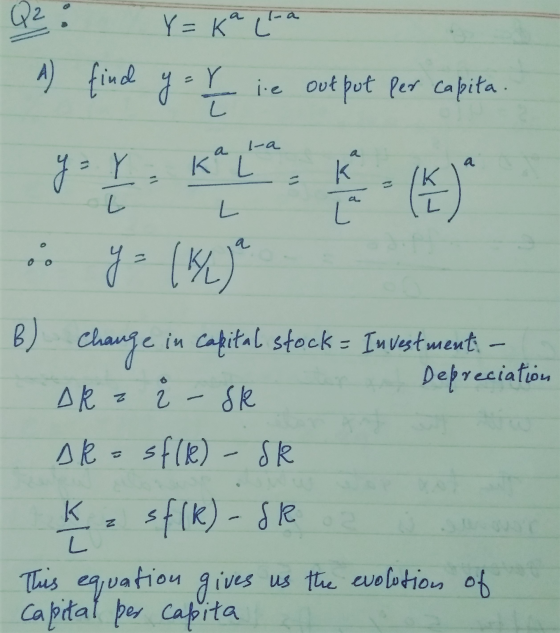
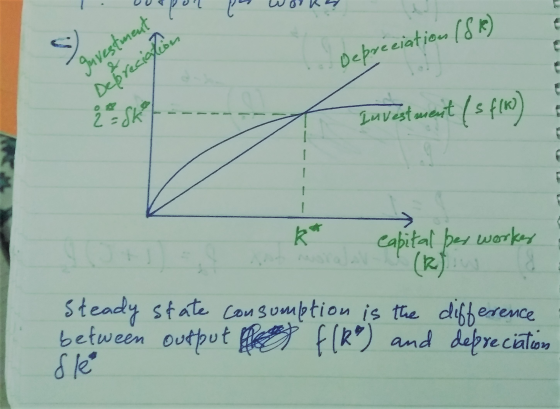
Dear student/learner, According to our protocol I am obliged to
solve only one question. you can post the second question
separately. It would be our pleasure to help you solve the second
question. I wish you best luck for your learning
endeavour.
Happy Learning
Add Answer to:
2. Consider the Solow growth model. Suppose that the production function is constant returns to scale...
4. The table below shows a Markov matrix for the income levels of 40 countries over...
 4. The table below shows a Markov matrix for the income levels of 40 countries over two centuries: Poor in 20h CE 20th CE Poor in 19th CE Middle Income in 19h CE 4 Rich in 19th CE 10 How has income inequality across these countries changed? Why?
Solow Growth Model D. Consider an economy with production characterized by function Y = AVKL, per...
 Solow Growth Model D. Consider an economy with production characterized by function Y = AVKL, per capita output y = AVkt with rate of depreciation of capital 8, investment it = sy. = sAvky, capital transition function kt+1 - k = SAVk - Okt, where s is savings ratio. 1. Putting per capita output (income) y on the y-axis and k on the x-axis, graph the curves for depre- ciation and investment. Label steady state capital k* and steady state...
Consider the Solow growth model with depreciation rate and population growth rate n. The equation of...
 Consider the Solow growth model with depreciation rate and population growth rate n. The equation of motion for the capital stock and the per worker production function in this economy are given by: Ak= s(f(k) - (8 + n) k y= f(k) = k1/4 a). Suppose adoption of modern birth control methods in a developing country causes the population growth rate to decrease. What happens in the main Solow diagram: what curve(s) shin, what happens to the steady- state level...
MALTHUS AND SOLOW GROWTH MODEL
Malthusian Model of Growth Notation: Yt Aggregate output; Nt Population size; L¯ Land (fixed); ct Per capita consumption Production: Aggregate production function is Yt = F(Nt , Lt) = zN2/3 t L 1/3 t Population Dynamics: Nt+1 = g(ct)Nt Population growth function: g(ct) = (3ct) 1/3 Parameter Values: Land: L¯ = 1000 for all t. Productivity parameter: z = 1 ...
Consider an economy described by the following Cobb-Douglas, constant-returns-to-scale, aggregate production function: Y (K, L)...
Consider an economy described by the following Cobb-Douglas, constant-returns-to-scale, aggregate production function: Y (K, L) = ?.??.? i.) Derive the per-capita/worker production function. ii.) Assume the depreciation rate (ɖ) is 1.5 percent, the population growth (n) is 4 percent, and the savings rate (s) is 8 percent; derive the discrete fundamental Solow Growth equation, and finally find the steady-state capital stock per-capita/worker (k*) and output per-capita/worker (y*). iii.) Assume the savings rate (s) rises to 16 percent, all else...
Exercise 1: Solow model . Consider an economy whose production function is defined by Y (t)...
Exercise 1: Solow model . Consider an economy whose production function is defined by Y (t) = F (K (t), L (t)) = K (t) 1 − α · L (t) α. with 0 <α <1. In this economy, the population grows at the following rate: L (t) = n + β where n and β are strictly positive constants and k (t) represents capital per capita: k (t) = L (t). Moreover, a constant part of the product is...
Two countries, Richland and Poorland, are described by the Solow model. They have the same Cobb-Douglas...
Two countries, Richland and Poorland, are described by the Solow model. They have the same Cobb-Douglas production function F ( K , L ) = A K α L 1 − α , but with different quantities of capital and labor. Richland saves 32% of its income, while Poorland saves 10 percent. Richland has population growth of 1% per year, while Poorland has population growth of 3% per year. (The numbers in this problem are chosen to be approximately realistic...
Suppose an economy follows the Solow growth model, with constant investment, depreciation, and population growth rates....
Suppose an economy follows the Solow growth model, with constant investment, depreciation, and population growth rates. Please explain your answers. (a) Suppose that the government withdraws an investment tax credit leading to a permanent drop in the investment rate. Discuss the effect on the level and growth of per capita income (PCI) in the short run. What happens to the level and growth of PCI in the long-run? (b) Suppose that the economy is below its steady state level per...
Consider a country described by the Solow model. The production function is y = 29, where...
 Consider a country described by the Solow model. The production function is y = 29, where 0 <a < 1. Assume that capital depreciates at a rate 8 € (0,1). a) Write down this production function in levels instead of in per capita terms. Does it display constant returns to scale? Show it. What about if a = 1? b) Find the value of c (per capita consumption) in steady state. c) Find the level of per capita capital that...
1. Consider the simple version of the Solow Growth Model discussed in class summarized by these...
 1. Consider the simple version of the Solow Growth Model discussed in class summarized by these four equations: Consumers save a fraction s of output: 1 = sy Capital grows as follows: K' = 1 + (1 - 8)K Firms use capital to make output: Y = AK 0.3 There is no government or trade: Y = C+/ where Y is GDP, / is investment, C is consumption, s is the savings rate, K is the capital stock this year,...
 4. The table below shows a Markov matrix for the income levels of 40 countries over two centuries: Poor in 20h CE 20th CE Poor in 19th CE Middle Income in 19h CE 4 Rich in 19th CE 10 How has income inequality across these countries changed? Why?
 Solow Growth Model D. Consider an economy with production characterized by function Y = AVKL, per capita output y = AVkt with rate of depreciation of capital 8, investment it = sy. = sAvky, capital transition function kt+1 - k = SAVk - Okt, where s is savings ratio. 1. Putting per capita output (income) y on the y-axis and k on the x-axis, graph the curves for depre- ciation and investment. Label steady state capital k* and steady state...
 Consider the Solow growth model with depreciation rate and population growth rate n. The equation of motion for the capital stock and the per worker production function in this economy are given by: Ak= s(f(k) - (8 + n) k y= f(k) = k1/4 a). Suppose adoption of modern birth control methods in a developing country causes the population growth rate to decrease. What happens in the main Solow diagram: what curve(s) shin, what happens to the steady- state level...
 Consider a country described by the Solow model. The production function is y = 29, where 0 <a < 1. Assume that capital depreciates at a rate 8 € (0,1). a) Write down this production function in levels instead of in per capita terms. Does it display constant returns to scale? Show it. What about if a = 1? b) Find the value of c (per capita consumption) in steady state. c) Find the level of per capita capital that...
 1. Consider the simple version of the Solow Growth Model discussed in class summarized by these four equations: Consumers save a fraction s of output: 1 = sy Capital grows as follows: K' = 1 + (1 - 8)K Firms use capital to make output: Y = AK 0.3 There is no government or trade: Y = C+/ where Y is GDP, / is investment, C is consumption, s is the savings rate, K is the capital stock this year,...
Most questions answered within 3 hours.
-
Where is the error in this code sequence?
String s1 = "Hello";
String s2 = "ello";...
asked 10 months ago -
Financial data for Joel de Paris, Inc., for last year
follow:
Joel de Paris, Inc.
Balance...
asked 10 months ago -
Consider this reaction:
Al2(SO4)3 (aq)+ BaCl3
(aq) Al2Cl6 (aq)- +
3BaSO4(s) . What is the...
asked 10 months ago -
Suppose that Savneet is considering increasing her
recent random sample from 20 car rentals to 40...
asked 10 months ago -
Trucks arrive at an unloading terminal at an average rate of 120
per hour.
Trucks arrive...
asked 10 months ago -
Why are methanol and ethanol completely soluble in water while
octanol is not very little soluble....
asked 10 months ago -
A facilities manager at a university reads in a research report
that the mean amount of...
asked 10 months ago -
When the CuSO4 is rehydrated by adding water to the anhydrous
compound, is this an endothermic...
asked 10 months ago -
A ray of sunlight is passing from diamond into crown glass; the
angle of incidence is...
asked 10 months ago -
A block of mass 0.249 kg is placed on top of a light, vertical
spring of...
asked 10 months ago -
how do the kidneys compensate in the presences of acidosis
a) trigger hyperventilate
b) reserve acid...
asked 10 months ago -
Question 501 pts
The rental rate of capital to the firm increases. Which of the
following...
asked 10 months ago