


Homework Answers
Let p denotes the true proportion of readers who own a particular make of car.
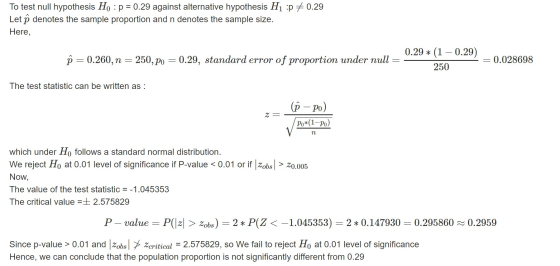
Conclusion : i)
Add Answer to:
A publisher reports that 29 % of their readers own a particular make of car. A...
A publisher reports that 45% of their readers own a particular make of car. A marketing...
 A publisher reports that 45% of their readers own a particular make of car. A marketing executive wants to test the claim that the percentage is actually over the reported percentage. A random sample of 130 found that 50% of the readers wned a particular make of car. Is there sufficient evidence at the 0.05 level to support the executive's claim? Step 2 of 7 Find the value of the test statistic Round your answer to two decimal places
A publisher reports that 44% of their readers own a laptop. A marketing executive wants to...
 A publisher reports that 44% of their readers own a laptop. A marketing executive wants to test the claim that the percentage is actually over the reported percentage. A random sample of 100 found that 48 % of the readers owned a laptop. Is there sufficient evidence at the 0.02 level to support the executive's claim? Step 1 of 7: State the null and alternative hypotheses. Answer Point Tables Keypad Keyboard Shortcuts < Ho I Ne Prev H A publisher...
A publisher reports that 43% of their readers own a particular make of car. A marketing...
A publisher reports that 43% of their readers own a particular make of car. A marketing executive wants to test the claim that the percentage is actually different from the reported percentage. A random sample of 140 found that 40% of the readers owned a particular make of car. State the null and alternative hypotheses.
Question 24 of 41 Step 1 of 1 01:21:46 A publisher reports that 53% of their...
 Question 24 of 41 Step 1 of 1 01:21:46 A publisher reports that 53% of their readers own a particular make of car. A marketing executive wants to test the claim that the percentage is actually different from the reported percentage. A random sample of 140 found that 50% of the readers owned a particular make of car. Is there sufficient evidence at the 0.10 level to support the executive's claim? Answer 2 Points Tables Keypad There is sufficient evidence...
A publisher reports that 33% of their readers own a particular make of car. A marketing...
A publisher reports that 33% of their readers own a particular make of car. A marketing executive wants to test the claim that the percentage is actually different from the reported percentage. A random sample of 100 found that 24% of the readers owned a particular make of car. Determine the P-value of the test statistic. Round your answer to four decimal places.
A publisher reports that 46% of their readers own a particular make of car. A marketing...
A publisher reports that 46% of their readers own a particular make of car. A marketing executive wants to test the claim that the percentage is actually different from the reported percentage. A random sample of 100 found that 38% of the readers owned a particular make of car. Determine the P-value of the test statistic. Round your answer to four decimal places.
A publisher reports that 64% of their readers own a particular make of car. A marketing...
A publisher reports that 64% of their readers own a particular make of car. A marketing executive wants to test the claim that the percentage is actually different from the reported percentage. A random sample of 130 found that 60% of the readers owned a particular make of car. Determine the P-value of the test statistic. Round your answer to four decimal places.
A publisher reports that 57%57% of their readers own a particular make of car. A marketing...
A publisher reports that 57%57% of their readers own a particular make of car. A marketing executive wants to test the claim that the percentage is actually different from the reported percentage. A random sample of 150150 found that 48%48% of the readers owned a particular make of car. State the null and alternative hypotheses.
A publisher reports that 42% of their readers own a particular make of car. A marketing...
A publisher reports that 42% of their readers own a particular make of car. A marketing executive wants to test the claim that the percentage is actually different from the reported percentage. A random sample of 370 found that 38% of the readers owned a particular make of car. Make the decision to reject or fail to reject the null hypothesis at the 0.02 level. A - Reject Null Hypothesis B - Fail to Reject Null Hypothesis
A publisher reports that 24 % of their readers own a laptop. A marketing executive wants...
 A publisher reports that 24 % of their readers own a laptop. A marketing executive wants to test the claim that the percentage is actually over the reported percentage. A random sample of 140 found that 30% of the readers owned a laptop. Is there sufficient evidence at the 0.01 level to support the executive's claim? Step 4 of 7: Determine the P value of the test statistic. Round your answer to four decimal places
 A publisher reports that 45% of their readers own a particular make of car. A marketing executive wants to test the claim that the percentage is actually over the reported percentage. A random sample of 130 found that 50% of the readers wned a particular make of car. Is there sufficient evidence at the 0.05 level to support the executive's claim? Step 2 of 7 Find the value of the test statistic Round your answer to two decimal places
 A publisher reports that 44% of their readers own a laptop. A marketing executive wants to test the claim that the percentage is actually over the reported percentage. A random sample of 100 found that 48 % of the readers owned a laptop. Is there sufficient evidence at the 0.02 level to support the executive's claim? Step 1 of 7: State the null and alternative hypotheses. Answer Point Tables Keypad Keyboard Shortcuts < Ho I Ne Prev H A publisher...
 Question 24 of 41 Step 1 of 1 01:21:46 A publisher reports that 53% of their readers own a particular make of car. A marketing executive wants to test the claim that the percentage is actually different from the reported percentage. A random sample of 140 found that 50% of the readers owned a particular make of car. Is there sufficient evidence at the 0.10 level to support the executive's claim? Answer 2 Points Tables Keypad There is sufficient evidence...
 A publisher reports that 24 % of their readers own a laptop. A marketing executive wants to test the claim that the percentage is actually over the reported percentage. A random sample of 140 found that 30% of the readers owned a laptop. Is there sufficient evidence at the 0.01 level to support the executive's claim? Step 4 of 7: Determine the P value of the test statistic. Round your answer to four decimal places
Most questions answered within 3 hours.
-
Where is the error in this code sequence?
String s1 = "Hello";
String s2 = "ello";...
asked 11 months ago -
Financial data for Joel de Paris, Inc., for last year
follow:
Joel de Paris, Inc.
Balance...
asked 11 months ago -
Consider this reaction:
Al2(SO4)3 (aq)+ BaCl3
(aq) Al2Cl6 (aq)- +
3BaSO4(s) . What is the...
asked 11 months ago -
Suppose that Savneet is considering increasing her
recent random sample from 20 car rentals to 40...
asked 11 months ago -
Trucks arrive at an unloading terminal at an average rate of 120
per hour.
Trucks arrive...
asked 11 months ago -
Why are methanol and ethanol completely soluble in water while
octanol is not very little soluble....
asked 11 months ago -
A facilities manager at a university reads in a research report
that the mean amount of...
asked 11 months ago -
When the CuSO4 is rehydrated by adding water to the anhydrous
compound, is this an endothermic...
asked 11 months ago -
A ray of sunlight is passing from diamond into crown glass; the
angle of incidence is...
asked 11 months ago -
A block of mass 0.249 kg is placed on top of a light, vertical
spring of...
asked 11 months ago -
how do the kidneys compensate in the presences of acidosis
a) trigger hyperventilate
b) reserve acid...
asked 11 months ago -
Question 501 pts
The rental rate of capital to the firm increases. Which of the
following...
asked 11 months ago