
Homework Answers
2NH3(g) --------> 3H2(g) + N2(g)
I 3.36 0 0
C -2*1.33 3*1.33 1.33
E 0.7 3.99 1.33
Kc = [N2][H2]3/[NH3]2
[NH3] = 0.7/10.2 = 0.068M
[H2] = 3.99/10.2 = 0.39M
[N2] = 1.33/10.2 = 0.13M
Kc = [N2][H2]3/[NH3]2
= 0.13*(0.39)3/(0.068)2
= 0.019773/0.004628 = 4.2724
Add Answer to:
Mol NH_3 are placed in a 10.2 L flask and allowed to equilibrate at some temperature....
A technician placed a 2.5 mol of NO(g) in an empty 2.0 L flask and allowed...
A technician placed a 2.5 mol of NO(g) in an empty 2.0 L flask and allowed the contents to establish the following equilibrium. 4NO(g)⇋2N2O(g)+O2(g)+197kJ At equilibrium it was determined that there was 0.58 mol of N2O(g) present. Q: The percent yield of this reaction is ? Q: The equilibrium concentration of NO(g) is? Q: The equilibrium constant for this equilibrium expressed in scientific notation is a.b x 10-c. The values of a, b, and c are?
For the following equilibrium: N_2(g) + H_2(g) rightarrow NH_3(g) delta H= -386 kJ/mole Predict the direction...
 For the following equilibrium: N_2(g) + H_2(g) rightarrow NH_3(g) delta H= -386 kJ/mole Predict the direction the equilibrium will shift if: N_2 is added? H_2 is removed? NH_3 is added? NH_3 is removed? the volume of the container is decreased? the pressure is increased by adding Argon gas? the reaction is cooled? equal number of moles of H_2 and NH_3 are added? a catalyst is added The equilibrium constant for the following reaction is 5.0 at 400 degree C. CO_(g)...
2.5 moles of PCl5 are placed in a 5.0 L flask and allowed to come to...
2.5 moles of PCl5 are placed in a 5.0 L flask and allowed to come to equilibrium. How many moles of PCl5 will be present at equilibrium? Reaction: PCl5 D PCl3 + Cl2 Kc = 0.47
If 0.696 mol PCl5 is placed in a 1.78 L flask and allowed to reach equilibrium...
 If 0.696 mol PCl5 is placed in a
1.78 L flask and allowed to reach equilibrium at a
given temperature, what is the final concentration of
Cl2 in the flask?
PCl5(g) PCl3(aq)
+ Cl2(g)
Kc = 0.47
a. 0.429 M
b. 0.243 M
c. 0.254 M
d. 0.275 M
e. 0.724 M
If 0.696 mol PCl5 is placed in a
1.78 L flask and allowed to reach equilibrium at a
given temperature, what is the final concentration of
Cl2 in the flask?
PCl5(g) PCl3(aq)
+ Cl2(g)
Kc = 0.47
a. 0.429 M
b. 0.243 M
c. 0.254 M
d. 0.275 M
e. 0.724 M
Initially there are 5.000 mol pure SO3 in a 12.00 L flask at a certain temperature....
Initially there are 5.000 mol pure SO3 in a 12.00 L flask at a certain temperature. At equilibrium, some sulfur dioxide and 0.755 mol oxygen gas forms. Determine the equilibruim constant for the reaction at this temperature.
At a particular temperature, 12.0 mol of SO_3 is placed into a 3.0-L rigid container, and...
 At a particular temperature, 12.0 mol of SO_3 is placed into a 3.0-L rigid container, and the SO_3 dissociates by the reaction| 2SO_3(g) 2SO_2(g) + O_2(g) At equilibrium, 3.0 mol of SO_2 is present. Calculate K_c for this reaction. 1.5 0.11 0.72 0.056 0.17 0.0035
0.60 mol of Br, and 0.60 mol of Cl, are placed in a 1.00 L flask...
 0.60 mol of Br, and 0.60 mol of Cl, are placed in a 1.00 L flask and allowed to reach equilibrium. (There is no BrCla first.) After reaching equilibrium, the flask is found to contain 0.28 mol of BrCl. What is the value of K for this reaction? Br2(e) + Cl2(8) $ 2 BrCl(e) K=???? A. B. C. D. E. 0.37 0.76 0.61 2.7 None of the above The reaction of bromine gas with chlorine gas, shown here, has a...
At a certain temperature, 0.840 mol of SO_3 is placed in a 1.50-L container. 2 SO3_(c)...
 At a certain temperature, 0.840 mol of SO_3 is placed in a 1.50-L container. 2 SO3_(c) 2 SO_2(g) + O_2(g) At equilibrium, 0.170 mol of O_2 is present. Calculate K_c. K_c =
1.Initially, 0.64 mol of PCl5 is placed in a 1.0 L flask. At equilibrium, there is...
1.Initially, 0.64 mol of PCl5 is placed in a 1.0 L flask. At equilibrium, there is 0.12 mol of PCl3 in the flask. What is the equilibrium concentration of PCl5? 2.What is the equilibrium concentration of Cl2? 3.What is the numerical value of the equilibrium constant, Kc, for the reaction?
5.20 mol of solid A was placed in a sealed 1.00-L container and allowed to decompose...
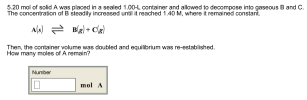 5.20 mol of solid A was placed in a sealed 1.00-L container and allowed to decompose into gaseous B and C. The concentration of B steadily increased until it reached 1.40 M, where it remained constant Then, the container volume was doubled and equilibrium was re-established. How many moles of A remain? Number mol A
 For the following equilibrium: N_2(g) + H_2(g) rightarrow NH_3(g) delta H= -386 kJ/mole Predict the direction the equilibrium will shift if: N_2 is added? H_2 is removed? NH_3 is added? NH_3 is removed? the volume of the container is decreased? the pressure is increased by adding Argon gas? the reaction is cooled? equal number of moles of H_2 and NH_3 are added? a catalyst is added The equilibrium constant for the following reaction is 5.0 at 400 degree C. CO_(g)...
 If 0.696 mol PCl5 is placed in a
1.78 L flask and allowed to reach equilibrium at a
given temperature, what is the final concentration of
Cl2 in the flask?
PCl5(g) PCl3(aq)
+ Cl2(g)
Kc = 0.47
a. 0.429 M
b. 0.243 M
c. 0.254 M
d. 0.275 M
e. 0.724 M
If 0.696 mol PCl5 is placed in a
1.78 L flask and allowed to reach equilibrium at a
given temperature, what is the final concentration of
Cl2 in the flask?
PCl5(g) PCl3(aq)
+ Cl2(g)
Kc = 0.47
a. 0.429 M
b. 0.243 M
c. 0.254 M
d. 0.275 M
e. 0.724 M
 At a particular temperature, 12.0 mol of SO_3 is placed into a 3.0-L rigid container, and the SO_3 dissociates by the reaction| 2SO_3(g) 2SO_2(g) + O_2(g) At equilibrium, 3.0 mol of SO_2 is present. Calculate K_c for this reaction. 1.5 0.11 0.72 0.056 0.17 0.0035
 0.60 mol of Br, and 0.60 mol of Cl, are placed in a 1.00 L flask and allowed to reach equilibrium. (There is no BrCla first.) After reaching equilibrium, the flask is found to contain 0.28 mol of BrCl. What is the value of K for this reaction? Br2(e) + Cl2(8) $ 2 BrCl(e) K=???? A. B. C. D. E. 0.37 0.76 0.61 2.7 None of the above The reaction of bromine gas with chlorine gas, shown here, has a...
 At a certain temperature, 0.840 mol of SO_3 is placed in a 1.50-L container. 2 SO3_(c) 2 SO_2(g) + O_2(g) At equilibrium, 0.170 mol of O_2 is present. Calculate K_c. K_c =
 5.20 mol of solid A was placed in a sealed 1.00-L container and allowed to decompose into gaseous B and C. The concentration of B steadily increased until it reached 1.40 M, where it remained constant Then, the container volume was doubled and equilibrium was re-established. How many moles of A remain? Number mol A
Most questions answered within 3 hours.
-
Where is the error in this code sequence?
String s1 = "Hello";
String s2 = "ello";...
asked 10 months ago -
Financial data for Joel de Paris, Inc., for last year
follow:
Joel de Paris, Inc.
Balance...
asked 10 months ago -
Consider this reaction:
Al2(SO4)3 (aq)+ BaCl3
(aq) Al2Cl6 (aq)- +
3BaSO4(s) . What is the...
asked 10 months ago -
Suppose that Savneet is considering increasing her
recent random sample from 20 car rentals to 40...
asked 10 months ago -
Trucks arrive at an unloading terminal at an average rate of 120
per hour.
Trucks arrive...
asked 10 months ago -
Why are methanol and ethanol completely soluble in water while
octanol is not very little soluble....
asked 10 months ago -
A facilities manager at a university reads in a research report
that the mean amount of...
asked 10 months ago -
When the CuSO4 is rehydrated by adding water to the anhydrous
compound, is this an endothermic...
asked 10 months ago -
A ray of sunlight is passing from diamond into crown glass; the
angle of incidence is...
asked 10 months ago -
A block of mass 0.249 kg is placed on top of a light, vertical
spring of...
asked 10 months ago -
how do the kidneys compensate in the presences of acidosis
a) trigger hyperventilate
b) reserve acid...
asked 10 months ago -
Question 501 pts
The rental rate of capital to the firm increases. Which of the
following...
asked 10 months ago