Partnerships can only have individuals as partners and the maximum number of partners is limited to...
Partnerships can only have individuals as partners and the maximum number of partners is limited to 100.
A. True
B. False
Homework Answers
Answer- TRUE- Partnerships can only have individuals as partners and the maximum number of partners is limited to 100.
Explanation- As per the Indian Companies Act, 2013 a Partnership firm can have maximum 100 Partners. But in the partnership act, there is no upper limit if fixed.
Add Answer to:
Partnerships can only have individuals as partners and the
maximum number of partners is limited to...
Which of the following statements is true as it relates to limited liability partnerships? A. Only...
Which of the following statements is true as it relates to limited liability partnerships? A. Only senior partners are liable for the partnership's debts. B. Partners are personally liable for the acts of those under their supervision. C. Partners have no liability in a limited liability partnership arrangement. D. All partners must be AICPA members.
2. It might surprise you to know that limited partnerships can be formed by families as...
 2. It might surprise you to know that limited partnerships can be formed by families as well as companies. Use the Internet to find out how to set up a family limited partnership. Who would be the general partners and who would be the limited partners and why? What advantages would this type of arrangement have for the family? What has the IRS said about family limited partnerships?!
Limited Partnerships It might surprise you to know that limited partnerships can be formed by families...
 Limited Partnerships It might surprise you to know that limited partnerships can be formed by families as well as companies. Use the Internet to find out how to set up a family limited partnership. Who would be the general partners and who would be the limited partners--and why? What advantages would this type of arrangement have for the family? What has the IRS said about family limited partnerships? Franchise Students should research the costs and benefits of becoming a franchisee...
a. Under a General Partnership, partners are liable only to the extent of their capital contributions....
a. Under a General Partnership, partners are liable only to the extent of their capital contributions. True False b. Under a Limited Liability Limited Partnership, the liability of all partners is limited to the amount of their investments in the firm. True False c. When a partner ceases to be associated in the carrying on of the partnership business, this is called: A. Joint and several liability B. A fiduciary duty C. Winding up D. Dissociation d. Which of the...
Complete the following sentences. Owners of ______ have limited liability. A. partnerships and corporations B. partnerships,...
Complete the following sentences. Owners of ______ have limited liability. A. partnerships and corporations B. partnerships, proprietorships, and corporations C. proprietorships and partnerships D. corporations In ______, retained profits are taxed twice. A.partnerships, proprietorships, and corporations B.proprietorships and partnerships C.corporations D.partnerships and corporations
When no LP certificate is filed, what is the result? O a Only limited partners are...
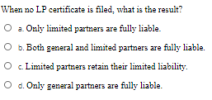 When no LP certificate is filed, what is the result? O a Only limited partners are fully liable. O b. Both general and limited partners are fully liable. O c. Limited partners retain their limited liability. O d. Only general partners are fully liable.
E12-1 Mark Rensing has prepared the following list of statements about partnerships.
E12-1 Mark Rensing has prepared the following list of statements about partnerships. 1. A partnership is an association of three or more persons to carry on as co-owners of a business for profit. 2. The legal requirements for forming a partnership can be quite burdensome. 3. A partnership is not an entity for financial reporting purposes 4. The net income of a partnership is taxed as a separate entity. 5. The act of any partner is binding on all other partners, even when partners perform...
14. Of the following forms of business organization, which have stockholders with limited liability? proprietorships partnerships...
 14. Of the following forms of business organization, which have stockholders with limited liability? proprietorships partnerships corporations limited partnerships Soo
Complete the following sentences. Owners of have limited liability. O A. proprietorships and partnerships O B. part...
 Complete the following sentences. Owners of have limited liability. O A. proprietorships and partnerships O B. partnerships, proprietorships, and corporations O c. corporations OD. partnerships and corporations Click to select your answer and then click Check Answer.
Which of the following is a difference between corporations and partnerships? a. Partnerships are subject to...
Which of the following is a difference between corporations and partnerships? a. Partnerships are subject to double taxation; corporations are not. b. With partnerships, ownership rights are divisible and easily transferable; this is not true for corporations. c. Corporate owners face limited liability; owners of partnerships do not. d. Corporations always have more owners than partnerships.
 2. It might surprise you to know that limited partnerships can be formed by families as well as companies. Use the Internet to find out how to set up a family limited partnership. Who would be the general partners and who would be the limited partners and why? What advantages would this type of arrangement have for the family? What has the IRS said about family limited partnerships?!
 Limited Partnerships It might surprise you to know that limited partnerships can be formed by families as well as companies. Use the Internet to find out how to set up a family limited partnership. Who would be the general partners and who would be the limited partners--and why? What advantages would this type of arrangement have for the family? What has the IRS said about family limited partnerships? Franchise Students should research the costs and benefits of becoming a franchisee...
 When no LP certificate is filed, what is the result? O a Only limited partners are fully liable. O b. Both general and limited partners are fully liable. O c. Limited partners retain their limited liability. O d. Only general partners are fully liable.
 14. Of the following forms of business organization, which have stockholders with limited liability? proprietorships partnerships corporations limited partnerships Soo
 Complete the following sentences. Owners of have limited liability. O A. proprietorships and partnerships O B. partnerships, proprietorships, and corporations O c. corporations OD. partnerships and corporations Click to select your answer and then click Check Answer.
Most questions answered within 3 hours.
-
Where is the error in this code sequence?
String s1 = "Hello";
String s2 = "ello";...
asked 11 months ago -
Financial data for Joel de Paris, Inc., for last year
follow:
Joel de Paris, Inc.
Balance...
asked 11 months ago -
Consider this reaction:
Al2(SO4)3 (aq)+ BaCl3
(aq) Al2Cl6 (aq)- +
3BaSO4(s) . What is the...
asked 11 months ago -
Suppose that Savneet is considering increasing her
recent random sample from 20 car rentals to 40...
asked 11 months ago -
Trucks arrive at an unloading terminal at an average rate of 120
per hour.
Trucks arrive...
asked 11 months ago -
Why are methanol and ethanol completely soluble in water while
octanol is not very little soluble....
asked 11 months ago -
A facilities manager at a university reads in a research report
that the mean amount of...
asked 11 months ago -
When the CuSO4 is rehydrated by adding water to the anhydrous
compound, is this an endothermic...
asked 11 months ago -
A ray of sunlight is passing from diamond into crown glass; the
angle of incidence is...
asked 11 months ago -
A block of mass 0.249 kg is placed on top of a light, vertical
spring of...
asked 11 months ago -
how do the kidneys compensate in the presences of acidosis
a) trigger hyperventilate
b) reserve acid...
asked 11 months ago -
Question 501 pts
The rental rate of capital to the firm increases. Which of the
following...
asked 11 months ago