

Homework Answers
Add Answer to:
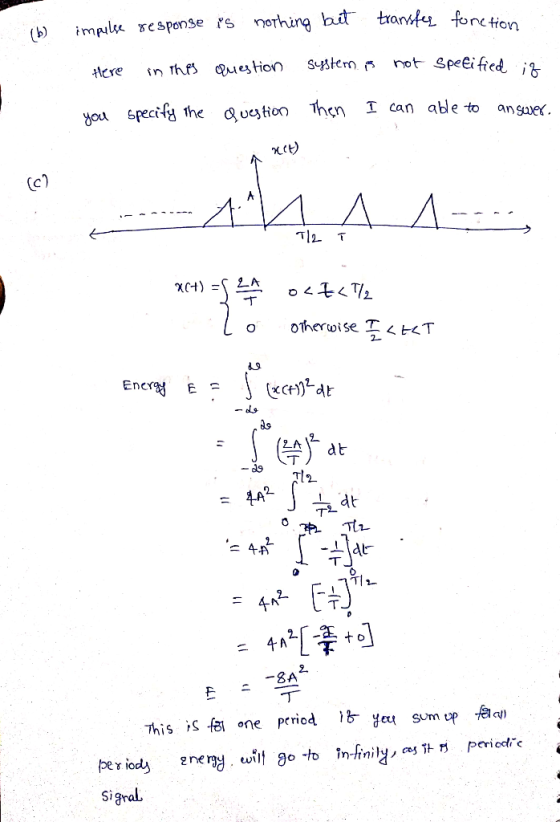
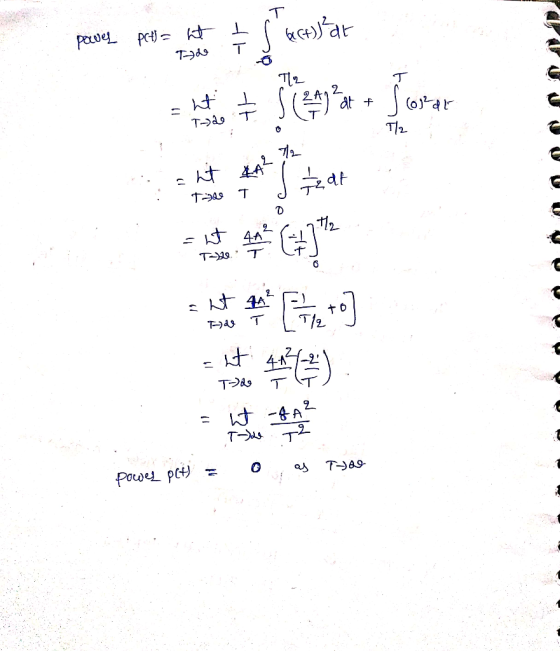
b) Find the unit impulse response of the system. c) The figure below shows a periodic...
Suppose that for the LTI system depicted in the following figure (a), the impulse response and th...
 Suppose that for the LTI system depicted in the following figure (a), the impulse response and the transfer function are given by h(t) = e-tu(t) H(S) = s+1 1 H 100 The input signal x(t) is the square wave of Figure (b), where t is in seconds. Since the fundamental period is To = 2π, the fundamental frequency is ao-2π/L = 1 rad/s and kaa-k. 3t (a) Use the Table provided to find the exponential Fourier series of the signal...
Question three The figure below shows a unit step response of a second order system. From...
 Question three The figure below shows a unit step response of a second order system. From the graph of response find: 1- The rise timet, 2- The peak timet, 3- The maximum overshoot Mp 4- The damped natural frequency w 5. The transfer function. Hence find the damping ratio ζ and the natural frequency ah-Find also the transfer function of the system. r 4 02 15 25 35 45 Question Four For the control system shown in the figure below,...
1. Consider the system shown in the figure below. The system is an integrator, in which...
 1. Consider the system shown in the figure below. The system is an integrator, in which the output is the integral: y(t)x()dr -00 Integrator x(t) y(t) (a) We may determine the impulse response h(t) by applying an impulse signal to the integrator, i.e. x(t) -5(t). What is the impulse response? Answer: (10 points) (b) The output of the integrator may be found by apply convolution method to determine the output. The convolution of the two signals is expressed a)ht -...
1. Suppose that for the LTi system depicred in the following Sgure al the impulse response...
 1. Suppose that for the LTi system depicred in the following Sgure al the impulse response and the transfer function ane given by The input signal it) is the square wave of Figure (bl, whare t is in seconds. Since the fundamental period isT?-2r, the fundamental frequency is ab-2s/To-1 rad/s and kas,-k. lbi (a) use the Table provided to find the exponential Fourier serias of she signal it The xpceential Fourier series for the signal may be givn by where...
5. The figure below shows a system consisting of a continous- time LTI system followed by a sampler (, conver...
 5. The figure below shows a system consisting of a continous- time LTI system followed by a sampler (, conversion to a sequence (, and an LTI discrete-time system. The continous-time LTI system is causal and satisfies the linear, constant-coefficient differential equation The input is a unit impulse a. Determine . (10 points) b. Determine the frequency response and the impulse response such that. (10 points). Conversiony(n) of %(t) w(n) inpuse train H(ew) to a sequence P(t) low shows a...
1. The impulse response of a second order system is shown below: Impulse Response Amplitude 1...
 1. The impulse response of a second order system is shown below: Impulse Response Amplitude 1 1 2 3 5 6 7 Time (seconds) Please find the characteristic equation of this system. Please include detailed steps.
Determine the system function, impulse response, and zero-state response of the system shown in the below...
 Determine the system function, impulse response, and zero-state response of the system shown in the below Figure x(n) y(n) 7-1
Consider the LTI system with input ??(??) = ?? ?????(??) and the impulse response ?(??) =...
 Consider the LTI system with input ??(??) = ?? ?????(??) and the
impulse response ?(??) = ?? ?2????(??). A. (3 points) Determine
??(??) and ??(??) and the ROCs B. (3 points) Using the
convolutional property of the Laplace transform, determine ??(??),
the Laplace transform of the output, ??(??) C. (3 points) From the
answer of part B, find ??(??)
9 points) Consider the LTI system with input x(t)eu(t) and the impulse response h(t)-e-2u(t) A. 3 points) Determine X(s) and H(s)...
Consider the LTI system with input ??(??) = ?? ?????(??) and the
impulse response ?(??) = ?? ?2????(??). A. (3 points) Determine
??(??) and ??(??) and the ROCs B. (3 points) Using the
convolutional property of the Laplace transform, determine ??(??),
the Laplace transform of the output, ??(??) C. (3 points) From the
answer of part B, find ??(??)
9 points) Consider the LTI system with input x(t)eu(t) and the impulse response h(t)-e-2u(t) A. 3 points) Determine X(s) and H(s)...
One of the most important classes of time dependent signals are periodic signals. Periodic signals satisfy tho following signal equations, x(t) X(t) x(t+nt) for n 2,3. The periodic signals to b...
 One of the most important classes of time dependent signals are periodic signals. Periodic signals satisfy tho following signal equations, x(t) X(t) x(t+nt) for n 2,3. The periodic signals to be observed in this laboratory assignment are shown below. In all the examples A represents the amplitude of the signal and may be given as the measurement from 0 to the peak value A, Apk or can be given as the measurement between A and -A which defines a peak-to-peak...
5. Find the unit impulse response of a system specified by the equation (D2 5D 6)y(t)...
 5. Find the unit impulse response of a system specified by the equation (D2 5D 6)y(t) (D2 7D 11)x(t)
 Suppose that for the LTI system depicted in the following figure (a), the impulse response and the transfer function are given by h(t) = e-tu(t) H(S) = s+1 1 H 100 The input signal x(t) is the square wave of Figure (b), where t is in seconds. Since the fundamental period is To = 2π, the fundamental frequency is ao-2π/L = 1 rad/s and kaa-k. 3t (a) Use the Table provided to find the exponential Fourier series of the signal...
 Question three The figure below shows a unit step response of a second order system. From the graph of response find: 1- The rise timet, 2- The peak timet, 3- The maximum overshoot Mp 4- The damped natural frequency w 5. The transfer function. Hence find the damping ratio ζ and the natural frequency ah-Find also the transfer function of the system. r 4 02 15 25 35 45 Question Four For the control system shown in the figure below,...
 1. Consider the system shown in the figure below. The system is an integrator, in which the output is the integral: y(t)x()dr -00 Integrator x(t) y(t) (a) We may determine the impulse response h(t) by applying an impulse signal to the integrator, i.e. x(t) -5(t). What is the impulse response? Answer: (10 points) (b) The output of the integrator may be found by apply convolution method to determine the output. The convolution of the two signals is expressed a)ht -...
 1. Suppose that for the LTi system depicred in the following Sgure al the impulse response and the transfer function ane given by The input signal it) is the square wave of Figure (bl, whare t is in seconds. Since the fundamental period isT?-2r, the fundamental frequency is ab-2s/To-1 rad/s and kas,-k. lbi (a) use the Table provided to find the exponential Fourier serias of she signal it The xpceential Fourier series for the signal may be givn by where...
 5. The figure below shows a system consisting of a continous- time LTI system followed by a sampler (, conversion to a sequence (, and an LTI discrete-time system. The continous-time LTI system is causal and satisfies the linear, constant-coefficient differential equation The input is a unit impulse a. Determine . (10 points) b. Determine the frequency response and the impulse response such that. (10 points). Conversiony(n) of %(t) w(n) inpuse train H(ew) to a sequence P(t) low shows a...
 1. The impulse response of a second order system is shown below: Impulse Response Amplitude 1 1 2 3 5 6 7 Time (seconds) Please find the characteristic equation of this system. Please include detailed steps.
 Determine the system function, impulse response, and zero-state response of the system shown in the below Figure x(n) y(n) 7-1
 Consider the LTI system with input ??(??) = ?? ?????(??) and the
impulse response ?(??) = ?? ?2????(??). A. (3 points) Determine
??(??) and ??(??) and the ROCs B. (3 points) Using the
convolutional property of the Laplace transform, determine ??(??),
the Laplace transform of the output, ??(??) C. (3 points) From the
answer of part B, find ??(??)
9 points) Consider the LTI system with input x(t)eu(t) and the impulse response h(t)-e-2u(t) A. 3 points) Determine X(s) and H(s)...
Consider the LTI system with input ??(??) = ?? ?????(??) and the
impulse response ?(??) = ?? ?2????(??). A. (3 points) Determine
??(??) and ??(??) and the ROCs B. (3 points) Using the
convolutional property of the Laplace transform, determine ??(??),
the Laplace transform of the output, ??(??) C. (3 points) From the
answer of part B, find ??(??)
9 points) Consider the LTI system with input x(t)eu(t) and the impulse response h(t)-e-2u(t) A. 3 points) Determine X(s) and H(s)...
 One of the most important classes of time dependent signals are periodic signals. Periodic signals satisfy tho following signal equations, x(t) X(t) x(t+nt) for n 2,3. The periodic signals to be observed in this laboratory assignment are shown below. In all the examples A represents the amplitude of the signal and may be given as the measurement from 0 to the peak value A, Apk or can be given as the measurement between A and -A which defines a peak-to-peak...
 5. Find the unit impulse response of a system specified by the equation (D2 5D 6)y(t) (D2 7D 11)x(t)
Most questions answered within 3 hours.
-
Where is the error in this code sequence?
String s1 = "Hello";
String s2 = "ello";...
asked 10 months ago -
Financial data for Joel de Paris, Inc., for last year
follow:
Joel de Paris, Inc.
Balance...
asked 10 months ago -
Consider this reaction:
Al2(SO4)3 (aq)+ BaCl3
(aq) Al2Cl6 (aq)- +
3BaSO4(s) . What is the...
asked 10 months ago -
Suppose that Savneet is considering increasing her
recent random sample from 20 car rentals to 40...
asked 10 months ago -
Trucks arrive at an unloading terminal at an average rate of 120
per hour.
Trucks arrive...
asked 10 months ago -
Why are methanol and ethanol completely soluble in water while
octanol is not very little soluble....
asked 10 months ago -
A facilities manager at a university reads in a research report
that the mean amount of...
asked 10 months ago -
When the CuSO4 is rehydrated by adding water to the anhydrous
compound, is this an endothermic...
asked 10 months ago -
A ray of sunlight is passing from diamond into crown glass; the
angle of incidence is...
asked 10 months ago -
A block of mass 0.249 kg is placed on top of a light, vertical
spring of...
asked 10 months ago -
how do the kidneys compensate in the presences of acidosis
a) trigger hyperventilate
b) reserve acid...
asked 10 months ago -
Question 501 pts
The rental rate of capital to the firm increases. Which of the
following...
asked 10 months ago