

Homework Answers
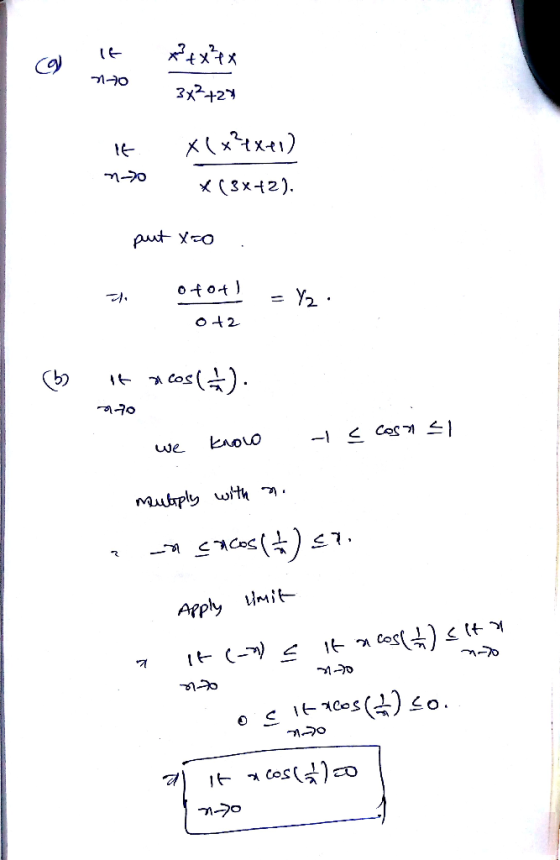
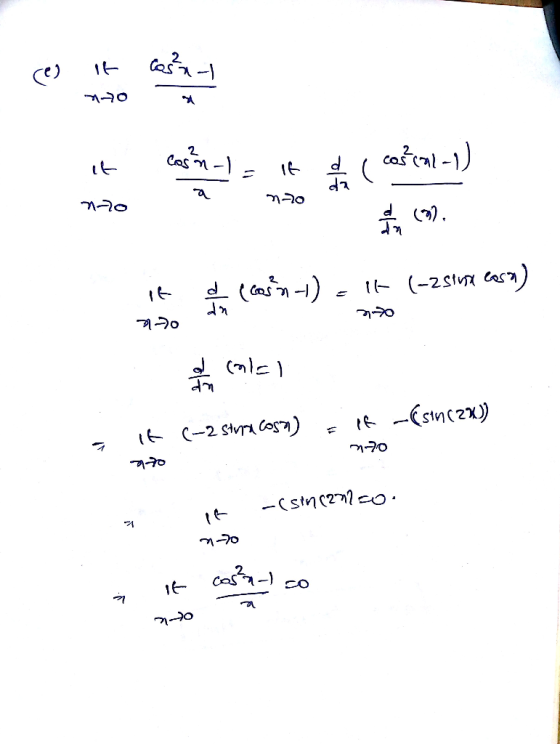

Add Answer to:
(6 marks) Evaluate the following limits, or explain why they do not exist. You should show...
(b) Evaluate the following limits or explain why they do not exist: Hint: you do not...
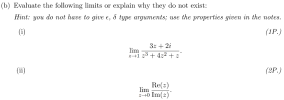 (b) Evaluate the following limits or explain why they do not exist: Hint: you do not have to give e, 6 type arguments; use the properties given in the notes. (i) (1P.) 3z2i lim 2-1 z 4z2 + z (ii) (2P.) Re(z) lim Im(2)
f(x, y) = y/(sqrt(z? + y2) + x) Evaluate the limits below, if they exist. If the limit does not exist, explain why it d...
 f(x, y) = y/(sqrt(z? + y2) + x) Evaluate the limits below, if they exist. If the limit does not exist, explain why it does not exist Yon musi elearly staie if you ity, lopital's rle or the sandwch theorem in your working. You do not need to justify using limit laws. (i) lim f(x, y) (ii) im f(r, y (iv) zlin2-1.0 arctan ^Ca.v)l
f(x, y) = y/(sqrt(z? + y2) + x)
Evaluate the limits below, if they exist. If...
f(x, y) = y/(sqrt(z? + y2) + x) Evaluate the limits below, if they exist. If the limit does not exist, explain why it does not exist Yon musi elearly staie if you ity, lopital's rle or the sandwch theorem in your working. You do not need to justify using limit laws. (i) lim f(x, y) (ii) im f(r, y (iv) zlin2-1.0 arctan ^Ca.v)l
f(x, y) = y/(sqrt(z? + y2) + x)
Evaluate the limits below, if they exist. If...
explain clearly please Problem 3 (6 points each). Evaluate the following limits algebraically, showing all work....
 explain clearly please
Problem 3 (6 points each). Evaluate the following limits algebraically, showing all work. If the limit does not exist, then write DNE and explain why it does not exist. You may use L'Hospial's rule but if you do you must specify that you have done so. (a) lim (e-2x + 2 tan-? (3.)) (5) limun (2+1) (c) lim a tan (1/1)
explain clearly please
Problem 3 (6 points each). Evaluate the following limits algebraically, showing all work. If the limit does not exist, then write DNE and explain why it does not exist. You may use L'Hospial's rule but if you do you must specify that you have done so. (a) lim (e-2x + 2 tan-? (3.)) (5) limun (2+1) (c) lim a tan (1/1)
Question 2 (10 marks) In this question you must state if you use any standard limits, continuity, l'Hôpital's r...
 Question 2 (10 marks) In this question you must state if you use any standard limits, continuity, l'Hôpital's rule, the sandwich theorem or any convergence tests for series. You do not need to justify using limit laws 2n n3 or explain why it does not exist. (a) Evaluate lim n (b) Determine whether each of the following converge: n+3 2n (i) 2 (3n) (ii) (n3)! n=1
Question 2 (10 marks) In this question you must state if you use any...
Question 2 (10 marks) In this question you must state if you use any standard limits, continuity, l'Hôpital's rule, the sandwich theorem or any convergence tests for series. You do not need to justify using limit laws 2n n3 or explain why it does not exist. (a) Evaluate lim n (b) Determine whether each of the following converge: n+3 2n (i) 2 (3n) (ii) (n3)! n=1
Question 2 (10 marks) In this question you must state if you use any...
5. (6 marks) For each of the following sets determine whether the supremum and infimum exist and ...
 Can someone fully solve this for me please
5. (6 marks) For each of the following sets determine whether the supremum and infimum exist and if so, give the supremum and infimum. (You are not required to show any working for this question.) (a) Q (b) EN n+2 1,5
5. (6 marks) For each of the following sets determine whether the supremum and infimum exist and if so, give the supremum and infimum. (You are not required to show any...
Can someone fully solve this for me please
5. (6 marks) For each of the following sets determine whether the supremum and infimum exist and if so, give the supremum and infimum. (You are not required to show any working for this question.) (a) Q (b) EN n+2 1,5
5. (6 marks) For each of the following sets determine whether the supremum and infimum exist and if so, give the supremum and infimum. (You are not required to show any...
can you show steps please and explain what you use as your limits and why 12....
 can you show steps please and explain what you use as your limits
and why
12. Determine the magnitude of the electric field at any point P a distance x from a very long wire of uniformly distributed charge. Assume x is much smaller than the length of the wire, and let 2 be the charge per unit length (C/m). Ane – 21-26
can you show steps please and explain what you use as your limits
and why
12. Determine the magnitude of the electric field at any point P a distance x from a very long wire of uniformly distributed charge. Assume x is much smaller than the length of the wire, and let 2 be the charge per unit length (C/m). Ane – 21-26
(12) Evaluate the following limits. You must show all your work to get full credit. 2.2...
 (12) Evaluate the following limits. You must show all your work to get full credit. 2.2 - 2-3 (a) lim 2-1 12-2-2 3.42 (b) lim 2-01 - COS 2 (c) lim x tan(3/2) 200 [8] Farmer Bob has 400 linear feet of fence with which to build a rectangular enclosure along the bank of a straight river. If no fence is required along the river bank, what dimensions will maximize the total area covered by the enclosure and what is...
thx!!! previous info (iv) Explain why it follows from (iv) that IV 2T+1 I(x) = Σ 2n+1 7and (2n +1)28 Like at least one of Euler's proofs, it derives the latter first and then deduces th...
 thx!!!
previous info
(iv) Explain why it follows from (iv) that IV 2T+1 I(x) = Σ 2n+1 7and (2n +1)28 Like at least one of Euler's proofs, it derives the latter first and then deduces the former from it We will work with the function sin 2θ 1 + x cos 2θ ( tan-1 where T and θ are two independent variables. Sometimes we will regard x as the variable and sometimes and we will try to keep this clear....
thx!!!
previous info
(iv) Explain why it follows from (iv) that IV 2T+1 I(x) = Σ 2n+1 7and (2n +1)28 Like at least one of Euler's proofs, it derives the latter first and then deduces the former from it We will work with the function sin 2θ 1 + x cos 2θ ( tan-1 where T and θ are two independent variables. Sometimes we will regard x as the variable and sometimes and we will try to keep this clear....
iv only pls (iv) Explain why it follows from (iv) that IV 2T+1 I(x) = Σ 2n+1 7and (2n +1)28 Like at least one of Euler's proofs, it derives the latter first and then deduces the former fro...
 iv only pls
(iv) Explain why it follows from (iv) that IV 2T+1 I(x) = Σ 2n+1 7and (2n +1)28 Like at least one of Euler's proofs, it derives the latter first and then deduces the former from it We will work with the function sin 2θ 1 + x cos 2θ ( tan-1 where T and θ are two independent variables. Sometimes we will regard x as the variable and sometimes and we will try to keep this clear....
iv only pls
(iv) Explain why it follows from (iv) that IV 2T+1 I(x) = Σ 2n+1 7and (2n +1)28 Like at least one of Euler's proofs, it derives the latter first and then deduces the former from it We will work with the function sin 2θ 1 + x cos 2θ ( tan-1 where T and θ are two independent variables. Sometimes we will regard x as the variable and sometimes and we will try to keep this clear....
QUESTION 1 [TOTAL MARKS: 25] Q 1(a) [5 Marks] i. What is the State postulate? [2...
 QUESTION 1 [TOTAL MARKS: 25] Q 1(a) [5 Marks] i. What is the State postulate? [2 marks] ii. Using a sketch, briefly explain the difference(s) between a Closed System and an Isolated system. [3 Marks] Q 1(b) [20 Marks] Table 1 contains property information. The working fluid is water. Complete the table. You must show all calculations and/or explain how you determined your values, where applicable. [15] Plot the values on a P-v diagram. You should identify the phases for...
 (b) Evaluate the following limits or explain why they do not exist: Hint: you do not have to give e, 6 type arguments; use the properties given in the notes. (i) (1P.) 3z2i lim 2-1 z 4z2 + z (ii) (2P.) Re(z) lim Im(2)
 f(x, y) = y/(sqrt(z? + y2) + x) Evaluate the limits below, if they exist. If the limit does not exist, explain why it does not exist Yon musi elearly staie if you ity, lopital's rle or the sandwch theorem in your working. You do not need to justify using limit laws. (i) lim f(x, y) (ii) im f(r, y (iv) zlin2-1.0 arctan ^Ca.v)l
f(x, y) = y/(sqrt(z? + y2) + x)
Evaluate the limits below, if they exist. If...
f(x, y) = y/(sqrt(z? + y2) + x) Evaluate the limits below, if they exist. If the limit does not exist, explain why it does not exist Yon musi elearly staie if you ity, lopital's rle or the sandwch theorem in your working. You do not need to justify using limit laws. (i) lim f(x, y) (ii) im f(r, y (iv) zlin2-1.0 arctan ^Ca.v)l
f(x, y) = y/(sqrt(z? + y2) + x)
Evaluate the limits below, if they exist. If...
 explain clearly please
Problem 3 (6 points each). Evaluate the following limits algebraically, showing all work. If the limit does not exist, then write DNE and explain why it does not exist. You may use L'Hospial's rule but if you do you must specify that you have done so. (a) lim (e-2x + 2 tan-? (3.)) (5) limun (2+1) (c) lim a tan (1/1)
explain clearly please
Problem 3 (6 points each). Evaluate the following limits algebraically, showing all work. If the limit does not exist, then write DNE and explain why it does not exist. You may use L'Hospial's rule but if you do you must specify that you have done so. (a) lim (e-2x + 2 tan-? (3.)) (5) limun (2+1) (c) lim a tan (1/1)
 Question 2 (10 marks) In this question you must state if you use any standard limits, continuity, l'Hôpital's rule, the sandwich theorem or any convergence tests for series. You do not need to justify using limit laws 2n n3 or explain why it does not exist. (a) Evaluate lim n (b) Determine whether each of the following converge: n+3 2n (i) 2 (3n) (ii) (n3)! n=1
Question 2 (10 marks) In this question you must state if you use any...
Question 2 (10 marks) In this question you must state if you use any standard limits, continuity, l'Hôpital's rule, the sandwich theorem or any convergence tests for series. You do not need to justify using limit laws 2n n3 or explain why it does not exist. (a) Evaluate lim n (b) Determine whether each of the following converge: n+3 2n (i) 2 (3n) (ii) (n3)! n=1
Question 2 (10 marks) In this question you must state if you use any...
 Can someone fully solve this for me please
5. (6 marks) For each of the following sets determine whether the supremum and infimum exist and if so, give the supremum and infimum. (You are not required to show any working for this question.) (a) Q (b) EN n+2 1,5
5. (6 marks) For each of the following sets determine whether the supremum and infimum exist and if so, give the supremum and infimum. (You are not required to show any...
Can someone fully solve this for me please
5. (6 marks) For each of the following sets determine whether the supremum and infimum exist and if so, give the supremum and infimum. (You are not required to show any working for this question.) (a) Q (b) EN n+2 1,5
5. (6 marks) For each of the following sets determine whether the supremum and infimum exist and if so, give the supremum and infimum. (You are not required to show any...
 can you show steps please and explain what you use as your limits
and why
12. Determine the magnitude of the electric field at any point P a distance x from a very long wire of uniformly distributed charge. Assume x is much smaller than the length of the wire, and let 2 be the charge per unit length (C/m). Ane – 21-26
can you show steps please and explain what you use as your limits
and why
12. Determine the magnitude of the electric field at any point P a distance x from a very long wire of uniformly distributed charge. Assume x is much smaller than the length of the wire, and let 2 be the charge per unit length (C/m). Ane – 21-26
 (12) Evaluate the following limits. You must show all your work to get full credit. 2.2 - 2-3 (a) lim 2-1 12-2-2 3.42 (b) lim 2-01 - COS 2 (c) lim x tan(3/2) 200 [8] Farmer Bob has 400 linear feet of fence with which to build a rectangular enclosure along the bank of a straight river. If no fence is required along the river bank, what dimensions will maximize the total area covered by the enclosure and what is...
 thx!!!
previous info
(iv) Explain why it follows from (iv) that IV 2T+1 I(x) = Σ 2n+1 7and (2n +1)28 Like at least one of Euler's proofs, it derives the latter first and then deduces the former from it We will work with the function sin 2θ 1 + x cos 2θ ( tan-1 where T and θ are two independent variables. Sometimes we will regard x as the variable and sometimes and we will try to keep this clear....
thx!!!
previous info
(iv) Explain why it follows from (iv) that IV 2T+1 I(x) = Σ 2n+1 7and (2n +1)28 Like at least one of Euler's proofs, it derives the latter first and then deduces the former from it We will work with the function sin 2θ 1 + x cos 2θ ( tan-1 where T and θ are two independent variables. Sometimes we will regard x as the variable and sometimes and we will try to keep this clear....
 iv only pls
(iv) Explain why it follows from (iv) that IV 2T+1 I(x) = Σ 2n+1 7and (2n +1)28 Like at least one of Euler's proofs, it derives the latter first and then deduces the former from it We will work with the function sin 2θ 1 + x cos 2θ ( tan-1 where T and θ are two independent variables. Sometimes we will regard x as the variable and sometimes and we will try to keep this clear....
iv only pls
(iv) Explain why it follows from (iv) that IV 2T+1 I(x) = Σ 2n+1 7and (2n +1)28 Like at least one of Euler's proofs, it derives the latter first and then deduces the former from it We will work with the function sin 2θ 1 + x cos 2θ ( tan-1 where T and θ are two independent variables. Sometimes we will regard x as the variable and sometimes and we will try to keep this clear....
 QUESTION 1 [TOTAL MARKS: 25] Q 1(a) [5 Marks] i. What is the State postulate? [2 marks] ii. Using a sketch, briefly explain the difference(s) between a Closed System and an Isolated system. [3 Marks] Q 1(b) [20 Marks] Table 1 contains property information. The working fluid is water. Complete the table. You must show all calculations and/or explain how you determined your values, where applicable. [15] Plot the values on a P-v diagram. You should identify the phases for...
Most questions answered within 3 hours.
-
Where is the error in this code sequence?
String s1 = "Hello";
String s2 = "ello";...
asked 10 months ago -
Financial data for Joel de Paris, Inc., for last year
follow:
Joel de Paris, Inc.
Balance...
asked 10 months ago -
Consider this reaction:
Al2(SO4)3 (aq)+ BaCl3
(aq) Al2Cl6 (aq)- +
3BaSO4(s) . What is the...
asked 10 months ago -
Suppose that Savneet is considering increasing her
recent random sample from 20 car rentals to 40...
asked 10 months ago -
Trucks arrive at an unloading terminal at an average rate of 120
per hour.
Trucks arrive...
asked 10 months ago -
Why are methanol and ethanol completely soluble in water while
octanol is not very little soluble....
asked 10 months ago -
A facilities manager at a university reads in a research report
that the mean amount of...
asked 10 months ago -
When the CuSO4 is rehydrated by adding water to the anhydrous
compound, is this an endothermic...
asked 10 months ago -
A ray of sunlight is passing from diamond into crown glass; the
angle of incidence is...
asked 10 months ago -
A block of mass 0.249 kg is placed on top of a light, vertical
spring of...
asked 10 months ago -
how do the kidneys compensate in the presences of acidosis
a) trigger hyperventilate
b) reserve acid...
asked 10 months ago -
Question 501 pts
The rental rate of capital to the firm increases. Which of the
following...
asked 10 months ago