

Homework Answers
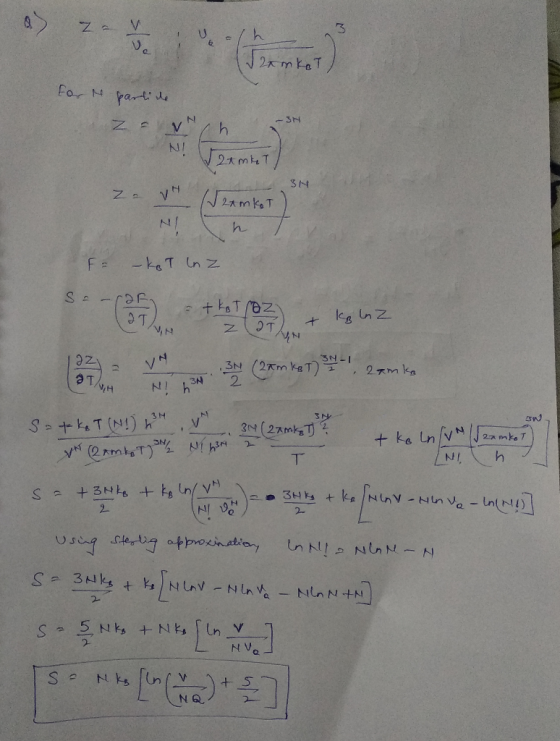
 please like. Thank you
3. It can be shown that the canonical partition function of an N-particle monatomic ideal gas con...
 Please be specific about the solution and thank you so much!
3. It can be shown that the canonical partition function of an N-particle monatomic ideal gas confined to a container of volume V at temperature T is given by 3 Use this partition function to derive an expression for the average energy and the constant- volume heat capacity of the monatomic ideal gas. Note that in classical thermodynamics these quantities were simply given. Your calculations show that these quantities...
Please be specific about the solution and thank you so much!
3. It can be shown that the canonical partition function of an N-particle monatomic ideal gas confined to a container of volume V at temperature T is given by 3 Use this partition function to derive an expression for the average energy and the constant- volume heat capacity of the monatomic ideal gas. Note that in classical thermodynamics these quantities were simply given. Your calculations show that these quantities...
An ideal gas enclosed in a volume V is composed of N identical particles in equilibrium...
An ideal gas enclosed in a volume V is composed of N identical particles in equilibrium at temperature T. (a) Write down the N-particle classical partition function Z in terms of the single-particle partition function ζ, and show that Z it can be written as ln(Z)=N(ln (V/N) + 3/2ln(T)+σ (1) where σ does not depend on either N, T or V . (b) From Equation 1 derive the mean energy E, the equation of state of the ideal gas and...
2) Next week, we will show that the partition function for a monatomic ideal gas is given by Q(N,V,T) - 1 ( 2mk,T 30/2...
 2) Next week, we will show that the partition function for a monatomic ideal gas is given by Q(N,V,T) - 1 ( 2mk,T 30/2 ? N 422) VN where m is the mass of the gas molecules and h is Planck's constant. Derive expressions for the pressure and energy from this partition function.
B.2 The multiplicity of a monatomic ideal gas is given by 2 = f(N)VN U3N/2, where...
 B.2 The multiplicity of a monatomic ideal gas is given by 2 = f(N)VN U3N/2, where V is the volume occupied by the gas, U its internal energy, N the number of particles in the gas and f(N) a complicated function of N. [2] (i) Show that the entropy S of this system is given by 3 S = Nkg In V + ŽNkg In U + g(N), where g(N) is some function of N. (ii) Define the temperature T...
Problem C The partition function for an ideal gas is given by integrating over all possible...
 Problem C The partition function for an ideal gas is given by integrating over all possible position and momen- tum configurations, weighted by a Boltzmann factor, for each particle (6 integrals per particle over z, v, z, pz, py, pz _ each running from-oo to +oo) and multiplying all N of these together (the factor of h is included to cancel the dimensions of dpdr; the factor of N! is included to divide out the multiplicity of particle-particle exchange) a)...
Pls show full working thank you Problem 4.1 Ideal gas equation of state from the Grand...
 Pls
show full working thank you
Problem 4.1 Ideal gas equation of state from the Grand potential The Grand Canonical ensemble can make some calculations particularly simple. To derive the ideal gas equation of state, we first note that the canonical partition function of a set of N identical and indistinguishable particles is given by Z-z/N! , where z is the single particle partition function in the canonical ensemble a) Show that the Grand Canonical partition function is -žte®)" b...
Pls
show full working thank you
Problem 4.1 Ideal gas equation of state from the Grand potential The Grand Canonical ensemble can make some calculations particularly simple. To derive the ideal gas equation of state, we first note that the canonical partition function of a set of N identical and indistinguishable particles is given by Z-z/N! , where z is the single particle partition function in the canonical ensemble a) Show that the Grand Canonical partition function is -žte®)" b...
min The grand canonical partition function ofan ideal gas is 3ega with q-( and λ-e".kr. Derive...
 min The grand canonical partition function ofan ideal gas is 3ega with q-( and λ-e".kr. Derive the entropy, pressure, number of particles, internal energy and heat capacity. Comment on the link between p and N. v
(80 pts) Entropy of the ideal gas: Consider a monatomic gas of identical non-interacting particles of...
 (80 pts) Entropy of the ideal gas: Consider a monatomic gas of identical non-interacting particles of mass m. The kinetic energy of each particle is given in terms of its momentum p by Ekinp2/(2m). For a given total energy U, volume V and total particle number N (with N » 1) calculate the entropy S(U, V,N)-klog Ω(U, V,N), where Ω(U, V,N) counts the number of different microscopic configurations for given N, U and V. To get a finite number for...
Derive F, P,U, and Cv in terms of N, V, T and constants for the Ideal...
Derive F, P,U, and Cv in terms of N, V, T and constants for the Ideal Gas partition function Q(N,V,T) = V^N / (L^(3N)*N!), where L = h/sqrt(2*pi*m*kB*T)
Statistical_Mechanics 2 20 points) 2D ideal Fermi gas 24 Consider an ideal Fermi gas in 2D....
 Statistical_Mechanics
2 20 points) 2D ideal Fermi gas 24 Consider an ideal Fermi gas in 2D. It is contained in an area of dimensions L x L. The particle mass is m. (a) Find the density of states D(e) N/L2 (b) Find the Fermi energy as a function of the particle density n = (c) Find the total energy as a function of the Fermi energy ef. (d) Find the chemical potential u as a function of n and T....
Statistical_Mechanics
2 20 points) 2D ideal Fermi gas 24 Consider an ideal Fermi gas in 2D. It is contained in an area of dimensions L x L. The particle mass is m. (a) Find the density of states D(e) N/L2 (b) Find the Fermi energy as a function of the particle density n = (c) Find the total energy as a function of the Fermi energy ef. (d) Find the chemical potential u as a function of n and T....
 Please be specific about the solution and thank you so much!
3. It can be shown that the canonical partition function of an N-particle monatomic ideal gas confined to a container of volume V at temperature T is given by 3 Use this partition function to derive an expression for the average energy and the constant- volume heat capacity of the monatomic ideal gas. Note that in classical thermodynamics these quantities were simply given. Your calculations show that these quantities...
Please be specific about the solution and thank you so much!
3. It can be shown that the canonical partition function of an N-particle monatomic ideal gas confined to a container of volume V at temperature T is given by 3 Use this partition function to derive an expression for the average energy and the constant- volume heat capacity of the monatomic ideal gas. Note that in classical thermodynamics these quantities were simply given. Your calculations show that these quantities...
 2) Next week, we will show that the partition function for a monatomic ideal gas is given by Q(N,V,T) - 1 ( 2mk,T 30/2 ? N 422) VN where m is the mass of the gas molecules and h is Planck's constant. Derive expressions for the pressure and energy from this partition function.
 B.2 The multiplicity of a monatomic ideal gas is given by 2 = f(N)VN U3N/2, where V is the volume occupied by the gas, U its internal energy, N the number of particles in the gas and f(N) a complicated function of N. [2] (i) Show that the entropy S of this system is given by 3 S = Nkg In V + ŽNkg In U + g(N), where g(N) is some function of N. (ii) Define the temperature T...
 Problem C The partition function for an ideal gas is given by integrating over all possible position and momen- tum configurations, weighted by a Boltzmann factor, for each particle (6 integrals per particle over z, v, z, pz, py, pz _ each running from-oo to +oo) and multiplying all N of these together (the factor of h is included to cancel the dimensions of dpdr; the factor of N! is included to divide out the multiplicity of particle-particle exchange) a)...
 Pls
show full working thank you
Problem 4.1 Ideal gas equation of state from the Grand potential The Grand Canonical ensemble can make some calculations particularly simple. To derive the ideal gas equation of state, we first note that the canonical partition function of a set of N identical and indistinguishable particles is given by Z-z/N! , where z is the single particle partition function in the canonical ensemble a) Show that the Grand Canonical partition function is -žte®)" b...
Pls
show full working thank you
Problem 4.1 Ideal gas equation of state from the Grand potential The Grand Canonical ensemble can make some calculations particularly simple. To derive the ideal gas equation of state, we first note that the canonical partition function of a set of N identical and indistinguishable particles is given by Z-z/N! , where z is the single particle partition function in the canonical ensemble a) Show that the Grand Canonical partition function is -žte®)" b...
 min The grand canonical partition function ofan ideal gas is 3ega with q-( and λ-e".kr. Derive the entropy, pressure, number of particles, internal energy and heat capacity. Comment on the link between p and N. v
 (80 pts) Entropy of the ideal gas: Consider a monatomic gas of identical non-interacting particles of mass m. The kinetic energy of each particle is given in terms of its momentum p by Ekinp2/(2m). For a given total energy U, volume V and total particle number N (with N » 1) calculate the entropy S(U, V,N)-klog Ω(U, V,N), where Ω(U, V,N) counts the number of different microscopic configurations for given N, U and V. To get a finite number for...
 Statistical_Mechanics
2 20 points) 2D ideal Fermi gas 24 Consider an ideal Fermi gas in 2D. It is contained in an area of dimensions L x L. The particle mass is m. (a) Find the density of states D(e) N/L2 (b) Find the Fermi energy as a function of the particle density n = (c) Find the total energy as a function of the Fermi energy ef. (d) Find the chemical potential u as a function of n and T....
Statistical_Mechanics
2 20 points) 2D ideal Fermi gas 24 Consider an ideal Fermi gas in 2D. It is contained in an area of dimensions L x L. The particle mass is m. (a) Find the density of states D(e) N/L2 (b) Find the Fermi energy as a function of the particle density n = (c) Find the total energy as a function of the Fermi energy ef. (d) Find the chemical potential u as a function of n and T....
Most questions answered within 3 hours.
-
Where is the error in this code sequence?
String s1 = "Hello";
String s2 = "ello";...
asked 11 months ago -
Financial data for Joel de Paris, Inc., for last year
follow:
Joel de Paris, Inc.
Balance...
asked 11 months ago -
Consider this reaction:
Al2(SO4)3 (aq)+ BaCl3
(aq) Al2Cl6 (aq)- +
3BaSO4(s) . What is the...
asked 11 months ago -
Suppose that Savneet is considering increasing her
recent random sample from 20 car rentals to 40...
asked 11 months ago -
Trucks arrive at an unloading terminal at an average rate of 120
per hour.
Trucks arrive...
asked 11 months ago -
Why are methanol and ethanol completely soluble in water while
octanol is not very little soluble....
asked 11 months ago -
A facilities manager at a university reads in a research report
that the mean amount of...
asked 11 months ago -
When the CuSO4 is rehydrated by adding water to the anhydrous
compound, is this an endothermic...
asked 11 months ago -
A ray of sunlight is passing from diamond into crown glass; the
angle of incidence is...
asked 11 months ago -
A block of mass 0.249 kg is placed on top of a light, vertical
spring of...
asked 11 months ago -
how do the kidneys compensate in the presences of acidosis
a) trigger hyperventilate
b) reserve acid...
asked 11 months ago -
Question 501 pts
The rental rate of capital to the firm increases. Which of the
following...
asked 11 months ago