1. Suppose we take a sample from two separate populations and record some quantitative measurement for...
1. Suppose we take a sample from two separate populations and record some quantitative measurement for both. The first sample contained 60 respondents and resulted sample mean of 103 with a sample standard deviation of 8.2. The second sample contained 75 respondents and resulted sample mean of 100 with a sample standard deviation of 7.56. Using this information, our goal is to test:
H0:
μ1-μ2 = 0
= 0
Ha:
μ1-μ2
> 0
What is the test statistic, t , for this example?
Note: for your test statistic, keep the order of (sample #1) minus
(sample #2).
, for this example?
Note: for your test statistic, keep the order of (sample #1) minus
(sample #2).
- 0.549
- 1.980
- 2.186
- 3.165
- 4.552
2. Using the information from the previous problem, which tail will you look at to find your p-value?
- Left tail
- Both tails
- Right Tail
3. Refer to the information in the previous two questions. Using the df and t-distribution calculator Excel spreadsheet, how many degrees of freedom will this test use?
- 78.445
- 98.342
- 99.987
- 111.926
- 121.666
4. Using the information from the previous three questions, what is the p-value for this hypothesis test?
- 0.00098
- 0.015
- 0.019
- 0.030
- 0.067
5. Suppose we take sample from two separate populations and record some quantitative measurement for both. The results of these samples are given in the following table:
|
ni |
yi |
si |
|
|
Sample #1 |
34 |
5.4 |
6.4 |
|
Sample #2 |
31 |
7.4 |
8.79 |


Use this information to test the following hypotheses:
H0:
μ1-μ2
= 0
Ha:
μ1-μ2
< 0
What is the test statistic, t, for this example?
Note: for your test statistic, keep the order of (sample #1) minus
(sample #2).
- The test statistic is less than -2.0.
- The test statistic is between -2.0 and -1.5.
- The test statistic is between -1.5 and -1.0.
- The test statistic is between -1.0 and -0.5.
- The test statistic is between -0.5 and 0.
6. Using the information from the previous problem, which tail will you look at to find your p-value?
- Left tail
- Both tails
- Right tail
7. Refer to the information in the previous two questions. Using the df and t-distribution calculator Excel spreadsheet, how many degrees of freedom will this test use?
- 31.879
- 42.199
- 54.446
- 67.012
- 88.430
Homework Answers
1.


 1.(C)
1.(C)
2.(C)
3.(E)
4.(B)
5. same as 1st question calculation we get (C)
6.(A)
7.(C)
Add Answer to:
1. Suppose we take a sample from two separate populations and
record some quantitative measurement for...
Consider the following hypothesis test. The following results are from independent samples taken from two populations....
Consider the following hypothesis test. The following results are from independent samples taken from two populations. H0: Ha: μ1 μ2 0 μ1 μ2 0 Sample 1 Sample 2 n1 35 n2 40 13.6 10.1 s1 5.2 s2 8.5 testSELF x ¯1 x ¯2 x ¯1 x ¯ a. What is the value of the test statistic? b. What is the degrees of freedom for the t distribution? c. What is the p-value? d. At α .05, what is your conclusion?
Find the p-value for each of these situations. Be sure to take into account whether the...
Find the p-value for each of these situations. Be sure to take into account whether the test is left sided, right sided, or two sided. Hints: Draw a picture! Also, all provided information may not be relevant. Note that when testing the value of a single population mean (rather than a difference in means), degrees of freedom are df = n - 1. Round all answers to three decimal places a. H0: μ1 - μ2 = 0 HA: μ1 -...
Independent random samples selected from two normal populations produced the sample means and standard deviations shown...
Independent random samples selected from two normal populations produced the sample means and standard deviations shown below: Sample 1 Sample 2 x̅1 = 5.4 x̅2 = 8.2 s1 = 5.6 s2 = 8.2 n1 = 20 n2 = 18 Conduct the test H0 : μ1 - μ2 = 0 against H1 : μ1 - μ2 ≠ 0 ,then the test statistic is __________.
Consider two populations. A random sample of 15 observations from the first population revealed a sample...
Consider two populations. A random sample of 15 observations from the first population revealed a sample mean of 300 and a sample standard deviation of 12. A random sample of 18 observations from the second population revealed a sample mean of 293 and a sample standard deviation of 14. Test the hypotheses H0 : μ1 − μ2 = 0 and H1 : μ1 − μ2 ≠ 0 ,respectively. (a) Calculate the pooled estimate of the population variance. (b) Test the...
Consider the following summary statistics, calculated from two independent random samples taken from normally distributed populations....
Consider the following summary statistics, calculated from two independent random samples taken from normally distributed populations. Sample 1 Sample 2 x¯1=20.92 x¯2=26.80 s21=2.89 s22=3.81 n1=19 n2=15 Test the null hypothesis H0:μ1=μ2against the alternative hypothesis HA:μ1<μ2. a) Calculate the test statistic for the Welch Approximate t procedure. Round your response to at least 3 decimal places. b) The Welch-Satterthwaite approximation to the degrees of freedom is given by df = 27.983055. Using this information, determine the range in which the p-value...
Consider the following summary statistics, calculated from two independent random samples taken from normally distributed populations....
Consider the following summary statistics, calculated from two independent random samples taken from normally distributed populations. Sample 1 Sample 2 x¯1=20.08 x¯2=24.51 s21=2.05 s22=3.20 n1=19 n2=16 Test the null hypothesis H0:μ1=μ2against the alternative hypothesis HA:μ1<μ2. a) Calculate the test statistic for the Welch Approximate t procedure. Round your response to at least 3 decimal places. b) The Welch-Satterthwaite approximation to the degrees of freedom is given by df = 28.610808. Using this information, determine the range in which the p-value...
Consider the following competing hypotheses and accompanying sample data drawn independently from normally distributed populations. (You...
Consider the following competing hypotheses and accompanying sample data drawn independently from normally distributed populations. (You may find it useful to reference the appropriate table: z table or t table) H0: μ1 − μ2 = 0 HA: μ1 − μ2 ≠ 0 x−1x−1 = 55 x−2x−2 = 59 σ1 = 11.00 σ2 = 1.52 n1 = 23 n2 = 23 a-1. Calculate the value of the test statistic. (Negative values should be indicated by a minus sign. Round all intermediate...
Consider the following competing hypotheses and accompanying sample data drawn independently from normally distributed populations. (You...
Consider the following competing hypotheses and accompanying sample data drawn independently from normally distributed populations. (You may find it useful to reference the appropriate table: z table or t table) H0: μ1 − μ2 ≥ 0 HA: μ1 − μ2 < 0 x−1 x − 1 = 222 x−2 x − 2 = 253 s1 = 32 s2 = 26 n1 = 12 n2 = 12 a-1. Calculate the value of the test statistic under the assumption that the population...
Consider the following competing hypotheses and accompanying sample data drawn independently from normally distributed populations. (You may find it useful to reference the appropriate table: z table or t table)
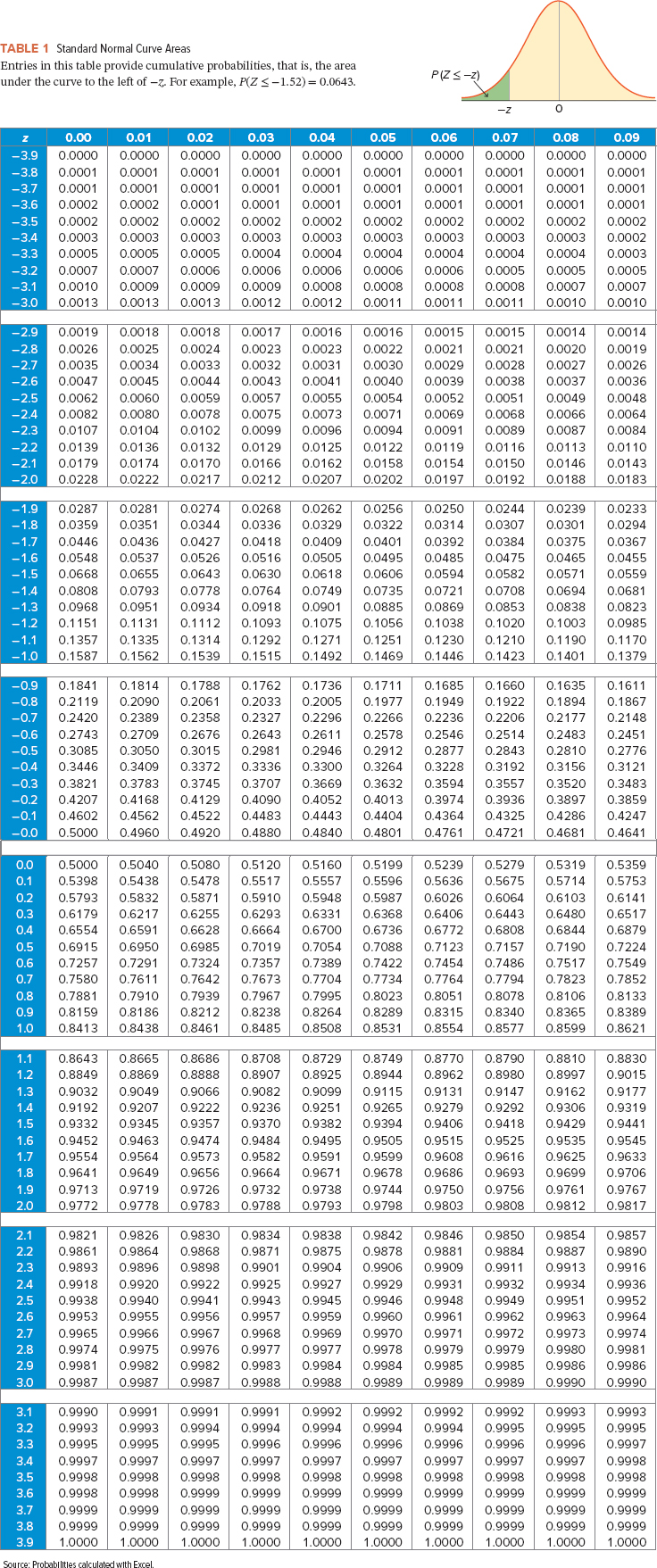 Consider the following competing hypotheses and accompanying sample data drawn independently from normally distributed populations. (You may find it useful to reference the appropriate table: z table or t table) H0: μ1 − μ2 = 0HA: μ1 − μ2 ≠ 0 x−1x−1 = 57x−2 = 63σ1 = 11.5σ2 = 15.2n1 = 20n2 = 20a-1. Calculate the value of the test statistic. (Negative values should be indicated by a minus sign. Round all intermediate calculations to at least 4 decimal places and final answer to 2 decimal places.)Test Statistic ?
In a study on the effect of an oral rinse on plaque buildup on teeth, sixteen...
In a study on the effect of an oral rinse on plaque buildup on teeth, sixteen people whose teeth were thoroughly cleaned and polished were randomly assigned to two groups of eight subjects each. Both groups were assigned to use oral rinses (no brushing) for a 2-week period. Group 1 used a rinse that contained an antiplaque agent. Group 2, the control group, received a similar rinse except that the rinse contained no antiplaque agent. A measure of plaque buildup...
Most questions answered within 3 hours.
-
Where is the error in this code sequence?
String s1 = "Hello";
String s2 = "ello";...
asked 10 months ago -
Financial data for Joel de Paris, Inc., for last year
follow:
Joel de Paris, Inc.
Balance...
asked 10 months ago -
Consider this reaction:
Al2(SO4)3 (aq)+ BaCl3
(aq) Al2Cl6 (aq)- +
3BaSO4(s) . What is the...
asked 10 months ago -
Suppose that Savneet is considering increasing her
recent random sample from 20 car rentals to 40...
asked 10 months ago -
Trucks arrive at an unloading terminal at an average rate of 120
per hour.
Trucks arrive...
asked 10 months ago -
Why are methanol and ethanol completely soluble in water while
octanol is not very little soluble....
asked 10 months ago -
A facilities manager at a university reads in a research report
that the mean amount of...
asked 10 months ago -
When the CuSO4 is rehydrated by adding water to the anhydrous
compound, is this an endothermic...
asked 10 months ago -
A ray of sunlight is passing from diamond into crown glass; the
angle of incidence is...
asked 10 months ago -
A block of mass 0.249 kg is placed on top of a light, vertical
spring of...
asked 10 months ago -
how do the kidneys compensate in the presences of acidosis
a) trigger hyperventilate
b) reserve acid...
asked 10 months ago -
Question 501 pts
The rental rate of capital to the firm increases. Which of the
following...
asked 10 months ago