
Homework Answers
Add Answer to:
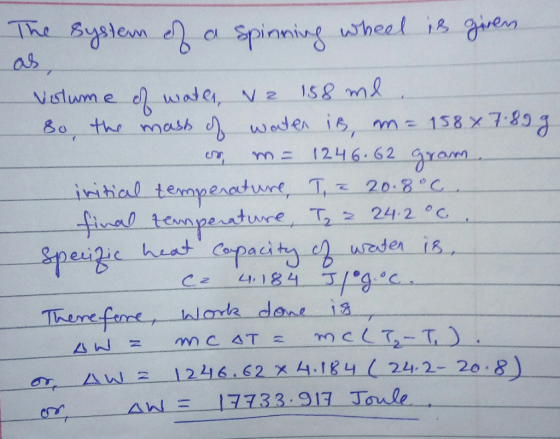
A rapidly spinning paddle wheel raises the temperature of 158mL of water from 20.8 degree C...
Consider using the apparatus shown in Fig. 4-1(a), known as the Joule paddle wheel, to determine...
 Consider using the apparatus shown in Fig. 4-1(a), known as the Joule paddle wheel, to determine the specific heat at constant atmospheric pressure. The paddle wheel is driven by a slowly falling weight, and both have a temperature of 14.5 degree C. As a result of the work done by the 0.427 kg mass that falls 1.00 m, the temperature of 1 kg of water rises 1 degree C. Calculate Cp.
Horizontal-shaft paddle wheel flocculators are to be used for flocculation in a water plant with a...
Horizontal-shaft paddle wheel flocculators are to be used for flocculation in a water plant with a design flow rate of 150 mld (million-liter per day) and water temperature of 10oC. Flocculation is to be designed with two parallel trains and each train is to be made off five stages of flocculation in series. The total detention time for flocculation is to be 20 min. Two paddle wheels will be on the shaft in each stage. The paddle wheel design contains...
1/2 Question 3 A piston-cylinder assembly fitted with a paddle wheel contains air, initially at 38°C,...
 1/2 Question 3 A piston-cylinder assembly fitted with a paddle wheel contains air, initially at 38°C, 125 kPa, and a volume of 0.02 mº. Energy in the amount of 1.8 kJ is transferred to the air by the paddle wheel. The volume of the air in the piston-cylinder increases to 0.05 mº at constant pressure. If the heat transfer between the air and its surroundings can be ignored, determine (a) the mass of the air in the piston-cylinder (b) the...
4. Nitrogen (M-28.01 lb/ibmol) fills a closed rigid tank fitted with paddle wheel, initially at 8...
 4. Nitrogen (M-28.01 lb/ibmol) fills a closed rigid tank fitted with paddle wheel, initially at 80°F, 20 psia, and a volume of 2 ft3. The gas is stirred by the paddle wheel to a final temperature of 300°F During the process heat transfer from the gas to its surroundings occurs in an amount of 1.6 Btu. Assuming ideal gas behavior, determine the mass of gas and the work done. Kinetic and potential energy effects can be ignored. R 1545.bmol R(20...
PHYSICS energy principle and momentum principle question help!! Problem 12 Joule's paddle wheel experiment consists of...
 PHYSICS energy principle and
momentum principle question help!!
Problem 12 Joule's paddle wheel experiment consists of a falling weight which spins a paddle-wheel in an insulated barrel of water. As the weight falls, the water warms up. Assume idealized conditions with no friction in the pulley, string, and bearings. How much does the temperature of the water change? Assume there is 0.4 kg of water, the weight has m=100 kg and it falls 1 m. The specific heat capacity of...
PHYSICS energy principle and
momentum principle question help!!
Problem 12 Joule's paddle wheel experiment consists of a falling weight which spins a paddle-wheel in an insulated barrel of water. As the weight falls, the water warms up. Assume idealized conditions with no friction in the pulley, string, and bearings. How much does the temperature of the water change? Assume there is 0.4 kg of water, the weight has m=100 kg and it falls 1 m. The specific heat capacity of...
5.8×10⁻² mol of an ideal monatomic gas undergoes an adiabatic compression that raises its temperature from...
5.8×10⁻² mol of an ideal monatomic gas undergoes an adiabatic compression that raises its temperature from 11 ∘C to 41 ∘C. Assume R = 8.315 J/mol⋅K. How much work is done on the gas to compress it? Express your answer to two significant figures and include the appropriate units.
intained in a well- addle wheel 5°C. How much /4-101 Air in the amount of 1...
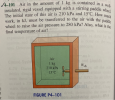 intained in a well- addle wheel 5°C. How much /4-101 Air in the amount of 1 kg is contained in a insulated, rigid vessel equipped with a stirring paddle w The initial state of this air is 210 kPa and 15°C. How work, in kJ, must be transferred to the air with the wheel to raise the air pressure to 280 kPa? Also, what i final temperature of air? the paddle hat is the dom Air 1 kg 210 kPa...
Problem 6.028 SI Air contained in a rigid, insulated tank fitted with a paddle wheel, initially...
 Problem 6.028 SI Air contained in a rigid, insulated tank fitted with a paddle wheel, initially at 300 K, 2 bar, and a volume of 2 m, is stirred until its temperature is 600 K. Assuming the ideal gas model for the air, and ignoring kinetic and potential energy, determine (a) the final pressure, in bar (b) the work, in kJ (c) the amount of entropy produced, kJ/K Solve using: (1) data from Table A-22. (2) constant cy read from...
A quantity of ice at 0 degree C is added to 50 g of water in a glass at 55 degree C. After the ice melted, the temperatu...
A quantity of ice at 0 degree C is added to 50 g of water in a glass at 55 degree C. After the ice melted, the temperature of the water was 15 degree C. How much ice was added?
lf 100g of water is contained in a 300g aluminum container at 20 degree C and...
 lf 100g of water is contained in a 300g aluminum container at 20 degree C and an additional 200g of water at 100 degree C is added to the container, determine the final temperature of the system. In an insulated container, 300g of ice at an initial temperature of-50 degree C is added to 550g of water at an initial temperature of 20 degree C. Find: a) the final temperature of the system b) the amount of ice remaining (if...
 Consider using the apparatus shown in Fig. 4-1(a), known as the Joule paddle wheel, to determine the specific heat at constant atmospheric pressure. The paddle wheel is driven by a slowly falling weight, and both have a temperature of 14.5 degree C. As a result of the work done by the 0.427 kg mass that falls 1.00 m, the temperature of 1 kg of water rises 1 degree C. Calculate Cp.
 1/2 Question 3 A piston-cylinder assembly fitted with a paddle wheel contains air, initially at 38°C, 125 kPa, and a volume of 0.02 mº. Energy in the amount of 1.8 kJ is transferred to the air by the paddle wheel. The volume of the air in the piston-cylinder increases to 0.05 mº at constant pressure. If the heat transfer between the air and its surroundings can be ignored, determine (a) the mass of the air in the piston-cylinder (b) the...
 4. Nitrogen (M-28.01 lb/ibmol) fills a closed rigid tank fitted with paddle wheel, initially at 80°F, 20 psia, and a volume of 2 ft3. The gas is stirred by the paddle wheel to a final temperature of 300°F During the process heat transfer from the gas to its surroundings occurs in an amount of 1.6 Btu. Assuming ideal gas behavior, determine the mass of gas and the work done. Kinetic and potential energy effects can be ignored. R 1545.bmol R(20...
 PHYSICS energy principle and
momentum principle question help!!
Problem 12 Joule's paddle wheel experiment consists of a falling weight which spins a paddle-wheel in an insulated barrel of water. As the weight falls, the water warms up. Assume idealized conditions with no friction in the pulley, string, and bearings. How much does the temperature of the water change? Assume there is 0.4 kg of water, the weight has m=100 kg and it falls 1 m. The specific heat capacity of...
PHYSICS energy principle and
momentum principle question help!!
Problem 12 Joule's paddle wheel experiment consists of a falling weight which spins a paddle-wheel in an insulated barrel of water. As the weight falls, the water warms up. Assume idealized conditions with no friction in the pulley, string, and bearings. How much does the temperature of the water change? Assume there is 0.4 kg of water, the weight has m=100 kg and it falls 1 m. The specific heat capacity of...
 intained in a well- addle wheel 5°C. How much /4-101 Air in the amount of 1 kg is contained in a insulated, rigid vessel equipped with a stirring paddle w The initial state of this air is 210 kPa and 15°C. How work, in kJ, must be transferred to the air with the wheel to raise the air pressure to 280 kPa? Also, what i final temperature of air? the paddle hat is the dom Air 1 kg 210 kPa...
 Problem 6.028 SI Air contained in a rigid, insulated tank fitted with a paddle wheel, initially at 300 K, 2 bar, and a volume of 2 m, is stirred until its temperature is 600 K. Assuming the ideal gas model for the air, and ignoring kinetic and potential energy, determine (a) the final pressure, in bar (b) the work, in kJ (c) the amount of entropy produced, kJ/K Solve using: (1) data from Table A-22. (2) constant cy read from...
 lf 100g of water is contained in a 300g aluminum container at 20 degree C and an additional 200g of water at 100 degree C is added to the container, determine the final temperature of the system. In an insulated container, 300g of ice at an initial temperature of-50 degree C is added to 550g of water at an initial temperature of 20 degree C. Find: a) the final temperature of the system b) the amount of ice remaining (if...
Most questions answered within 3 hours.
-
Where is the error in this code sequence?
String s1 = "Hello";
String s2 = "ello";...
asked 11 months ago -
Financial data for Joel de Paris, Inc., for last year
follow:
Joel de Paris, Inc.
Balance...
asked 11 months ago -
Consider this reaction:
Al2(SO4)3 (aq)+ BaCl3
(aq) Al2Cl6 (aq)- +
3BaSO4(s) . What is the...
asked 11 months ago -
Suppose that Savneet is considering increasing her
recent random sample from 20 car rentals to 40...
asked 11 months ago -
Trucks arrive at an unloading terminal at an average rate of 120
per hour.
Trucks arrive...
asked 11 months ago -
Why are methanol and ethanol completely soluble in water while
octanol is not very little soluble....
asked 11 months ago -
A facilities manager at a university reads in a research report
that the mean amount of...
asked 11 months ago -
When the CuSO4 is rehydrated by adding water to the anhydrous
compound, is this an endothermic...
asked 11 months ago -
A ray of sunlight is passing from diamond into crown glass; the
angle of incidence is...
asked 11 months ago -
A block of mass 0.249 kg is placed on top of a light, vertical
spring of...
asked 11 months ago -
how do the kidneys compensate in the presences of acidosis
a) trigger hyperventilate
b) reserve acid...
asked 11 months ago -
Question 501 pts
The rental rate of capital to the firm increases. Which of the
following...
asked 11 months ago