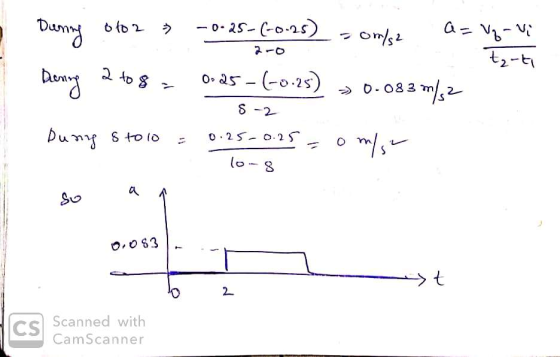
Change the velocity-time graph to the position-time graph and acceleration-time graph.

Homework Answers
Add Answer to:
Change the velocity-time graph to the position-time graph and
acceleration-time graph.
10 Fi (5 )
Problem 9 For the following described motion, draw a position-time, a velocity-time, and an acceleration-time graph...
Problem 9 For the following described motion, draw a position-time, a velocity-time, and an acceleration-time graph on the grids provided: 1. Standing still at the 0.6 meter position for 1 second. 2. Walking away from the detector speeding up slowly and steadily for 2 seconds, going from rest to 1.0 m/s, at x=1.6 m. 3. Walking away from the detector steadily at 1.0 m/s for 2 seconds. 4. Coming to rest slowly and steadily over a 1 second period. 5....
What is a valid definition of acceleration? A. rate of velocity change B. rate of position...
What is a valid definition of acceleration? A. rate of velocity change B. rate of position change C. slope of the position-vs-time graph D. rate of speed change
15. Sketch the acceleration versus time graph derived from the velocity versus time graph. Acceleration versus...
 15. Sketch the acceleration versus time graph derived from the velocity versus time graph. Acceleration versus Time -1 -3 123 45678 9 10 Time (s) Extra Credit 16. Name four fields of classical physics? 17. If a =-4m/fi+6m/s2j, v, =12m/s i + 9m/sj and ri-|0mit-18 mj, find r(t) at t-4s in polar coordinates
1) a) For the position vs. time graph shown below, sketch the velocity vs. time and...
 1) a) For the position vs. time graph shown below, sketch the velocity vs. time and acceleration vs. time graphs corresponding to the motion. (5 pts each) Beside the position and acceleration graphs, describe the motion of the object and explain why you drew the graph the way you did. (10 pts) 25 pts total
where the position vs. time graph is not linear, describe how the velocity and acceleration looked...
where the position vs. time graph is not linear, describe how the velocity and acceleration looked over the same time period.
Position Graph Velocity Graph time (s) time (s) (a) On the coordinate axis below, draw a...
 Position Graph Velocity Graph time (s) time (s) (a) On the coordinate axis below, draw a motion diagram for this object moving from t-0 to 3 second Show 4 events using one-second intervals. A motion diagram includes position dots, time, and velocity vectors -5 m -3 m 2 m -l m r 0 Im (b) On the coordinate axis below, draw a motion diagram for this object moving from t-3 to 5 second Show 3 events using one-second intervals. A...
The graph shows the kinematics (vertical position, velocity, and acceleration) of the center of gravity of...
 The
graph shows the kinematics (vertical position, velocity, and
acceleration) of the center of gravity of a diver and the reaction
force of the diving boar during the takeoff phase for a 3 1?2
backward somersault dive in the tuck position.
a)
At what time(s) (approximately) does the displacement of the diver
change direction? How many times does this occur during the takeoff
phase of the dive?
b)
When does the center of gravity accelerate in the upward direction
and...
The
graph shows the kinematics (vertical position, velocity, and
acceleration) of the center of gravity of a diver and the reaction
force of the diving boar during the takeoff phase for a 3 1?2
backward somersault dive in the tuck position.
a)
At what time(s) (approximately) does the displacement of the diver
change direction? How many times does this occur during the takeoff
phase of the dive?
b)
When does the center of gravity accelerate in the upward direction
and...
Plot the acceleration, position, and velocity as a function of time for an object thrown up...
Plot the acceleration, position, and velocity as a function of time for an object thrown up in the air with an initial velocity of 10m/s. What is the velocity when the position graph reaches a maximum?
the change in velocity divided by change me the slope of a velocity versus time graph...
 the change in velocity divided by change me the slope of a velocity versus time graph the slope of an acceleration versus time graph the time rate of change in velocity QUESTION 5 A cheetah accelerates from rest to 27 m/s in 5 s. What is its acceleration? Write your answer to three significant figures. QUESTION 6 While visiting the Sky Tower, you drop some coins from the top floor which is 222 m above the ground. What is their...
 15. Sketch the acceleration versus time graph derived from the velocity versus time graph. Acceleration versus Time -1 -3 123 45678 9 10 Time (s) Extra Credit 16. Name four fields of classical physics? 17. If a =-4m/fi+6m/s2j, v, =12m/s i + 9m/sj and ri-|0mit-18 mj, find r(t) at t-4s in polar coordinates
 1) a) For the position vs. time graph shown below, sketch the velocity vs. time and acceleration vs. time graphs corresponding to the motion. (5 pts each) Beside the position and acceleration graphs, describe the motion of the object and explain why you drew the graph the way you did. (10 pts) 25 pts total
 Position Graph Velocity Graph time (s) time (s) (a) On the coordinate axis below, draw a motion diagram for this object moving from t-0 to 3 second Show 4 events using one-second intervals. A motion diagram includes position dots, time, and velocity vectors -5 m -3 m 2 m -l m r 0 Im (b) On the coordinate axis below, draw a motion diagram for this object moving from t-3 to 5 second Show 3 events using one-second intervals. A...
 The
graph shows the kinematics (vertical position, velocity, and
acceleration) of the center of gravity of a diver and the reaction
force of the diving boar during the takeoff phase for a 3 1?2
backward somersault dive in the tuck position.
a)
At what time(s) (approximately) does the displacement of the diver
change direction? How many times does this occur during the takeoff
phase of the dive?
b)
When does the center of gravity accelerate in the upward direction
and...
The
graph shows the kinematics (vertical position, velocity, and
acceleration) of the center of gravity of a diver and the reaction
force of the diving boar during the takeoff phase for a 3 1?2
backward somersault dive in the tuck position.
a)
At what time(s) (approximately) does the displacement of the diver
change direction? How many times does this occur during the takeoff
phase of the dive?
b)
When does the center of gravity accelerate in the upward direction
and...
 the change in velocity divided by change me the slope of a velocity versus time graph the slope of an acceleration versus time graph the time rate of change in velocity QUESTION 5 A cheetah accelerates from rest to 27 m/s in 5 s. What is its acceleration? Write your answer to three significant figures. QUESTION 6 While visiting the Sky Tower, you drop some coins from the top floor which is 222 m above the ground. What is their...
Most questions answered within 3 hours.
-
Where is the error in this code sequence?
String s1 = "Hello";
String s2 = "ello";...
asked 10 months ago -
Financial data for Joel de Paris, Inc., for last year
follow:
Joel de Paris, Inc.
Balance...
asked 10 months ago -
Consider this reaction:
Al2(SO4)3 (aq)+ BaCl3
(aq) Al2Cl6 (aq)- +
3BaSO4(s) . What is the...
asked 10 months ago -
Suppose that Savneet is considering increasing her
recent random sample from 20 car rentals to 40...
asked 10 months ago -
Trucks arrive at an unloading terminal at an average rate of 120
per hour.
Trucks arrive...
asked 10 months ago -
Why are methanol and ethanol completely soluble in water while
octanol is not very little soluble....
asked 10 months ago -
A facilities manager at a university reads in a research report
that the mean amount of...
asked 10 months ago -
When the CuSO4 is rehydrated by adding water to the anhydrous
compound, is this an endothermic...
asked 10 months ago -
A ray of sunlight is passing from diamond into crown glass; the
angle of incidence is...
asked 10 months ago -
A block of mass 0.249 kg is placed on top of a light, vertical
spring of...
asked 10 months ago -
how do the kidneys compensate in the presences of acidosis
a) trigger hyperventilate
b) reserve acid...
asked 10 months ago -
Question 501 pts
The rental rate of capital to the firm increases. Which of the
following...
asked 10 months ago