#3 (4 points) Fowle Marketing Research, Inc., bases charges to a client on the assumption that...
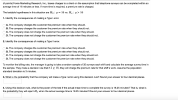
#3 (4 points) Fowle Marketing Research, Inc., bases charges to a client on the assumption that telephone surveys can be completed within an average time of 18 minutes or less. If more time is required, a premium rate is charged.
The testable hypotheses in this situation are ?0:?=18 vs. ??:?>18
1. Identify the consequences of making a Type I
error.
A. The company does not charge the customer the
premium rate when they should.
B. The company charges the customer the premium
rate when they should not.
C. The company charges the customer the premium
rate when they should.
D. The company does not charge the customer the
premium rate when they should not.
2. Identify the consequences of making a Type
II error.
A. The company does not charge the customer the
premium rate when they should.
B. The company charges the customer the premium
rate when they should.
C. The company charges the customer the premium
rate when they should not.
D. The company does not charge the customer the
premium rate when they should not.
To monitor the billing rate, the manager is going to take a random sample of 30 surveys each shift and calculate the average survey time in the sample. They make a decision rule that if ?¯≥20, they will charge the premium rate for that shift's work. Assume the population standard deviation is 7 minutes.
3. What is the probability that the company will make a Type I error using this decision rule? Round your answer to four decimal places.
4. Using this decision rule, what is the power of the test if the actual mean time to complete the survey is 19.75 minutes? That is, what is the probability they will reject H0 when the actual average time is 19.75 minutes? Round your answer to four decimal places.
Homework Answers
1. The consequences of making a Type I error -
ans-> B. The company charges the customer the premium rate when they should not.
2. The consequences of making a Type II error -
ans-> A. The company does not charge the customer the premium rate when they should.
Add Answer to:
#3 (4 points) Fowle Marketing Research, Inc., bases charges to a
client on the assumption that...
(4 points) Fowle Marketing Research, Inc., bases charges to a client on the assumption that telephone...
 (4 points) Fowle Marketing Research, Inc., bases charges to a client on the assumption that telephone surveys can be completed within an average time of 16 minutes or less. If more time is required, a premium rate is charged. The testable hypotheses in this situation are H M = 16 vs. H :N > 16 1. Identify the consequences of making a Type I error. A. The company charges the customer the premium rate when they should. B. The company...
(4 points) Fowle Marketing Research, Inc., bases charges to a cient on the assumption that teleph...
 (4 points) Fowle Marketing Research, Inc., bases charges to a cient on the assumption that telephone surveys can be completed within an average time of 15 mminutes or less. If more time is required, a premium rate is charged The testable hypotheses in this situation are H0 : μ = 15 vs. 14: μ > 15 1. Identify the consequences of making a Type l eror A. The company charges the customer the premium rate when they should. B. The...
Fowle Marketing Research, Inc., bases charges to a client on the assumption that telephone surveys can...
Fowle Marketing Research, Inc., bases charges to a client on the assumption that telephone surveys can be completed within an average time of 14 minutes or less. If more time is required, a premium rate is charged. The testable hypotheses in this situation are H0:μ=14H0:μ=14 vs. Ha:μ>14Ha:μ>14 1. Identify the consequences of making a Type I error. A. The company charges the customer the premium rate when they should. B. The company charges the customer the premium rate when they...
Fowle Marketing Research, Inc., bases charges to a client on the assumption that telephone surveys can...
Fowle Marketing Research, Inc., bases charges to a client on the assumption that telephone surveys can be completed within an average time of 14 minutes or less. If more time is required, a premium rate is charged. To monitor the billing rate, the manager is going to take a random sample of 15 surveys each shift and calculate the average survey time in the sample. They make a decision rule that if x¯≥15.5, they will charge the premium rate for...
Fowle Marketing Research, Inc., bases charges to a client on the assumption that telephone surveys can...
Fowle Marketing Research, Inc., bases charges to a client on the assumption that telephone surveys can be completed in a mean time of 15 minutes or less. If a longer mean survey time is necessary, a premium rate is charged. With a sample of 35 surveys, a population standard deviation of 4 minutes, and a level of significance of .01, the sample mean will be used to test the null hypothesis H0: μ is less than equal 15. a. What...
Fowle Marketing Research, Inc., bases charges to a client on the assumption that telephone surveys can be completed in a mean time of 15 minutes or less.
. Fowle Marketing Research, Inc., bases charges to a client on the assumption that telephone surveys can be completed in a mean time of 15 minutes or less. If a longer mean survey time is necessary, a premium rate is charged. A sample of 35 surveys provided the survey times shown in the file named Fowle. Based upon past studies, the population standard deviation is assumed known with σ = 4 minutes. Is the premium rate justified?(a). Formulate the null...
Fowle Marketing Research, Inc., bases charges to a client on the assumption that telephone surveys can...
Fowle Marketing Research, Inc., bases charges to a client on the assumption that telephone surveys can be completed in a mean time of 15 minutes or less. If a longer mean survey time is necessary, a premium rate is charged. Suppose a sample of 35 surveys produces the data in the Microsoft Excel Online file below. Use a known σ = 3.2 minutes. Is the premium rate justified? Compute the value of the test statistic (to 2 decimals). What is...
Fowle Marketing Research, Inc., bases charges to a client on the assumption that telephone surveys can...
Fowle Marketing Research, Inc., bases charges to a client on the assumption that telephone surveys can be completed in a mean time of 15 minutes or less. If a longer mean survey time is necessary, a premium rate is charged. A sample of 35 surveys provided a mean time of 17 minutes. Based upon past studies, the population standard deviation is assumed known with σ=4. Is the premium rate justified? Compute the value of the test statistic. (Round to two...
Fowle Marketing Research, Inc., bases charges to a client on the assumption that telephone surveys can...
Fowle Marketing Research, Inc., bases charges to a client on the assumption that telephone surveys can be completed in a mean time of 15 minutes or less. If a longer mean survey time is necessary, a premium rate is charged. Suppose a sample of 35 surveys produces the data in the Microsoft Excel Online file below. Use a known σ = 3.7 minutes. Is the premium rate justified? 20.3 13.7 16.2 18.1 14.3 17.3 14.6 17.4 18.5 10.2 15.1 16.6...
Fowle Marketing Research, Inc., bases charges to a client on the assumption that telephone surveys can...
 Fowle Marketing Research, Inc., bases charges to a client on the assumption that telephone surveys can be completed in a mean time of 13 minutes or less. If a longer mean survey time is necessary, a premium rate is charged. A sample of 35 surveys from a particular dient provided the survey times shown in the file named Fowle. Based upon past studies, the population standard deviation is assumed known with 9 minutes. Is the premium rate justified for this...
 (4 points) Fowle Marketing Research, Inc., bases charges to a client on the assumption that telephone surveys can be completed within an average time of 16 minutes or less. If more time is required, a premium rate is charged. The testable hypotheses in this situation are H M = 16 vs. H :N > 16 1. Identify the consequences of making a Type I error. A. The company charges the customer the premium rate when they should. B. The company...
 (4 points) Fowle Marketing Research, Inc., bases charges to a cient on the assumption that telephone surveys can be completed within an average time of 15 mminutes or less. If more time is required, a premium rate is charged The testable hypotheses in this situation are H0 : μ = 15 vs. 14: μ > 15 1. Identify the consequences of making a Type l eror A. The company charges the customer the premium rate when they should. B. The...
 Fowle Marketing Research, Inc., bases charges to a client on the assumption that telephone surveys can be completed in a mean time of 13 minutes or less. If a longer mean survey time is necessary, a premium rate is charged. A sample of 35 surveys from a particular dient provided the survey times shown in the file named Fowle. Based upon past studies, the population standard deviation is assumed known with 9 minutes. Is the premium rate justified for this...
Most questions answered within 3 hours.
-
Where is the error in this code sequence?
String s1 = "Hello";
String s2 = "ello";...
asked 11 months ago -
Financial data for Joel de Paris, Inc., for last year
follow:
Joel de Paris, Inc.
Balance...
asked 11 months ago -
Consider this reaction:
Al2(SO4)3 (aq)+ BaCl3
(aq) Al2Cl6 (aq)- +
3BaSO4(s) . What is the...
asked 11 months ago -
Suppose that Savneet is considering increasing her
recent random sample from 20 car rentals to 40...
asked 11 months ago -
Trucks arrive at an unloading terminal at an average rate of 120
per hour.
Trucks arrive...
asked 11 months ago -
Why are methanol and ethanol completely soluble in water while
octanol is not very little soluble....
asked 11 months ago -
A facilities manager at a university reads in a research report
that the mean amount of...
asked 11 months ago -
When the CuSO4 is rehydrated by adding water to the anhydrous
compound, is this an endothermic...
asked 11 months ago -
A ray of sunlight is passing from diamond into crown glass; the
angle of incidence is...
asked 11 months ago -
A block of mass 0.249 kg is placed on top of a light, vertical
spring of...
asked 11 months ago -
how do the kidneys compensate in the presences of acidosis
a) trigger hyperventilate
b) reserve acid...
asked 11 months ago -
Question 501 pts
The rental rate of capital to the firm increases. Which of the
following...
asked 11 months ago