
Homework Answers
Add Answer to:
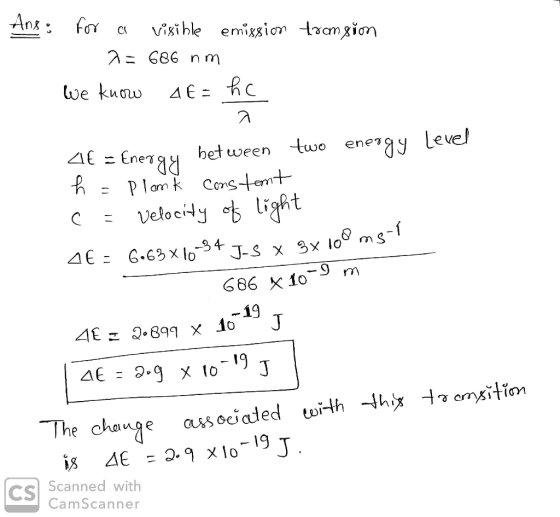
Question 9 4 pts After excitation, of helium gas there are five distinct, visible emission lines....
Please help with this chemistry lab question ATOMIC EMISSION SPECTROSCOPY ADVANCED STUDY ASSIGNMENT Name Section Date...
 Please help with this chemistry lab question
ATOMIC EMISSION SPECTROSCOPY ADVANCED STUDY ASSIGNMENT Name Section Date This assignment MUST be completed before the laboratory period begins. Wavelength values for the hydrogen emission spectrum are required for the experiment. A few answers have been provided for you. You may wish to verify some of these to ensure that your calculation methods and signifcant digits are correct. 1. Calculate energy values for the first SIX hydrogen energy levels usings En =-RH/n--(2.179 x10-18J/n2...
Please help with this chemistry lab question
ATOMIC EMISSION SPECTROSCOPY ADVANCED STUDY ASSIGNMENT Name Section Date This assignment MUST be completed before the laboratory period begins. Wavelength values for the hydrogen emission spectrum are required for the experiment. A few answers have been provided for you. You may wish to verify some of these to ensure that your calculation methods and signifcant digits are correct. 1. Calculate energy values for the first SIX hydrogen energy levels usings En =-RH/n--(2.179 x10-18J/n2...
My question is attached. Question 8 Status: Incorrect Points earned: 0.00/1.00 Visible light falls into wavelength...
 My question is attached.
Question 8 Status: Incorrect Points earned: 0.00/1.00 Visible light falls into wavelength ranges of 400-700 nm, for which 1 m = 1 x 10° nm. The energy and wavelength of light are related by the equation hc E where E is energy in Joules, h is Planck's constant (6.626 x 10⁻³⁴ J-s), c is the speed of light ( 2.998 x 10⁸ m/s), and is the wavelength in m. If a visible light photon has a...
My question is attached.
Question 8 Status: Incorrect Points earned: 0.00/1.00 Visible light falls into wavelength ranges of 400-700 nm, for which 1 m = 1 x 10° nm. The energy and wavelength of light are related by the equation hc E where E is energy in Joules, h is Planck's constant (6.626 x 10⁻³⁴ J-s), c is the speed of light ( 2.998 x 10⁸ m/s), and is the wavelength in m. If a visible light photon has a...
4 Item 4 Learning Goal: To calculate the wavelengths of the lines in the hydrogen emission...
 4
Item 4 Learning Goal: To calculate the wavelengths of the lines in the hydrogen emission spectrum Atoms give off light when heated or otherwise excited! The light emitted by excited atoms consists of only a few wavelengths, rather than a full rainbow of colors. When this light is passed through a prism, the result is a series of discrete lines separated by blank areas. The visible lines in the series of the hydrogen spectrum are caused by emission of...
4
Item 4 Learning Goal: To calculate the wavelengths of the lines in the hydrogen emission spectrum Atoms give off light when heated or otherwise excited! The light emitted by excited atoms consists of only a few wavelengths, rather than a full rainbow of colors. When this light is passed through a prism, the result is a series of discrete lines separated by blank areas. The visible lines in the series of the hydrogen spectrum are caused by emission of...
Use the following information to answer the next question. The following diagram represents the emission lines...
 Use the following information to answer the next question. The following diagram represents the emission lines that are produced for the Balmer Series of hydrogen. Each line is produced as an electron makes a transition from a higher Bohr energy level to n-2. Balmer Series Spectral Line Wavelengths IT I 300 nm 400 nm 500 nm 600 mm 700 nm 8. The regions of the electromagnetic spectrum into which the lines of the Balmer Series of hydrogen are classified are...
A student records the following wavelengths (to ±10 nm) for the helium emission. Extension Requests Print Assignment Question 12 3 456 Total -2 -fi 4.9/5-1-11-1 4.9/11(44.5%) Points Assignment Submis...
 A student records the following wavelengths (to ±10 nm) for the
helium emission.
Extension Requests Print Assignment Question 12 3 456 Total -2 -fi 4.9/5-1-11-1 4.9/11(44.5%) Points Assignment Submission Description For this assignment, you submit answers by question parts. The number of submissions ramaining for each question part only changes if you submit or change the answer Quantum States for the Visible Hydrogen Atomic Emission Spectrum Assignment Scoring Your last submission is used for your score. 1. -12 points UCSCGenChemL1...
A student records the following wavelengths (to ±10 nm) for the
helium emission.
Extension Requests Print Assignment Question 12 3 456 Total -2 -fi 4.9/5-1-11-1 4.9/11(44.5%) Points Assignment Submission Description For this assignment, you submit answers by question parts. The number of submissions ramaining for each question part only changes if you submit or change the answer Quantum States for the Visible Hydrogen Atomic Emission Spectrum Assignment Scoring Your last submission is used for your score. 1. -12 points UCSCGenChemL1...
Chemist Hydrogen Spectrum Drac 8 m/s = 4.487 X 10' Lab A10 W est 2010 (2)...
 Chemist Hydrogen Spectrum Drac 8 m/s = 4.487 X 10' Lab A10 W est 2010 (2) 1. For each of the obse of the observed wavelengths in the hydrogen spectrum, calculate the energy of each photon emited. 110nm - E-hc 6.626 xE-345s 3.00xE8 m/s - 4.8483 x 10¹⁵ j 7 41xE-7AM 104 nm -> E he= 6.626x E-3935 <0.00 xE8 ms - 4.481 -19 4.34E-7m. 186 nm - E= he = 6.626 xE-34 35 X 3.00 xE8B/s, 4.090 x 10...
Using your spectroscope, you observe a light source and see several strong, distinct lines. Is this...
Using your spectroscope, you observe a light source and see several strong, distinct lines. Is this source continuous or discrete? Given a line with a wavelength corresponding to 500 nm, calculate the energy of the emitted light. Given a photon emitted from a hydrogen lamp with a wavelength of 434 nm, identify the correct transition in the Balmer series. R_h = 2.18 *10^(-18) J. (Hint: it is in the visible region of the electromagnetic spectrum) Looking through your spectroscope, you...
X-r ct Question 4 0/3 pts ncorrect What is the energy of 1 mol of 725...
 X-r ct Question 4 0/3 pts ncorrect What is the energy of 1 mol of 725 nm photon (in J). The Planck's constant h 6.63 x 10 34 J-s. The speed of light is 3.00 x 10⁸ m/s, Avogadro's number N 6.02 x 10²³ /mol. Pay attention to unit! 1.65 x 10sJ 8.68 x 10⁸j 2.74 x 10¹⁹ J 1.65 x 10⁴J Partial 2/3 pts
05 Question (4 points) When a hydrogen atom absorbs a photon of electromagnetic radiation (EMR), the...
 05 Question (4 points) When a hydrogen atom absorbs a photon of electromagnetic radiation (EMR), the internal energy of the atom increases and one or more electrons may be energized into an excited state. The release of this extra energy as the excited state electron transitions back to a lower energy state results in the emission of a photon. These energy changes are responsible for the emission spectrum of hydrogen (shown below) and are described by the Bohr equation. AE...
increasing magnitude of lattice energy KCl, KF, Kl / Question 8 4 pts / A hydrogen...
 increasing magnitude of lattice energy KCl, KF, Kl
/ Question 8 4 pts / A hydrogen atom with an electron absorbs light having a frequency of 6.90 x 10¹⁴ Hz thus causing the electron to transition to a final energy state of n = 5. Determine the principal quantum number level for the initial state in this electronic transition. UCSLIURE 4 pts What is the velocity (m/s) of a steel ball (7.75 g) with a wavelength of 3.46x 10⁻²⁴ nm?...
increasing magnitude of lattice energy KCl, KF, Kl
/ Question 8 4 pts / A hydrogen atom with an electron absorbs light having a frequency of 6.90 x 10¹⁴ Hz thus causing the electron to transition to a final energy state of n = 5. Determine the principal quantum number level for the initial state in this electronic transition. UCSLIURE 4 pts What is the velocity (m/s) of a steel ball (7.75 g) with a wavelength of 3.46x 10⁻²⁴ nm?...
 Please help with this chemistry lab question
ATOMIC EMISSION SPECTROSCOPY ADVANCED STUDY ASSIGNMENT Name Section Date This assignment MUST be completed before the laboratory period begins. Wavelength values for the hydrogen emission spectrum are required for the experiment. A few answers have been provided for you. You may wish to verify some of these to ensure that your calculation methods and signifcant digits are correct. 1. Calculate energy values for the first SIX hydrogen energy levels usings En =-RH/n--(2.179 x10-18J/n2...
Please help with this chemistry lab question
ATOMIC EMISSION SPECTROSCOPY ADVANCED STUDY ASSIGNMENT Name Section Date This assignment MUST be completed before the laboratory period begins. Wavelength values for the hydrogen emission spectrum are required for the experiment. A few answers have been provided for you. You may wish to verify some of these to ensure that your calculation methods and signifcant digits are correct. 1. Calculate energy values for the first SIX hydrogen energy levels usings En =-RH/n--(2.179 x10-18J/n2...
 My question is attached.
Question 8 Status: Incorrect Points earned: 0.00/1.00 Visible light falls into wavelength ranges of 400-700 nm, for which 1 m = 1 x 10° nm. The energy and wavelength of light are related by the equation hc E where E is energy in Joules, h is Planck's constant (6.626 x 10⁻³⁴ J-s), c is the speed of light ( 2.998 x 10⁸ m/s), and is the wavelength in m. If a visible light photon has a...
My question is attached.
Question 8 Status: Incorrect Points earned: 0.00/1.00 Visible light falls into wavelength ranges of 400-700 nm, for which 1 m = 1 x 10° nm. The energy and wavelength of light are related by the equation hc E where E is energy in Joules, h is Planck's constant (6.626 x 10⁻³⁴ J-s), c is the speed of light ( 2.998 x 10⁸ m/s), and is the wavelength in m. If a visible light photon has a...
 4
Item 4 Learning Goal: To calculate the wavelengths of the lines in the hydrogen emission spectrum Atoms give off light when heated or otherwise excited! The light emitted by excited atoms consists of only a few wavelengths, rather than a full rainbow of colors. When this light is passed through a prism, the result is a series of discrete lines separated by blank areas. The visible lines in the series of the hydrogen spectrum are caused by emission of...
4
Item 4 Learning Goal: To calculate the wavelengths of the lines in the hydrogen emission spectrum Atoms give off light when heated or otherwise excited! The light emitted by excited atoms consists of only a few wavelengths, rather than a full rainbow of colors. When this light is passed through a prism, the result is a series of discrete lines separated by blank areas. The visible lines in the series of the hydrogen spectrum are caused by emission of...
 Use the following information to answer the next question. The following diagram represents the emission lines that are produced for the Balmer Series of hydrogen. Each line is produced as an electron makes a transition from a higher Bohr energy level to n-2. Balmer Series Spectral Line Wavelengths IT I 300 nm 400 nm 500 nm 600 mm 700 nm 8. The regions of the electromagnetic spectrum into which the lines of the Balmer Series of hydrogen are classified are...
 A student records the following wavelengths (to ±10 nm) for the
helium emission.
Extension Requests Print Assignment Question 12 3 456 Total -2 -fi 4.9/5-1-11-1 4.9/11(44.5%) Points Assignment Submission Description For this assignment, you submit answers by question parts. The number of submissions ramaining for each question part only changes if you submit or change the answer Quantum States for the Visible Hydrogen Atomic Emission Spectrum Assignment Scoring Your last submission is used for your score. 1. -12 points UCSCGenChemL1...
A student records the following wavelengths (to ±10 nm) for the
helium emission.
Extension Requests Print Assignment Question 12 3 456 Total -2 -fi 4.9/5-1-11-1 4.9/11(44.5%) Points Assignment Submission Description For this assignment, you submit answers by question parts. The number of submissions ramaining for each question part only changes if you submit or change the answer Quantum States for the Visible Hydrogen Atomic Emission Spectrum Assignment Scoring Your last submission is used for your score. 1. -12 points UCSCGenChemL1...
 Chemist Hydrogen Spectrum Drac 8 m/s = 4.487 X 10' Lab A10 W est 2010 (2) 1. For each of the obse of the observed wavelengths in the hydrogen spectrum, calculate the energy of each photon emited. 110nm - E-hc 6.626 xE-345s 3.00xE8 m/s - 4.8483 x 10¹⁵ j 7 41xE-7AM 104 nm -> E he= 6.626x E-3935 <0.00 xE8 ms - 4.481 -19 4.34E-7m. 186 nm - E= he = 6.626 xE-34 35 X 3.00 xE8B/s, 4.090 x 10...
 X-r ct Question 4 0/3 pts ncorrect What is the energy of 1 mol of 725 nm photon (in J). The Planck's constant h 6.63 x 10 34 J-s. The speed of light is 3.00 x 10⁸ m/s, Avogadro's number N 6.02 x 10²³ /mol. Pay attention to unit! 1.65 x 10sJ 8.68 x 10⁸j 2.74 x 10¹⁹ J 1.65 x 10⁴J Partial 2/3 pts
 05 Question (4 points) When a hydrogen atom absorbs a photon of electromagnetic radiation (EMR), the internal energy of the atom increases and one or more electrons may be energized into an excited state. The release of this extra energy as the excited state electron transitions back to a lower energy state results in the emission of a photon. These energy changes are responsible for the emission spectrum of hydrogen (shown below) and are described by the Bohr equation. AE...
 increasing magnitude of lattice energy KCl, KF, Kl
/ Question 8 4 pts / A hydrogen atom with an electron absorbs light having a frequency of 6.90 x 10¹⁴ Hz thus causing the electron to transition to a final energy state of n = 5. Determine the principal quantum number level for the initial state in this electronic transition. UCSLIURE 4 pts What is the velocity (m/s) of a steel ball (7.75 g) with a wavelength of 3.46x 10⁻²⁴ nm?...
increasing magnitude of lattice energy KCl, KF, Kl
/ Question 8 4 pts / A hydrogen atom with an electron absorbs light having a frequency of 6.90 x 10¹⁴ Hz thus causing the electron to transition to a final energy state of n = 5. Determine the principal quantum number level for the initial state in this electronic transition. UCSLIURE 4 pts What is the velocity (m/s) of a steel ball (7.75 g) with a wavelength of 3.46x 10⁻²⁴ nm?...
Most questions answered within 3 hours.
-
Where is the error in this code sequence?
String s1 = "Hello";
String s2 = "ello";...
asked 11 months ago -
Financial data for Joel de Paris, Inc., for last year
follow:
Joel de Paris, Inc.
Balance...
asked 11 months ago -
Consider this reaction:
Al2(SO4)3 (aq)+ BaCl3
(aq) Al2Cl6 (aq)- +
3BaSO4(s) . What is the...
asked 11 months ago -
Suppose that Savneet is considering increasing her
recent random sample from 20 car rentals to 40...
asked 11 months ago -
Trucks arrive at an unloading terminal at an average rate of 120
per hour.
Trucks arrive...
asked 11 months ago -
Why are methanol and ethanol completely soluble in water while
octanol is not very little soluble....
asked 11 months ago -
A facilities manager at a university reads in a research report
that the mean amount of...
asked 11 months ago -
When the CuSO4 is rehydrated by adding water to the anhydrous
compound, is this an endothermic...
asked 11 months ago -
A ray of sunlight is passing from diamond into crown glass; the
angle of incidence is...
asked 11 months ago -
A block of mass 0.249 kg is placed on top of a light, vertical
spring of...
asked 11 months ago -
how do the kidneys compensate in the presences of acidosis
a) trigger hyperventilate
b) reserve acid...
asked 11 months ago -
Question 501 pts
The rental rate of capital to the firm increases. Which of the
following...
asked 11 months ago