
Homework Answers
Solution:
Exceptions:
Exceptions are generally considered as the events that occur during program execution and normal flow of program execution alters.
There are various kinds of exceptions like RuntimeException, NullPointerException, ArithmeticException etc..
It is necessary to handle these exceptions when they occur in our execution. We catch them using catch() blocks present after try blocks on our code.
Given Four sets with various options to be filled in given code.
The outputs that are obtained after placing these different options in our code are as shown below.
First Set:
The program gives error.
Here when the exception is thrown, it must be handled in the same function when it is not declared.
So, this statement as shown in the below screenshot does not compile and gives you a error that it must be caught or declared to be thrown.

Second Set:
The code compiles and produces output ADGH.
The Arithmetic Exception is caught when it is raised and the A is displayed on console. And the statements in the finally block are displayed.

Third Set:
The code gives error.
In the main function when f() is called, it calls g() in turn and Null Pointer Exception is handled.
But in the main method again Null pointer Exception is being caught after try statement.
This raises error that NullPointerException has already been caught.

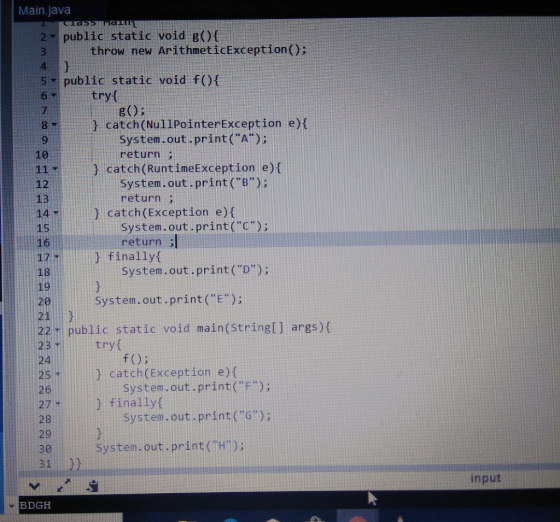
Fourth set:
The code compiles and produces output as BDGH.
The Arithmetic exception is thrown and it is subset of RuntimeException. So it is caught by it and prints B on console.
Then the statements that are present in the finally block are executed.
Add Answer to:
Question 5 (10 points) Assume you have the following code, with blanks to be filled in...
Please help me answer these questions in java programming language. Please answer it line after line...
Please help me answer these questions in java programming language. Please answer it line after line so that I can understand please. Does it compile or not? No programming is done in this exercise, simply answer the questions asked in the code given below. class Exemple { /*Explain why this code does not compile */ public void m1() { foo(); } public int foo() throws Exception { throw new Exception(); } /*Explain why this code is not considered as good...
Question 1 (5 points) Question 1 Unsaved What is displayed on the console when running the...
Question 1 (5 points) Question 1 Unsaved What is displayed on the console when running the following program? public class Quiz2B { public static void main(String[] args) { try { System.out.println("Welcome to Java"); int i = 0; int y = 2 / i; System.out.println("Welcome to Java"); } catch (RuntimeException ex) { System.out.println("Welcome to Java"); } finally { System.out.println("End of the block"); } } } Question 1 options: The program displays Welcome to Java two times. The program displays Welcome to...
Question 10 (3 points) Which of the following statement is not true? There is a recursive...
 Question 10 (3 points) Which of the following statement is not true? There is a recursive sum method as shown below. When sum (19) is called, summation of all odd numbers less than 19 will be calculated and returned public int sum(int x){ if (x == 0) return 0: else return sum(x-2) + x; The following code segment will throw a testException. This exception has been handled in the way that do nothing but to continue when this exception happens....
Lab 3 Step One First, create an empty directory for lab3. There is no starter code for this lab. You will be throwing an...
Lab 3 Step One First, create an empty directory for lab3. There is no starter code for this lab. You will be throwing and catching exceptions in this exercise. Create a file called RuntimeException.h and put the following code in it. #include <string> class RuntimeException { private: string errorMsg; public: RuntimeException(const string& err) { errorMsg = err; } string getMessage() const { return errorMsg; } } Step Two In a new .cpp file in your directory, write a main function...
Lab 3 Step One First, create an empty directory for lab3. There is no starter code...
Lab 3 Step One First, create an empty directory for lab3. There is no starter code for this lab. You will be throwing and catching exceptions in this exercise. Create a file called RuntimeException.h and put the following code in it. #include <string> class RuntimeException { private: string errorMsg; public: RuntimeException(const string& err) { errorMsg = err; } string getMessage() const { return errorMsg; } } Step Two In a new .cpp file in your directory, write a main function...
What is the output of the following question? import java.io.IOException; import java.util. EmptyStackException: public class newclass...
 What is the output of the following question? import java.io.IOException; import java.util. EmptyStackException: public class newclass public static void main(String[] args) try System.out.printf("%d", 1); throw (new Exception()); catch (IOException e) System.out.printf("%d", 2); catch(EmptyStackException e) System.out.printf("%d", 3); catch(Exception e) System.out.printf("%d", 4); } finally System.out.printf("%d", 5); Q3) (15 points) a.Write a JAVA program that reads an arra JAVA program that reads an array from input file and invo Sort and Max ,that sorts the elements of the array and s the elements...
Can you plz help me this in java? QUESTION 14 Given public static void test() throws...
 Can you plz help me this in
java?
QUESTION 14 Given public static void test() throws FileNotFoundException{ try { throw FileNotFoundException(); } finally { Determine why it will not compile. Which statement(s) is(are) correct? (Choose all that apply) A. The code will not compile without a catch clause UB. The finally clause should be the final clause UC There is no class called FileNotFoundException D. None of these
Can you plz help me this in
java?
QUESTION 14 Given public static void test() throws FileNotFoundException{ try { throw FileNotFoundException(); } finally { Determine why it will not compile. Which statement(s) is(are) correct? (Choose all that apply) A. The code will not compile without a catch clause UB. The finally clause should be the final clause UC There is no class called FileNotFoundException D. None of these
need java code for this question Question 2 (15 marks) (a) Does the following class successfully...
 need java code for this question
Question 2 (15 marks) (a) Does the following class successfully compile? Explain your answer. public class MyClass public static void main(String arge) if(Integer.parseInt(args[0]) < 0) throw new RuntimeException(); C { 1 } If the class does compile, describe what will happen when we run it with command: java MyClass -10 (5 marks) (b) Write a complete definition of the method with the heading given below: public static double calculate insurance Premium double carValue, int...
need java code for this question
Question 2 (15 marks) (a) Does the following class successfully compile? Explain your answer. public class MyClass public static void main(String arge) if(Integer.parseInt(args[0]) < 0) throw new RuntimeException(); C { 1 } If the class does compile, describe what will happen when we run it with command: java MyClass -10 (5 marks) (b) Write a complete definition of the method with the heading given below: public static double calculate insurance Premium double carValue, int...
Problem 1 1. In the src → edu.neiu.p2 directory, create a package named problem1. 2. Create...
 Problem 1
1. In the src → edu.neiu.p2 directory, create a package named
problem1.
2. Create a Java class named StringParser with the
following:
• A public static method named findInteger that takes a String
and two char variables as parameters (in that order) and does not
return anything.
• The method should find and print the integer value that is
located in between the two characters. You can assume that the
second char parameter will always follow the first...
Problem 1
1. In the src → edu.neiu.p2 directory, create a package named
problem1.
2. Create a Java class named StringParser with the
following:
• A public static method named findInteger that takes a String
and two char variables as parameters (in that order) and does not
return anything.
• The method should find and print the integer value that is
located in between the two characters. You can assume that the
second char parameter will always follow the first...
What is the output of the following code: public static void main(String []args){ int x =...
What is the output of the following code: public static void main(String []args){ int x = 10; int y = 10; try{ System.out.println(function1(y, x)); } catch (Exception e) { System.out.println(“ERROR”); } } static int function1 (int x, int y) { x += 10; y += 7; return (x + y); }
 Question 10 (3 points) Which of the following statement is not true? There is a recursive sum method as shown below. When sum (19) is called, summation of all odd numbers less than 19 will be calculated and returned public int sum(int x){ if (x == 0) return 0: else return sum(x-2) + x; The following code segment will throw a testException. This exception has been handled in the way that do nothing but to continue when this exception happens....
 What is the output of the following question? import java.io.IOException; import java.util. EmptyStackException: public class newclass public static void main(String[] args) try System.out.printf("%d", 1); throw (new Exception()); catch (IOException e) System.out.printf("%d", 2); catch(EmptyStackException e) System.out.printf("%d", 3); catch(Exception e) System.out.printf("%d", 4); } finally System.out.printf("%d", 5); Q3) (15 points) a.Write a JAVA program that reads an arra JAVA program that reads an array from input file and invo Sort and Max ,that sorts the elements of the array and s the elements...
 Can you plz help me this in
java?
QUESTION 14 Given public static void test() throws FileNotFoundException{ try { throw FileNotFoundException(); } finally { Determine why it will not compile. Which statement(s) is(are) correct? (Choose all that apply) A. The code will not compile without a catch clause UB. The finally clause should be the final clause UC There is no class called FileNotFoundException D. None of these
Can you plz help me this in
java?
QUESTION 14 Given public static void test() throws FileNotFoundException{ try { throw FileNotFoundException(); } finally { Determine why it will not compile. Which statement(s) is(are) correct? (Choose all that apply) A. The code will not compile without a catch clause UB. The finally clause should be the final clause UC There is no class called FileNotFoundException D. None of these
 need java code for this question
Question 2 (15 marks) (a) Does the following class successfully compile? Explain your answer. public class MyClass public static void main(String arge) if(Integer.parseInt(args[0]) < 0) throw new RuntimeException(); C { 1 } If the class does compile, describe what will happen when we run it with command: java MyClass -10 (5 marks) (b) Write a complete definition of the method with the heading given below: public static double calculate insurance Premium double carValue, int...
need java code for this question
Question 2 (15 marks) (a) Does the following class successfully compile? Explain your answer. public class MyClass public static void main(String arge) if(Integer.parseInt(args[0]) < 0) throw new RuntimeException(); C { 1 } If the class does compile, describe what will happen when we run it with command: java MyClass -10 (5 marks) (b) Write a complete definition of the method with the heading given below: public static double calculate insurance Premium double carValue, int...
 Problem 1
1. In the src → edu.neiu.p2 directory, create a package named
problem1.
2. Create a Java class named StringParser with the
following:
• A public static method named findInteger that takes a String
and two char variables as parameters (in that order) and does not
return anything.
• The method should find and print the integer value that is
located in between the two characters. You can assume that the
second char parameter will always follow the first...
Problem 1
1. In the src → edu.neiu.p2 directory, create a package named
problem1.
2. Create a Java class named StringParser with the
following:
• A public static method named findInteger that takes a String
and two char variables as parameters (in that order) and does not
return anything.
• The method should find and print the integer value that is
located in between the two characters. You can assume that the
second char parameter will always follow the first...
Most questions answered within 3 hours.
-
Where is the error in this code sequence?
String s1 = "Hello";
String s2 = "ello";...
asked 10 months ago -
Financial data for Joel de Paris, Inc., for last year
follow:
Joel de Paris, Inc.
Balance...
asked 10 months ago -
Consider this reaction:
Al2(SO4)3 (aq)+ BaCl3
(aq) Al2Cl6 (aq)- +
3BaSO4(s) . What is the...
asked 10 months ago -
Suppose that Savneet is considering increasing her
recent random sample from 20 car rentals to 40...
asked 10 months ago -
Trucks arrive at an unloading terminal at an average rate of 120
per hour.
Trucks arrive...
asked 10 months ago -
Why are methanol and ethanol completely soluble in water while
octanol is not very little soluble....
asked 10 months ago -
A facilities manager at a university reads in a research report
that the mean amount of...
asked 10 months ago -
When the CuSO4 is rehydrated by adding water to the anhydrous
compound, is this an endothermic...
asked 10 months ago -
A ray of sunlight is passing from diamond into crown glass; the
angle of incidence is...
asked 10 months ago -
A block of mass 0.249 kg is placed on top of a light, vertical
spring of...
asked 10 months ago -
how do the kidneys compensate in the presences of acidosis
a) trigger hyperventilate
b) reserve acid...
asked 10 months ago -
Question 501 pts
The rental rate of capital to the firm increases. Which of the
following...
asked 10 months ago