
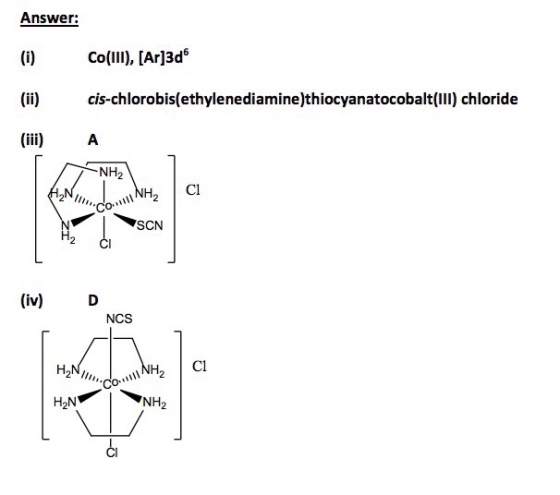
 Compare
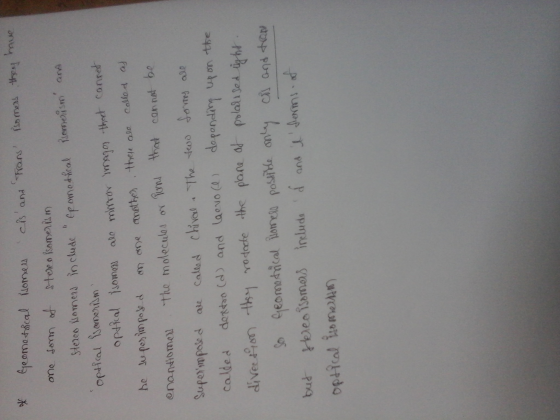
the answers of the first questions iv) and the second question, why
they give the different answer? I'm really confused because I think
stereoisomers includes geometric isomers and optical isomers,
therefore for both questions I think they all have two answers
(both cis and trans)
Compare
the answers of the first questions iv) and the second question, why
they give the different answer? I'm really confused because I think
stereoisomers includes geometric isomers and optical isomers,
therefore for both questions I think they all have two answers
(both cis and trans)Homework Answers
Add Answer to:
Compare
the answers of the first questions iv) and the second question, why
they give the...
Part A Which of the following pairs of coordination compounds or complex ions are examples of...
 Part A Which of the following pairs of coordination compounds or complex ions are examples of ionization isomers? [Fe(NH3)2(H20)4]Cl2 and [Fe(NH3)4(H20)2Cl2 [Cu(CO)gBr]CI and [Cu(CO), CIJBr [MnCl3Br]2- and [MnCIBr312- [Fe(NH3)2(H20)4]C12 and [Fe(NH3)2(H20)4]Br2 [Fe(CO)NO12+ and [Fe(CO) ONO]2+ Submit Previous Answers Request Answer Part A Identify the isomers that have ligands that coordinate to a metal with different donor atoms. stereoisomers cis-trans isomers linkage isomers O coordination isomers O optical isomers Submit Request Answer Which of the following is a type of constitutional...
Hi, These two questions have come up in my organic chemistry course but I'm not sure how to do them. I also have an extra question based from the first cycloalkene question; when is it/is it not a...
 Hi,
These two questions have come up in my organic chemistry course
but I'm not sure how to do them.
I also have an extra question based from the first cycloalkene
question; when is it/is it not applicable to define cis/trans
isomers? And how do you define them based on the wedges and
dashes?
Any help will be greatly appreciated,
Thank you
Give the correct IUPAC name for the following cycloalkene in the space provided. Your response must be exact;...
Hi,
These two questions have come up in my organic chemistry course
but I'm not sure how to do them.
I also have an extra question based from the first cycloalkene
question; when is it/is it not applicable to define cis/trans
isomers? And how do you define them based on the wedges and
dashes?
Any help will be greatly appreciated,
Thank you
Give the correct IUPAC name for the following cycloalkene in the space provided. Your response must be exact;...
Note: (Explain your answers and measure that you answer all small questions from part A to...
 Note: (Explain your
answers and measure that
you answer all small questions
from part A to part C below. Sorry for long
questions, but I give thanks to anyone who can help me)
A. Which complex ion is most likely to absorb light in the red region of the visible spectrum? [Cuci41 B. Which of the following compounds would most likely be yellow? [Cu(H20)4 isomer of diamminedichloroplatinum ion [Cu(CN)41 C. The following is a picture of the Cis a. b....
Note: (Explain your
answers and measure that
you answer all small questions
from part A to part C below. Sorry for long
questions, but I give thanks to anyone who can help me)
A. Which complex ion is most likely to absorb light in the red region of the visible spectrum? [Cuci41 B. Which of the following compounds would most likely be yellow? [Cu(H20)4 isomer of diamminedichloroplatinum ion [Cu(CN)41 C. The following is a picture of the Cis a. b....
the answers i circled are incorrect. can you give me all the correct answers and explain...
 the answers i circled are incorrect. can you give me all the
correct answers and explain why?
2) Which of the statements below correctly describes an achiral molecule? A The molecule has a nonsuperimposable mirror image. cule exhibits optical activity when it interacts with plane-polarized light. C) The molecule has an enantiomer. D) The molecule might be a meso form. E) None of the above 3) Predict the specific rotation of the compound shown. CH нс 4 A) It is...
the answers i circled are incorrect. can you give me all the
correct answers and explain why?
2) Which of the statements below correctly describes an achiral molecule? A The molecule has a nonsuperimposable mirror image. cule exhibits optical activity when it interacts with plane-polarized light. C) The molecule has an enantiomer. D) The molecule might be a meso form. E) None of the above 3) Predict the specific rotation of the compound shown. CH нс 4 A) It is...
the answers i circled are incorrect. can you give me the correct answers and explain why?...
 the answers i circled are incorrect. can you give me the
correct answers and explain why?
postural de Pero ss and so Lalash, an walach asymmetric carbon as Ror S. (3) label the How many asymmetric carbon atoms are present in the following compound A) B) 1 D) 3 E) 4 2) Which of the statements below correctly describes an achiral molecule? The molecule has a nonsuperimposable mirror image. B) The molecule exhibits optical activity when it interacts with plane-polarized...
the answers i circled are incorrect. can you give me the
correct answers and explain why?
postural de Pero ss and so Lalash, an walach asymmetric carbon as Ror S. (3) label the How many asymmetric carbon atoms are present in the following compound A) B) 1 D) 3 E) 4 2) Which of the statements below correctly describes an achiral molecule? The molecule has a nonsuperimposable mirror image. B) The molecule exhibits optical activity when it interacts with plane-polarized...
all of them please QUESTION 1 1 points Save Answer Which of the following can have...
 all of them please
QUESTION 1 1 points Save Answer Which of the following can have cis/trans isomers? Draw their isomers. CH3CH2CH=CH2 (CH3CH2)2CCHCH3 CH3CH2CH=CHCH3 CH2=CH2 QUESTION 2 1 points Save Answer Name the following compounds, with cis/trans nomenclature. trans-4-methyl-2-hexene trans-4-thyl-2-pentane O cis-4-thyl-2-pentane O cis-4-methyl-2-hexene QUESTION 3 1 points Save Answer Name the following compounds, with cis/trans nomenclature Br Br Otrsans-2,5-dibromo-3-hexene trans-1,4-dibromo-2-butane O cis-1,4-dibromo-2-butane cis 2,5-dibromo-3-hexene Click Save and Submit to see and submit Click Save All Answers to save all...
all of them please
QUESTION 1 1 points Save Answer Which of the following can have cis/trans isomers? Draw their isomers. CH3CH2CH=CH2 (CH3CH2)2CCHCH3 CH3CH2CH=CHCH3 CH2=CH2 QUESTION 2 1 points Save Answer Name the following compounds, with cis/trans nomenclature. trans-4-methyl-2-hexene trans-4-thyl-2-pentane O cis-4-thyl-2-pentane O cis-4-methyl-2-hexene QUESTION 3 1 points Save Answer Name the following compounds, with cis/trans nomenclature Br Br Otrsans-2,5-dibromo-3-hexene trans-1,4-dibromo-2-butane O cis-1,4-dibromo-2-butane cis 2,5-dibromo-3-hexene Click Save and Submit to see and submit Click Save All Answers to save all...
give explanations pls Chuper Cыper 5 MULTIPLE CHOICE QUESTIONS Part 5: Stereochemistry 5. Pairs of enantiomers...
 give explanations pls
Chuper Cыper 5 MULTIPLE CHOICE QUESTIONS Part 5: Stereochemistry 5. Pairs of enantiomers are: Answers on page 24-26 Topic: Identifications a nd Comparisons нс Снснснь н,с сHсH,сн, CI снснсн I. Which of the following is the enantiomer of the following substan ce? п Br CH сн ҫH.сH,сн, HC C сна H I II III снснсн, A) IV II and III, IV It does not have a non-superposable enantiomer Both II and III E C) II, IV D)...
give explanations pls
Chuper Cыper 5 MULTIPLE CHOICE QUESTIONS Part 5: Stereochemistry 5. Pairs of enantiomers are: Answers on page 24-26 Topic: Identifications a nd Comparisons нс Снснснь н,с сHсH,сн, CI снснсн I. Which of the following is the enantiomer of the following substan ce? п Br CH сн ҫH.сH,сн, HC C сна H I II III снснсн, A) IV II and III, IV It does not have a non-superposable enantiomer Both II and III E C) II, IV D)...
3. Cyclic compounds The presence of the ring in all but very large ring cyclic molecules...
 3. Cyclic compounds The presence of the ring in all but very large ring cyclic molecules prevents full rotation of the ring atoms. For this reason, stereoisomerism may also occur in cyclic molecules. a) Prepare a model of cyclohexane, C6H12. Draw the condensed formula. b) Build a model of methylcyclohexane (C7H14) by replacing one of the hydrogens of cyclohexane with a methyl group. Draw the skeletal formula for methylcyclohexane. 2 c) How many different isomers exist for methylcyclohexane (CyH34)? d)...
Please complete for Tuesday, we will go through the questions and mark them in class. pg 156 - 4.23,...
 Please complete for Tuesday, we will go through the questions and mark them in class. pg 156 - 4.23, 4.24, 4.26 pg 170 - 4.29, 4.31, pg 171-4.36 pg 175 - 4.59 pg 176- 4.74, 4.75, 4.80 pg 177-4.81, 4.82 pg 188- 5.1, 5.4, 5.5, 5.6, 5.11 - Using Table 5.1 pg 198-5.22, 5.25 pg 203 - 5.29 pg 206 - 5.37 pg 209 - 5.39 pg 2.14 5.61 pg 235-6.11, 6.14, 6.16 156 CHAPTER 4 Introduction to Organic Compounds...
Postlab Questions Answer the following questions on a separate sheet or in your lab notebook. Make...
 Postlab Questions Answer the following questions on a separate sheet or in your lab notebook. Make sure that the copy page is readable! D) Calculate the percentage yield for both reactions. Show all calculations. 2) What is the color of the reaction at the beginning of reaction? What causes the color? 3) Why do you dissolve maleic acid in diethyl ether and fumaric acid in water? 4) Give the complete reaction mechanisms for the formation of meso and racemic 2,3-...
 Part A Which of the following pairs of coordination compounds or complex ions are examples of ionization isomers? [Fe(NH3)2(H20)4]Cl2 and [Fe(NH3)4(H20)2Cl2 [Cu(CO)gBr]CI and [Cu(CO), CIJBr [MnCl3Br]2- and [MnCIBr312- [Fe(NH3)2(H20)4]C12 and [Fe(NH3)2(H20)4]Br2 [Fe(CO)NO12+ and [Fe(CO) ONO]2+ Submit Previous Answers Request Answer Part A Identify the isomers that have ligands that coordinate to a metal with different donor atoms. stereoisomers cis-trans isomers linkage isomers O coordination isomers O optical isomers Submit Request Answer Which of the following is a type of constitutional...
 Hi,
These two questions have come up in my organic chemistry course
but I'm not sure how to do them.
I also have an extra question based from the first cycloalkene
question; when is it/is it not applicable to define cis/trans
isomers? And how do you define them based on the wedges and
dashes?
Any help will be greatly appreciated,
Thank you
Give the correct IUPAC name for the following cycloalkene in the space provided. Your response must be exact;...
Hi,
These two questions have come up in my organic chemistry course
but I'm not sure how to do them.
I also have an extra question based from the first cycloalkene
question; when is it/is it not applicable to define cis/trans
isomers? And how do you define them based on the wedges and
dashes?
Any help will be greatly appreciated,
Thank you
Give the correct IUPAC name for the following cycloalkene in the space provided. Your response must be exact;...
 Note: (Explain your
answers and measure that
you answer all small questions
from part A to part C below. Sorry for long
questions, but I give thanks to anyone who can help me)
A. Which complex ion is most likely to absorb light in the red region of the visible spectrum? [Cuci41 B. Which of the following compounds would most likely be yellow? [Cu(H20)4 isomer of diamminedichloroplatinum ion [Cu(CN)41 C. The following is a picture of the Cis a. b....
Note: (Explain your
answers and measure that
you answer all small questions
from part A to part C below. Sorry for long
questions, but I give thanks to anyone who can help me)
A. Which complex ion is most likely to absorb light in the red region of the visible spectrum? [Cuci41 B. Which of the following compounds would most likely be yellow? [Cu(H20)4 isomer of diamminedichloroplatinum ion [Cu(CN)41 C. The following is a picture of the Cis a. b....
 the answers i circled are incorrect. can you give me all the
correct answers and explain why?
2) Which of the statements below correctly describes an achiral molecule? A The molecule has a nonsuperimposable mirror image. cule exhibits optical activity when it interacts with plane-polarized light. C) The molecule has an enantiomer. D) The molecule might be a meso form. E) None of the above 3) Predict the specific rotation of the compound shown. CH нс 4 A) It is...
the answers i circled are incorrect. can you give me all the
correct answers and explain why?
2) Which of the statements below correctly describes an achiral molecule? A The molecule has a nonsuperimposable mirror image. cule exhibits optical activity when it interacts with plane-polarized light. C) The molecule has an enantiomer. D) The molecule might be a meso form. E) None of the above 3) Predict the specific rotation of the compound shown. CH нс 4 A) It is...
 the answers i circled are incorrect. can you give me the
correct answers and explain why?
postural de Pero ss and so Lalash, an walach asymmetric carbon as Ror S. (3) label the How many asymmetric carbon atoms are present in the following compound A) B) 1 D) 3 E) 4 2) Which of the statements below correctly describes an achiral molecule? The molecule has a nonsuperimposable mirror image. B) The molecule exhibits optical activity when it interacts with plane-polarized...
the answers i circled are incorrect. can you give me the
correct answers and explain why?
postural de Pero ss and so Lalash, an walach asymmetric carbon as Ror S. (3) label the How many asymmetric carbon atoms are present in the following compound A) B) 1 D) 3 E) 4 2) Which of the statements below correctly describes an achiral molecule? The molecule has a nonsuperimposable mirror image. B) The molecule exhibits optical activity when it interacts with plane-polarized...
 all of them please
QUESTION 1 1 points Save Answer Which of the following can have cis/trans isomers? Draw their isomers. CH3CH2CH=CH2 (CH3CH2)2CCHCH3 CH3CH2CH=CHCH3 CH2=CH2 QUESTION 2 1 points Save Answer Name the following compounds, with cis/trans nomenclature. trans-4-methyl-2-hexene trans-4-thyl-2-pentane O cis-4-thyl-2-pentane O cis-4-methyl-2-hexene QUESTION 3 1 points Save Answer Name the following compounds, with cis/trans nomenclature Br Br Otrsans-2,5-dibromo-3-hexene trans-1,4-dibromo-2-butane O cis-1,4-dibromo-2-butane cis 2,5-dibromo-3-hexene Click Save and Submit to see and submit Click Save All Answers to save all...
all of them please
QUESTION 1 1 points Save Answer Which of the following can have cis/trans isomers? Draw their isomers. CH3CH2CH=CH2 (CH3CH2)2CCHCH3 CH3CH2CH=CHCH3 CH2=CH2 QUESTION 2 1 points Save Answer Name the following compounds, with cis/trans nomenclature. trans-4-methyl-2-hexene trans-4-thyl-2-pentane O cis-4-thyl-2-pentane O cis-4-methyl-2-hexene QUESTION 3 1 points Save Answer Name the following compounds, with cis/trans nomenclature Br Br Otrsans-2,5-dibromo-3-hexene trans-1,4-dibromo-2-butane O cis-1,4-dibromo-2-butane cis 2,5-dibromo-3-hexene Click Save and Submit to see and submit Click Save All Answers to save all...
 give explanations pls
Chuper Cыper 5 MULTIPLE CHOICE QUESTIONS Part 5: Stereochemistry 5. Pairs of enantiomers are: Answers on page 24-26 Topic: Identifications a nd Comparisons нс Снснснь н,с сHсH,сн, CI снснсн I. Which of the following is the enantiomer of the following substan ce? п Br CH сн ҫH.сH,сн, HC C сна H I II III снснсн, A) IV II and III, IV It does not have a non-superposable enantiomer Both II and III E C) II, IV D)...
give explanations pls
Chuper Cыper 5 MULTIPLE CHOICE QUESTIONS Part 5: Stereochemistry 5. Pairs of enantiomers are: Answers on page 24-26 Topic: Identifications a nd Comparisons нс Снснснь н,с сHсH,сн, CI снснсн I. Which of the following is the enantiomer of the following substan ce? п Br CH сн ҫH.сH,сн, HC C сна H I II III снснсн, A) IV II and III, IV It does not have a non-superposable enantiomer Both II and III E C) II, IV D)...
 3. Cyclic compounds The presence of the ring in all but very large ring cyclic molecules prevents full rotation of the ring atoms. For this reason, stereoisomerism may also occur in cyclic molecules. a) Prepare a model of cyclohexane, C6H12. Draw the condensed formula. b) Build a model of methylcyclohexane (C7H14) by replacing one of the hydrogens of cyclohexane with a methyl group. Draw the skeletal formula for methylcyclohexane. 2 c) How many different isomers exist for methylcyclohexane (CyH34)? d)...
 Please complete for Tuesday, we will go through the questions and mark them in class. pg 156 - 4.23, 4.24, 4.26 pg 170 - 4.29, 4.31, pg 171-4.36 pg 175 - 4.59 pg 176- 4.74, 4.75, 4.80 pg 177-4.81, 4.82 pg 188- 5.1, 5.4, 5.5, 5.6, 5.11 - Using Table 5.1 pg 198-5.22, 5.25 pg 203 - 5.29 pg 206 - 5.37 pg 209 - 5.39 pg 2.14 5.61 pg 235-6.11, 6.14, 6.16 156 CHAPTER 4 Introduction to Organic Compounds...
 Postlab Questions Answer the following questions on a separate sheet or in your lab notebook. Make sure that the copy page is readable! D) Calculate the percentage yield for both reactions. Show all calculations. 2) What is the color of the reaction at the beginning of reaction? What causes the color? 3) Why do you dissolve maleic acid in diethyl ether and fumaric acid in water? 4) Give the complete reaction mechanisms for the formation of meso and racemic 2,3-...
Most questions answered within 3 hours.
-
Where is the error in this code sequence?
String s1 = "Hello";
String s2 = "ello";...
asked 11 months ago -
Financial data for Joel de Paris, Inc., for last year
follow:
Joel de Paris, Inc.
Balance...
asked 11 months ago -
Consider this reaction:
Al2(SO4)3 (aq)+ BaCl3
(aq) Al2Cl6 (aq)- +
3BaSO4(s) . What is the...
asked 11 months ago -
Suppose that Savneet is considering increasing her
recent random sample from 20 car rentals to 40...
asked 11 months ago -
Trucks arrive at an unloading terminal at an average rate of 120
per hour.
Trucks arrive...
asked 11 months ago -
Why are methanol and ethanol completely soluble in water while
octanol is not very little soluble....
asked 11 months ago -
A facilities manager at a university reads in a research report
that the mean amount of...
asked 11 months ago -
When the CuSO4 is rehydrated by adding water to the anhydrous
compound, is this an endothermic...
asked 11 months ago -
A ray of sunlight is passing from diamond into crown glass; the
angle of incidence is...
asked 11 months ago -
A block of mass 0.249 kg is placed on top of a light, vertical
spring of...
asked 11 months ago -
how do the kidneys compensate in the presences of acidosis
a) trigger hyperventilate
b) reserve acid...
asked 11 months ago -
Question 501 pts
The rental rate of capital to the firm increases. Which of the
following...
asked 11 months ago