![(ii) [6 marks] Assume that we have an empty stack S and an empty queue Q. Given a series of stack operations on S as below: P](http://img.homeworklib.com/questions/9e263e90-cd86-11ea-ab79-eda208678365.png?x-oss-process=image/resize,w_560)
Homework Answers
 We know that in a Stack when we insert or push elements it follows
last-in-first-out ( LIFO ) rule, that is, last inserted element
will be the first to be deleted or popped. This is because the
Stack pointer, top of stack ( TOS ), always points to the new
element being inserted.
We know that in a Stack when we insert or push elements it follows
last-in-first-out ( LIFO ) rule, that is, last inserted element
will be the first to be deleted or popped. This is because the
Stack pointer, top of stack ( TOS ), always points to the new
element being inserted.
So, after push(S,10), push(S,7) and push(S,23) where S is the stack and the other parameter is the element to be inserted, our Stack S would look like
| 23 |
| 7 |
| 10 |
And TOS will point to 23.
then first pop(S) will give 23. And stack will become, for us,
| 7 |
| 10 |
And TOS points to 7. Then push(S,9) is performed. Stack becomes
| 9 |
| 7 |
| 10 |
And TOS points to 9.
Then Second pop(S) will give 9. TOS will then point to 7 again.
And third pop(S) will give 7. The stack at the end will become
| 10 |
We know that in a queue when we insert or enqueue elements it
follows first-in-first-out ( FIFO ) rule, that is, first inserted
element will be the first to be deleted or dequeued. This is
because the queue maintains two pointers,
front pointer (f) : points to the first element to be deleted and,
rear pointer(r) : points where the next element will be enqueued,
So, after enqueue(Q,10) , enqueue(Q,20) and enqueue(Q,33) our queue Q will look like :
| 10 | 20 | 33 |
f points to 10, and r points to 33.
first dequeue(Q) will give 10. And queue will be
| 20 | 33 |
where f will now point to 20 and r will point to 33.
After enqueue(Q,55) queue will become
| 20 | 33 | 55 |
where f will point to 20 and r will now point to 55.
Then second dequeue(Q) will give 20. And queue will be
| 33 | 55 |
where f will now point to 33 and r will point to 55.
Then third dequeue(Q) will give 33. And queue will be
| 55 |
where f will also point to 55 along with r .
BInary Search Tree is based on the fact that the left child of a
node is always less than the node and the right child is always
greater than the node, that is, the left subtree of the root will
consist of nodes lesser than the root and right subtree will
consist of nodes greater than the root.

Here, we can see that first element we inserted was 25, which becomes our root node as the tree was initially empty.
Second we insert 20, which goes to the left of root as it's less than 25.
Then we add 50 which is greater than root 25 and thus, it goes to the right of root node.
Then we add 15, which being less than 25 goes to left subtree, and then we check if 15 is less than or greater than 20, as it's less than 20 it becomes left child of 20.
Then we are adding 60 which is greater than root so, it goes to the right subtree. Then we compare it with 50 and as 60 is greater it becomes the right child of 50.
Then we add 30, which is greater than 25, it goes to right subtree, and then we compare it with 50 30 being less than 50, becomes the left child of 50.
At last we add 18 which being less than 25 goes to the left subtree and then we compare it with 20, which is greater than 18 so 18 should have been in the left of 20, but as 15 is already there so it is again compared with 15 and 18 is greater than 15 so, 18 becomes the right child of 15.
And thus. BST is completed.
Add Answer to:
(ii) [6 marks] Assume that we have an empty stack S and an empty queue Q....
Suppose that we start with an empty stack and execute the operations: push(5) push(12) popo) push(3)...
 Suppose that we start with an empty stack and execute the operations: push(5) push(12) popo) push(3) push(7) popo) What values are returned by the two pop() operations above, in order? First pop(): Second pop(): Suppose that we start with an empty stack and execute the operations: enqueue(5) enqueue(12) dequeue enqueue(3) enqueue(7) dequeuel) What values are returned by the two pop() operations above, in order? First dequeue(): Second dequeue():
A. Starting with an initially empty stack, after 6 push operations, 3 pop operations, and 2...
A. Starting with an initially empty stack, after 6 push operations, 3 pop operations, and 2 push operations, the number of elements in the stack would be: B. Starting with an initially empty queue, after 5 enqueue operations, 4 dequeue operations, and 6 enqueue operations, the number of elements in the queue would be:
I am to implement a simple simulation that supports a stack and a queue of items being either enqueued and dequeued (ont...
I am to implement a simple simulation that supports a stack and a queue of items being either enqueued and dequeued (onto the queue) or pushed and popped (onto the stack). I are required to use STL data structures to implement and create the stack and queue for my program. ----- testfile1.tst -------- enqueue 5 enqueue 7 push blooper push rookie dequeue push demerits pop enqueue 3 enqueue 8 push showplace enqueue 9 dequeue pop dequeue push palmetto push zebra...
help finish Queue, don't think I have the right thing. # 1. After studying the Stack...
 help finish Queue, don't think
I have the right thing.
# 1. After studying the Stack class and testStack() functions in stack.py # complete the Queue class below (and test it with the testQueue function) # # 2. Afer studying and testing the Circle class in circle.py, # complete the Rectangle class below (and test it with the testRectangle function) # # # 3. SUBMIT THIS ONE FILE, with your updates, TO ICON. # # # NOTE: you may certainly...
help finish Queue, don't think
I have the right thing.
# 1. After studying the Stack class and testStack() functions in stack.py # complete the Queue class below (and test it with the testQueue function) # # 2. Afer studying and testing the Circle class in circle.py, # complete the Rectangle class below (and test it with the testRectangle function) # # # 3. SUBMIT THIS ONE FILE, with your updates, TO ICON. # # # NOTE: you may certainly...
Question1 ) The STL provides similiar classes called stack and queue, both of which gave functions...
Question1 ) The STL provides similiar classes called stack and queue, both of which gave functions called push and pop. Answer the following questions: 1.1) Does the push perform a different action in the stack class then in the queue class? Explain the answer. 1.2) Does the pop perform a different action in the stack class then in the queue class? Explain the answer. Question 2) 2.1) Suppose you are tasked with implementing a reverse queue in which elements are...
e. public class Queue { // Uses the correct Stack class from ME2 Ex 19 private Stack mStack; public Queue() { setStack(new Stack()); } public Queue enqueue(E pData) { getStack().push(pData); return t...
 e. public class Queue { // Uses the correct Stack class from ME2
Ex 19 private Stack mStack; public Queue() { setStack(new Stack());
} public Queue enqueue(E pData) { getStack().push(pData); return
this; } public E dequeue() { return getStack().pop(); } public E
peek() { return getStack.peek(); } private Stack getStack() {
return mStack; } private void setStack(Stack pStack) { mStack =
pStack; } }
f. public class Queue extends Stack { // Uses the correct Stack
class from ME2 Ex...
e. public class Queue { // Uses the correct Stack class from ME2
Ex 19 private Stack mStack; public Queue() { setStack(new Stack());
} public Queue enqueue(E pData) { getStack().push(pData); return
this; } public E dequeue() { return getStack().pop(); } public E
peek() { return getStack.peek(); } private Stack getStack() {
return mStack; } private void setStack(Stack pStack) { mStack =
pStack; } }
f. public class Queue extends Stack { // Uses the correct Stack
class from ME2 Ex...
In C++ Implement a queue data structure using two stacks. Remember a queue has enqueue and...
In C++ Implement a queue data structure using two stacks. Remember a queue has enqueue and dequeue functions. You could use either the array or linked list implementation for stacks and queues. Source for stack array: --------------------------------------------------- #include<iostream> #define SIZE 100 #define NO_ELEMENT -999999 using namespace std; class Stack { int arr[SIZE]; // array to store Stack elements int top; public: Stack() { top = -1; } void push(int); // push an element into Stack int pop(); // pop the...
Suppose we have an array-based queue (circular buffer) of size 6: int data[6]; int front =...
Suppose we have an array-based queue (circular buffer) of size 6: int data[6]; int front = 0, back = 0; void enqueue(int x) { data[back] = x; back = (back + 1) % 6; } void dequeue() { front = (front + 1) % 6; } and we perform the following series of queue operations: enqueue(1); dequeue(); enqueue(2); dequeue(); enqueue(7); enqueue(3); enqueue(5); dequeue(); dequeue(); enqueue(4); enqueue(6); Write the state of the queue array after each operation, and at the end,...
Conceptual Questions Suppose you are given a (strange) computer that can only perform the followi...
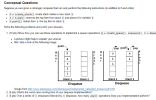 Python coding conceptual questions -
Conceptual Questions Suppose you are given a (strange) computer that can only perform the following instructions (in addition to if and while): S-create_stack() create stack makes a new stack s iS.pop() removes the top item from stack s and places it in variable i .S.push (i) makes item i the top item in stack s Solve the following problems and justify your answers: 1. (10 pts) Show how you can use these operations to implement...
Python coding conceptual questions -
Conceptual Questions Suppose you are given a (strange) computer that can only perform the following instructions (in addition to if and while): S-create_stack() create stack makes a new stack s iS.pop() removes the top item from stack s and places it in variable i .S.push (i) makes item i the top item in stack s Solve the following problems and justify your answers: 1. (10 pts) Show how you can use these operations to implement...
HI USING C++ CAN YOU PLEASE PROGRAM THIS ASSIGNMENT AND ADD COMMENTS: stackARRAY: #include<iostream> #define SIZE...
 HI USING C++ CAN YOU PLEASE PROGRAM THIS ASSIGNMENT AND ADD
COMMENTS:
stackARRAY:
#include<iostream>
#define SIZE 100
#define NO_ELEMENT -999999
using namespace std;
class Stack {
int arr[SIZE]; // array to store Stack elements
int top;
public:
Stack() {
top = -1;
}
void push(int); // push an element into Stack
int pop(); // pop the top element from Stack
int topElement(); // get the top element
void display(); // display Stack elements from top to bottom
};
void Stack...
HI USING C++ CAN YOU PLEASE PROGRAM THIS ASSIGNMENT AND ADD
COMMENTS:
stackARRAY:
#include<iostream>
#define SIZE 100
#define NO_ELEMENT -999999
using namespace std;
class Stack {
int arr[SIZE]; // array to store Stack elements
int top;
public:
Stack() {
top = -1;
}
void push(int); // push an element into Stack
int pop(); // pop the top element from Stack
int topElement(); // get the top element
void display(); // display Stack elements from top to bottom
};
void Stack...
 Suppose that we start with an empty stack and execute the operations: push(5) push(12) popo) push(3) push(7) popo) What values are returned by the two pop() operations above, in order? First pop(): Second pop(): Suppose that we start with an empty stack and execute the operations: enqueue(5) enqueue(12) dequeue enqueue(3) enqueue(7) dequeuel) What values are returned by the two pop() operations above, in order? First dequeue(): Second dequeue():
 help finish Queue, don't think
I have the right thing.
# 1. After studying the Stack class and testStack() functions in stack.py # complete the Queue class below (and test it with the testQueue function) # # 2. Afer studying and testing the Circle class in circle.py, # complete the Rectangle class below (and test it with the testRectangle function) # # # 3. SUBMIT THIS ONE FILE, with your updates, TO ICON. # # # NOTE: you may certainly...
help finish Queue, don't think
I have the right thing.
# 1. After studying the Stack class and testStack() functions in stack.py # complete the Queue class below (and test it with the testQueue function) # # 2. Afer studying and testing the Circle class in circle.py, # complete the Rectangle class below (and test it with the testRectangle function) # # # 3. SUBMIT THIS ONE FILE, with your updates, TO ICON. # # # NOTE: you may certainly...
 e. public class Queue { // Uses the correct Stack class from ME2
Ex 19 private Stack mStack; public Queue() { setStack(new Stack());
} public Queue enqueue(E pData) { getStack().push(pData); return
this; } public E dequeue() { return getStack().pop(); } public E
peek() { return getStack.peek(); } private Stack getStack() {
return mStack; } private void setStack(Stack pStack) { mStack =
pStack; } }
f. public class Queue extends Stack { // Uses the correct Stack
class from ME2 Ex...
e. public class Queue { // Uses the correct Stack class from ME2
Ex 19 private Stack mStack; public Queue() { setStack(new Stack());
} public Queue enqueue(E pData) { getStack().push(pData); return
this; } public E dequeue() { return getStack().pop(); } public E
peek() { return getStack.peek(); } private Stack getStack() {
return mStack; } private void setStack(Stack pStack) { mStack =
pStack; } }
f. public class Queue extends Stack { // Uses the correct Stack
class from ME2 Ex...
 Python coding conceptual questions -
Conceptual Questions Suppose you are given a (strange) computer that can only perform the following instructions (in addition to if and while): S-create_stack() create stack makes a new stack s iS.pop() removes the top item from stack s and places it in variable i .S.push (i) makes item i the top item in stack s Solve the following problems and justify your answers: 1. (10 pts) Show how you can use these operations to implement...
Python coding conceptual questions -
Conceptual Questions Suppose you are given a (strange) computer that can only perform the following instructions (in addition to if and while): S-create_stack() create stack makes a new stack s iS.pop() removes the top item from stack s and places it in variable i .S.push (i) makes item i the top item in stack s Solve the following problems and justify your answers: 1. (10 pts) Show how you can use these operations to implement...
 HI USING C++ CAN YOU PLEASE PROGRAM THIS ASSIGNMENT AND ADD
COMMENTS:
stackARRAY:
#include<iostream>
#define SIZE 100
#define NO_ELEMENT -999999
using namespace std;
class Stack {
int arr[SIZE]; // array to store Stack elements
int top;
public:
Stack() {
top = -1;
}
void push(int); // push an element into Stack
int pop(); // pop the top element from Stack
int topElement(); // get the top element
void display(); // display Stack elements from top to bottom
};
void Stack...
HI USING C++ CAN YOU PLEASE PROGRAM THIS ASSIGNMENT AND ADD
COMMENTS:
stackARRAY:
#include<iostream>
#define SIZE 100
#define NO_ELEMENT -999999
using namespace std;
class Stack {
int arr[SIZE]; // array to store Stack elements
int top;
public:
Stack() {
top = -1;
}
void push(int); // push an element into Stack
int pop(); // pop the top element from Stack
int topElement(); // get the top element
void display(); // display Stack elements from top to bottom
};
void Stack...
Most questions answered within 3 hours.
-
Where is the error in this code sequence?
String s1 = "Hello";
String s2 = "ello";...
asked 11 months ago -
Financial data for Joel de Paris, Inc., for last year
follow:
Joel de Paris, Inc.
Balance...
asked 11 months ago -
Consider this reaction:
Al2(SO4)3 (aq)+ BaCl3
(aq) Al2Cl6 (aq)- +
3BaSO4(s) . What is the...
asked 11 months ago -
Suppose that Savneet is considering increasing her
recent random sample from 20 car rentals to 40...
asked 11 months ago -
Trucks arrive at an unloading terminal at an average rate of 120
per hour.
Trucks arrive...
asked 11 months ago -
Why are methanol and ethanol completely soluble in water while
octanol is not very little soluble....
asked 11 months ago -
A facilities manager at a university reads in a research report
that the mean amount of...
asked 11 months ago -
When the CuSO4 is rehydrated by adding water to the anhydrous
compound, is this an endothermic...
asked 11 months ago -
A ray of sunlight is passing from diamond into crown glass; the
angle of incidence is...
asked 11 months ago -
A block of mass 0.249 kg is placed on top of a light, vertical
spring of...
asked 11 months ago -
how do the kidneys compensate in the presences of acidosis
a) trigger hyperventilate
b) reserve acid...
asked 11 months ago -
Question 501 pts
The rental rate of capital to the firm increases. Which of the
following...
asked 11 months ago