
Homework Answers
Answer;
Correct answer: A] trigger strategies
Explanation: Trigger strategies is a type of strategy used in a repeated game.It is employed in a repeated non-cooperative game. A trigger strategy essentially threatens other players with a worse punishment, Since a single defect by the opponent triggers defection forever, grim trigger is the most strictly unforgiving of strategies in an iterated game.
Add Answer to:
9. Which of these is a type of strategy used in a repeated game? O trigger...
In an infinitely repeated prisoner’s dilemma game the following strategy will solve the game if both...
In an infinitely repeated prisoner’s dilemma game the following strategy will solve the game if both players employ it Group of answer choices 1) A Dead Trigger Strategy 2) An Optimal Trigger Strategy 3) A Tit-for-Tat Strategy 4) All of the above 5) None of the above
If a Prisoner's Dilemma game is repeated daily, such that two rival stores choose a price...
If a Prisoner's Dilemma game is repeated daily, such that two rival stores choose a price simultaneously each morning for an extended number of days, which outcome can happen? The Nash equilibrium will continue to be played only until one firm engages a trigger strategy against the other. There will more likely be cooperation to achieve an outcome different from the Nash equilibrium that is better for both firms. The Nash equilibrium will continue to be played throughout the game....
3. (Level A) Suppose the following Prisoner's Dilemma is repeated infinitely: 112 C D C 2,...
 3. (Level A) Suppose the following Prisoner's Dilemma is repeated infinitely: 112 C D C 2, 2 0, 3 D 3,0 1, 1 Let uj be the payoff to player i in period t. Player i (i-1,2) maximizes her average discounted sum of payoffs, given by ( where o is the common discount factor of both players Suppose the players try to sustain (C, C) in each period by the Grim Trigger strategy. That is, each player plays the following...
3. (Level A) Suppose the following Prisoner's Dilemma is repeated infinitely: C 2, 2 0, 3...
 3. (Level A) Suppose the following Prisoner's Dilemma is repeated infinitely: C 2, 2 0, 3 D 3,0 1, Let uj be the payoff to player i in period t. Player i (i 1,2) maximizes her average discounted sum of payoffs, given by ( o0 (1-6 X6u where o is the common discount factor of both players Suppose the players try to sustain (C, C) in each period by the Grim Trigger strategy. That is, each player plays the following...
3. (Level A) Suppose the following Prisoner's Dilemma is repeated infinitely 112 C D C 2,...
 3. (Level A) Suppose the following Prisoner's Dilemma is repeated infinitely 112 C D C 2, 2 0, 3 D 3, 0|1, 1 Let uļ be the payoff to player i in period t. Player i (i = 1, 2) maximizes her. average discounted sum of payoffs, given by ( where δ is the common discount factor of both players Suppose the players try to sustain (C, C) in each period by the Grim Trigger strategy. That is, each player...
Consider the following game in strategic form: X, 9 12, 8 9, 10 11, y To...
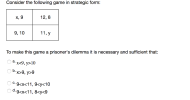 Consider the following game in strategic form: X, 9 12, 8 9, 10 11, y To make this game a prisoner's dilemma it is necessary and sufficient that: O c.
QUESTION 4 Which of the following is NOT true concerning the tit-for-tat strategy and how it...
 QUESTION 4 Which of the following is NOT true concerning the tit-for-tat strategy and how it fared in Robert Axelrod's 200-round prisoner's dilemma tournament? O a. The tit-for-tat strategy is not exploitable b. The tit for at strategy was the best strategy overall against a diversity of other strategies. Oc. The tit for at strategy is easy to read d. The tit-for-tat strategy won each round when pitted against any other strategy
• What is the Nash equilibrium in this game? A) Alistair increases its advertising budget, but...
 • What is the Nash equilibrium in this game?
A) Alistair increases its advertising budget, but Baine does
not.
B) Baine increases its advertising budget, but Alistair does
not.
C) Both Alistair and Baine increase their advertising
budgets.
D) There is no Nash equilibrium.
• How are the firms in this advertising game caught in a
prisoner's dilemma?
A) They are not in a prisoner's dilemma because there is one
clear strategy for each
B) They would be more profitable...
• What is the Nash equilibrium in this game?
A) Alistair increases its advertising budget, but Baine does
not.
B) Baine increases its advertising budget, but Alistair does
not.
C) Both Alistair and Baine increase their advertising
budgets.
D) There is no Nash equilibrium.
• How are the firms in this advertising game caught in a
prisoner's dilemma?
A) They are not in a prisoner's dilemma because there is one
clear strategy for each
B) They would be more profitable...
Game theory question (undergraduate economics) Consider the infinitely repeated game with the following stage game matrix:...
 Game theory question (undergraduate economics)
Consider the infinitely repeated game with the following stage game matrix: C D C 3,2 0,1 D 7,0 2,1 Under what conditions is there a subgame perfect equilibrium in which the players alternate between (C,C) and (C,D), starting with (C,C) in the first period? Under what conditions is there a subgame perfect equilibrium in which the players alternate between (C,C) and (D,D), starting with (C,C) in the first period? (Use modified trigger strategies)
Game theory question (undergraduate economics)
Consider the infinitely repeated game with the following stage game matrix: C D C 3,2 0,1 D 7,0 2,1 Under what conditions is there a subgame perfect equilibrium in which the players alternate between (C,C) and (C,D), starting with (C,C) in the first period? Under what conditions is there a subgame perfect equilibrium in which the players alternate between (C,C) and (D,D), starting with (C,C) in the first period? (Use modified trigger strategies)
1. Consider a repeated game in which the stage game in the following figure is played...
 1. Consider a repeated game in which the stage game in the following figure is played in each of two periods and there is no discounting. 1 LMR u 8,8 0,9 0.0 C 9,0 0,0 3,1 0 0.0 | 13 | 3.3 Fully describe a subgame perfect equilibrium in which the players select (U, L) in the first period.
 3. (Level A) Suppose the following Prisoner's Dilemma is repeated infinitely: 112 C D C 2, 2 0, 3 D 3,0 1, 1 Let uj be the payoff to player i in period t. Player i (i-1,2) maximizes her average discounted sum of payoffs, given by ( where o is the common discount factor of both players Suppose the players try to sustain (C, C) in each period by the Grim Trigger strategy. That is, each player plays the following...
 3. (Level A) Suppose the following Prisoner's Dilemma is repeated infinitely: C 2, 2 0, 3 D 3,0 1, Let uj be the payoff to player i in period t. Player i (i 1,2) maximizes her average discounted sum of payoffs, given by ( o0 (1-6 X6u where o is the common discount factor of both players Suppose the players try to sustain (C, C) in each period by the Grim Trigger strategy. That is, each player plays the following...
 3. (Level A) Suppose the following Prisoner's Dilemma is repeated infinitely 112 C D C 2, 2 0, 3 D 3, 0|1, 1 Let uļ be the payoff to player i in period t. Player i (i = 1, 2) maximizes her. average discounted sum of payoffs, given by ( where δ is the common discount factor of both players Suppose the players try to sustain (C, C) in each period by the Grim Trigger strategy. That is, each player...
 Consider the following game in strategic form: X, 9 12, 8 9, 10 11, y To make this game a prisoner's dilemma it is necessary and sufficient that: O c.
 QUESTION 4 Which of the following is NOT true concerning the tit-for-tat strategy and how it fared in Robert Axelrod's 200-round prisoner's dilemma tournament? O a. The tit-for-tat strategy is not exploitable b. The tit for at strategy was the best strategy overall against a diversity of other strategies. Oc. The tit for at strategy is easy to read d. The tit-for-tat strategy won each round when pitted against any other strategy
 • What is the Nash equilibrium in this game?
A) Alistair increases its advertising budget, but Baine does
not.
B) Baine increases its advertising budget, but Alistair does
not.
C) Both Alistair and Baine increase their advertising
budgets.
D) There is no Nash equilibrium.
• How are the firms in this advertising game caught in a
prisoner's dilemma?
A) They are not in a prisoner's dilemma because there is one
clear strategy for each
B) They would be more profitable...
• What is the Nash equilibrium in this game?
A) Alistair increases its advertising budget, but Baine does
not.
B) Baine increases its advertising budget, but Alistair does
not.
C) Both Alistair and Baine increase their advertising
budgets.
D) There is no Nash equilibrium.
• How are the firms in this advertising game caught in a
prisoner's dilemma?
A) They are not in a prisoner's dilemma because there is one
clear strategy for each
B) They would be more profitable...
 Game theory question (undergraduate economics)
Consider the infinitely repeated game with the following stage game matrix: C D C 3,2 0,1 D 7,0 2,1 Under what conditions is there a subgame perfect equilibrium in which the players alternate between (C,C) and (C,D), starting with (C,C) in the first period? Under what conditions is there a subgame perfect equilibrium in which the players alternate between (C,C) and (D,D), starting with (C,C) in the first period? (Use modified trigger strategies)
Game theory question (undergraduate economics)
Consider the infinitely repeated game with the following stage game matrix: C D C 3,2 0,1 D 7,0 2,1 Under what conditions is there a subgame perfect equilibrium in which the players alternate between (C,C) and (C,D), starting with (C,C) in the first period? Under what conditions is there a subgame perfect equilibrium in which the players alternate between (C,C) and (D,D), starting with (C,C) in the first period? (Use modified trigger strategies)
 1. Consider a repeated game in which the stage game in the following figure is played in each of two periods and there is no discounting. 1 LMR u 8,8 0,9 0.0 C 9,0 0,0 3,1 0 0.0 | 13 | 3.3 Fully describe a subgame perfect equilibrium in which the players select (U, L) in the first period.
Most questions answered within 3 hours.
-
Where is the error in this code sequence?
String s1 = "Hello";
String s2 = "ello";...
asked 11 months ago -
Financial data for Joel de Paris, Inc., for last year
follow:
Joel de Paris, Inc.
Balance...
asked 11 months ago -
Consider this reaction:
Al2(SO4)3 (aq)+ BaCl3
(aq) Al2Cl6 (aq)- +
3BaSO4(s) . What is the...
asked 11 months ago -
Suppose that Savneet is considering increasing her
recent random sample from 20 car rentals to 40...
asked 11 months ago -
Trucks arrive at an unloading terminal at an average rate of 120
per hour.
Trucks arrive...
asked 11 months ago -
Why are methanol and ethanol completely soluble in water while
octanol is not very little soluble....
asked 11 months ago -
A facilities manager at a university reads in a research report
that the mean amount of...
asked 11 months ago -
When the CuSO4 is rehydrated by adding water to the anhydrous
compound, is this an endothermic...
asked 11 months ago -
A ray of sunlight is passing from diamond into crown glass; the
angle of incidence is...
asked 11 months ago -
A block of mass 0.249 kg is placed on top of a light, vertical
spring of...
asked 11 months ago -
how do the kidneys compensate in the presences of acidosis
a) trigger hyperventilate
b) reserve acid...
asked 11 months ago -
Question 501 pts
The rental rate of capital to the firm increases. Which of the
following...
asked 11 months ago