
Homework Answers
Add Answer to:
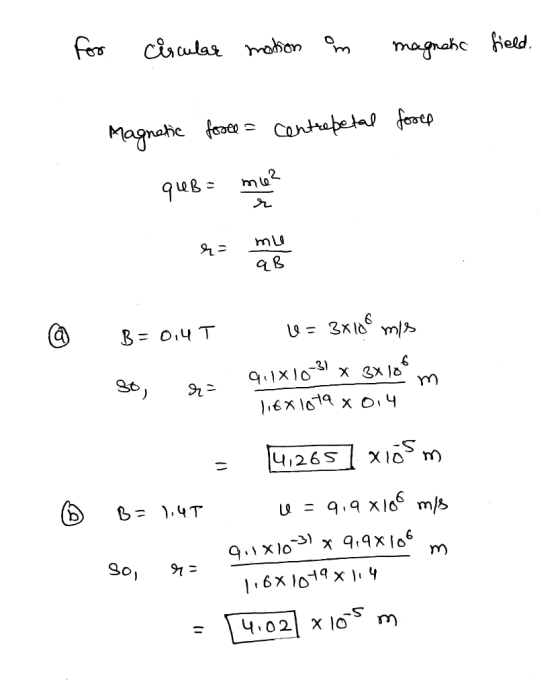
Calculate the radius of the circular orbit for the parameters specified below. Part (a) uses parameter...
Active Figure Motion of a Charged Particle in a Uniform Magnetic Field The animation below illustrates...
 Active Figure Motion of a Charged Particle in a Uniform Magnetic Field The animation below illustrates a charged particle moving in circular motion due to the magnetic force caused by a constant and uniform magnetic field oriented into the page. The blue crosses represent the tails of the magnetic field vectors nstructions: Use the blue sliders to adjust the mass, speed, particle charge and magnetic field magnitude. Change each parameter and observe the eftect on the particle's motion. If the...
For each case below, determine the terminal speed of the rod. In each case, the length...
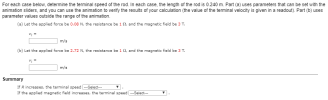 For each case below, determine the terminal speed of the rod. In each case, the length of the rod is 0.240 m. Part (a) uses parameters that can be set with the animation sliders, and you can use the animation to verify the results of your calculation (the value of the terminal velocity is given in a readout). Part (b) uses parameter values outside the range of the animation (a) Let the applied force be 0.08 N, the resistance be...
An electron is moving in a circular orbit of radius 12 cm in a uniform 0.30...
An electron is moving in a circular orbit of radius 12 cm in a uniform 0.30 T magnetic field perpendicular to the velocity of the electron. What is the linear speed of the electron in units of m/s? (me=9.11x10⁻³¹ kg, qe=1.6x10⁻¹⁹ C) Lütfen birini seçin: a. 3.16x10¹¹ b. 3.16x10⁹ c. 3.16x10¹⁰ d. 6.32x10⁹ e. 6.32x10¹⁰
In the Bohr model of the hydrogen atom, the electron moves in a circular orbit of...
In the Bohr model of the hydrogen atom, the electron moves in a circular orbit of radius with a speed of5.3 x 10^-11m with a speed of 2.2 x 10^6 m/s.Find the magnitude of the magnetic field that the electron produces at the location of the nucleus (treated as a point).B = _____T
A particle with charge 6.40 x 10^19 C travels in a circular orbit...
A particle with charge 6.40 x 10^19 C travels in a circular orbit with radius 4.68 cm due to the force exterted on it by magnetic field with magnitude 1.65 T and perpendicular to the orbit. What is the magnitude of the:(A) linear momentum p of the particle;(B) angular momentum L of the particle?
A particle with charge 6.40 times 10^-19 C travels in a circular orbit with radius 4.68...
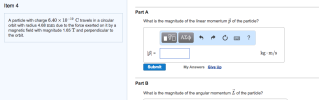 A particle with charge 6.40 times 10^-19 C travels in a circular orbit with radius 4.68 mm due to the force exerted on it by a magnetic field with magnitude 1.65 T and perpendicular to the orbit. What is the magnitude of the linear momentum p of the particle? What is the magnitude of the angular momentum L^rightarrow of the particle?
030 (part 1 of 2) 10.0 points A proton in a cyclotron is moving with a...
 030 (part 1 of 2) 10.0 points A proton in a cyclotron is moving with a speed of 3.27 x 10 m/s in a circle of radius 0.704 m. 1.67 x 10⁻²⁷ kg is the mass of the pro- ton, and 1.60218 x 10⁻¹⁹ C is its fundamental charge. What is the magnitude of the force exerted on the proton by the magnetic field of the cyclotron? Answer in units of N. 031 (part 2 of 2) 10.0 points What...
please show work! part c as well please! im really struggling and on a time limit...
 please show work!
part c as well please! im really struggling and on a time limit
please help!
3. A proton = 1.60 x 10⁻¹⁹ C, moves through a uniform magnetic field into the page. The proton, moving at a speed of 2.0 x 10 m/s in the direction shown, feels a force of 3.0 x 10⁻¹⁵ N. a) What is the magnitude of the magnetic field? b) Draw a vector on the charge indicating the direction of the force...
please show work!
part c as well please! im really struggling and on a time limit
please help!
3. A proton = 1.60 x 10⁻¹⁹ C, moves through a uniform magnetic field into the page. The proton, moving at a speed of 2.0 x 10 m/s in the direction shown, feels a force of 3.0 x 10⁻¹⁵ N. a) What is the magnitude of the magnetic field? b) Draw a vector on the charge indicating the direction of the force...
(a) What is Magnetic flux? (b) An electron with a rest mass of 9.11 x 10...
 (a) What is Magnetic flux? (b) An electron with a rest mass of 9.11 x 10 kg moves in a circular orbit of radius 1.4 x 10-'m in a uniform magnetic field of 3.5 x 10 Weber/meter square, perpendicular to the speed with which electron moves. Find the cyclotron frequency of the moving electron. (c) Discuss your answer in 4b above.
A negatively charged particle in a uniform magnetic field follows a circular path. The particle's speed is...
 A negatively charged particle in a uniform magnetic
field follows a circular path. The particle's speed is
240 m/s, the magnitude of the magnetic field is 0.28 T, and the
radius of the path is 830 m. a) Determine the mass of the
particle, given that its charge has a magnitude of 9.6 x 10^-4 C.
b) Choose the sketch which correctly shows the direction of the
magnetic field (in red) and the direction of the particle's
circular motion (in green)....
A negatively charged particle in a uniform magnetic
field follows a circular path. The particle's speed is
240 m/s, the magnitude of the magnetic field is 0.28 T, and the
radius of the path is 830 m. a) Determine the mass of the
particle, given that its charge has a magnitude of 9.6 x 10^-4 C.
b) Choose the sketch which correctly shows the direction of the
magnetic field (in red) and the direction of the particle's
circular motion (in green)....
 Active Figure Motion of a Charged Particle in a Uniform Magnetic Field The animation below illustrates a charged particle moving in circular motion due to the magnetic force caused by a constant and uniform magnetic field oriented into the page. The blue crosses represent the tails of the magnetic field vectors nstructions: Use the blue sliders to adjust the mass, speed, particle charge and magnetic field magnitude. Change each parameter and observe the eftect on the particle's motion. If the...
 For each case below, determine the terminal speed of the rod. In each case, the length of the rod is 0.240 m. Part (a) uses parameters that can be set with the animation sliders, and you can use the animation to verify the results of your calculation (the value of the terminal velocity is given in a readout). Part (b) uses parameter values outside the range of the animation (a) Let the applied force be 0.08 N, the resistance be...
 A particle with charge 6.40 times 10^-19 C travels in a circular orbit with radius 4.68 mm due to the force exerted on it by a magnetic field with magnitude 1.65 T and perpendicular to the orbit. What is the magnitude of the linear momentum p of the particle? What is the magnitude of the angular momentum L^rightarrow of the particle?
 030 (part 1 of 2) 10.0 points A proton in a cyclotron is moving with a speed of 3.27 x 10 m/s in a circle of radius 0.704 m. 1.67 x 10⁻²⁷ kg is the mass of the pro- ton, and 1.60218 x 10⁻¹⁹ C is its fundamental charge. What is the magnitude of the force exerted on the proton by the magnetic field of the cyclotron? Answer in units of N. 031 (part 2 of 2) 10.0 points What...
 please show work!
part c as well please! im really struggling and on a time limit
please help!
3. A proton = 1.60 x 10⁻¹⁹ C, moves through a uniform magnetic field into the page. The proton, moving at a speed of 2.0 x 10 m/s in the direction shown, feels a force of 3.0 x 10⁻¹⁵ N. a) What is the magnitude of the magnetic field? b) Draw a vector on the charge indicating the direction of the force...
please show work!
part c as well please! im really struggling and on a time limit
please help!
3. A proton = 1.60 x 10⁻¹⁹ C, moves through a uniform magnetic field into the page. The proton, moving at a speed of 2.0 x 10 m/s in the direction shown, feels a force of 3.0 x 10⁻¹⁵ N. a) What is the magnitude of the magnetic field? b) Draw a vector on the charge indicating the direction of the force...
 (a) What is Magnetic flux? (b) An electron with a rest mass of 9.11 x 10 kg moves in a circular orbit of radius 1.4 x 10-'m in a uniform magnetic field of 3.5 x 10 Weber/meter square, perpendicular to the speed with which electron moves. Find the cyclotron frequency of the moving electron. (c) Discuss your answer in 4b above.
 A negatively charged particle in a uniform magnetic
field follows a circular path. The particle's speed is
240 m/s, the magnitude of the magnetic field is 0.28 T, and the
radius of the path is 830 m. a) Determine the mass of the
particle, given that its charge has a magnitude of 9.6 x 10^-4 C.
b) Choose the sketch which correctly shows the direction of the
magnetic field (in red) and the direction of the particle's
circular motion (in green)....
A negatively charged particle in a uniform magnetic
field follows a circular path. The particle's speed is
240 m/s, the magnitude of the magnetic field is 0.28 T, and the
radius of the path is 830 m. a) Determine the mass of the
particle, given that its charge has a magnitude of 9.6 x 10^-4 C.
b) Choose the sketch which correctly shows the direction of the
magnetic field (in red) and the direction of the particle's
circular motion (in green)....
Most questions answered within 3 hours.
-
Where is the error in this code sequence?
String s1 = "Hello";
String s2 = "ello";...
asked 10 months ago -
Financial data for Joel de Paris, Inc., for last year
follow:
Joel de Paris, Inc.
Balance...
asked 10 months ago -
Consider this reaction:
Al2(SO4)3 (aq)+ BaCl3
(aq) Al2Cl6 (aq)- +
3BaSO4(s) . What is the...
asked 10 months ago -
Suppose that Savneet is considering increasing her
recent random sample from 20 car rentals to 40...
asked 10 months ago -
Trucks arrive at an unloading terminal at an average rate of 120
per hour.
Trucks arrive...
asked 10 months ago -
Why are methanol and ethanol completely soluble in water while
octanol is not very little soluble....
asked 10 months ago -
A facilities manager at a university reads in a research report
that the mean amount of...
asked 10 months ago -
When the CuSO4 is rehydrated by adding water to the anhydrous
compound, is this an endothermic...
asked 10 months ago -
A ray of sunlight is passing from diamond into crown glass; the
angle of incidence is...
asked 10 months ago -
A block of mass 0.249 kg is placed on top of a light, vertical
spring of...
asked 10 months ago -
how do the kidneys compensate in the presences of acidosis
a) trigger hyperventilate
b) reserve acid...
asked 10 months ago -
Question 501 pts
The rental rate of capital to the firm increases. Which of the
following...
asked 10 months ago