
Homework Answers
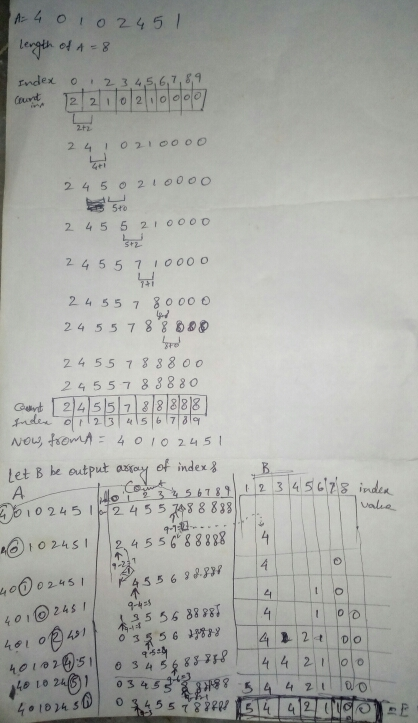
Attaching image for the steps..
Since I am not aware of the process you are following in class, I made it in generic format.
Add Answer to:
16. (5 points) Trace counting sort algorithm as it sorts the array into a descending order....
8. (5 points) Trace merge sort algorithm as it sorts the following sequence of integer array into...
 8. (5 points) Trace merge sort algorithm as it sorts the following sequence of integer array into a descending order. 42 45 10 64 55 37 96 7 9. (5 points) Trace shell sort algorithm that halves the gap size at each iteration as it sorts the following sequence of integer array into an ascending order. 42 18 10 64 85 37 96 71
8. (5 points) Trace merge sort algorithm as it sorts the following sequence of integer array...
8. (5 points) Trace merge sort algorithm as it sorts the following sequence of integer array into a descending order. 42 45 10 64 55 37 96 7 9. (5 points) Trace shell sort algorithm that halves the gap size at each iteration as it sorts the following sequence of integer array into an ascending order. 42 18 10 64 85 37 96 71
8. (5 points) Trace merge sort algorithm as it sorts the following sequence of integer array...
6. (10 points) Trace insertion sort algorithm as it sorts the following sequence of integer array...
 6. (10 points) Trace insertion sort algorithm as it sorts the following sequence of integer array into an ascending order. 17 3 12
2. In class, we discussed the recursive Merge-Sort algorithm. This sorts the whole array by sorting...
 2. In class, we discussed the recursive Merge-Sort algorithm. This sorts the whole array by sorting the left side, sorting the right side, and then merging them. Write a similar recursive algorithm that finds the maximum element of an array. (Find the max of the left side, then find the maximum of the right side, then compare the two.) Write pseudo-code for this algorithm. Give the recurrence relation that describes the number of comparisons that your algorithm uses.
Sorting Sort the following array using the quick sort algorithm: (4 Marks) a. 12 26 8...
 Sorting Sort the following array using the quick sort algorithm: (4 Marks) a. 12 26 8 9 7 0 4 Pivot selection is defined to be the first element of each sub-list. Show the array before and after each quicksort round (when the array is partitioned after placing the pivot at its correct position). Also, clearly highlight the pivot in each partition b. Consider an unsorted array of integers of size n. Write a Java program to arrange the array...
Write a function that gets an array as a parameter, sorts it in a descending fashion...
Write a function that gets an array as a parameter, sorts it in a descending fashion and returns the number of elements that did not change position in the sort (they were originally in the right position). int sortDESC(int* myArray, int size) if array = { 2, 3, 1, 0, -1} after calling the function the array should become {-1, 0, 1, 2 , 3 } and the function should return 1 (only one element has not changed place in...
Show how the Radix sort algorithm sorts the array: 36 14 27 40 31 17 5....
Show how the Radix sort algorithm sorts the array: 36 14 27 40 31 17 5. Must show the operation of the algorithm in details.
Algorithm ComparisonCountingSorting(A[0..n-1], S[0..n-1] ) //Input: Array A[0..n-1] of orderable values //Output: Array S[0..n-1] of...
Algorithm ComparisonCountingSorting(A[0..n-1], S[0..n-1] ) //Input: Array A[0..n-1] of orderable values //Output: Array S[0..n-1] of A's values in ascending order for i ← 0 to n – 1 do Count[i] ← 0 for i ← 0 to n – 2 do for j ← i + 1 to n – 1 do if A[i] < A[j] Count[j] ← Count[j] + 1 // increment counter of larger else Count[i] ← Count[i] + 1 for i ← 0 to n –...
2. Consider your ID as an array of 9 elements, apply an insertion sort algorithm to...
 2. Consider your ID as an array of 9 elements, apply an insertion sort algorithm to sort the numbers in descending order. Show your steps. Example ID: 201710340 Array: 2 0 7 0 1 1 0 3 4
Modify the sorts (selection sort, insertion sort, bubble sort, quick sort, and merge sort) by adding code to each to tally the total number of comparisons and total execution time of each algorithm. E...
Modify the sorts (selection sort, insertion sort, bubble sort, quick sort, and merge sort) by adding code to each to tally the total number of comparisons and total execution time of each algorithm. Execute the sort algorithms against the same list, recording information for the total number of comparisons and total execution time for each algorithm. Try several different lists, including at least one that is already in sorted order. ---------------------------------------------------------------------------------------------------------------- /** * Sorting demonstrates sorting and searching on an...
_______________________________________________________________________________________________ java language-trace instructions". (20 points) Show the contents of the array below, once the contents...
 _______________________________________________________________________________________________
java language-trace
instructions". (20 points) Show the contents of the array below, once the contents of the array below, once the "pivot" element is placed at its location after each call of the "Partition” algorithm, in the process of running Quick-Sort on said array. Arrange the data in ascending order (Trom Arrange the data in ascending order (from smallest to largest value). Always select the first element of the partition as "pivot" in data cat B. Apply sorting on...
_______________________________________________________________________________________________
java language-trace
instructions". (20 points) Show the contents of the array below, once the contents of the array below, once the "pivot" element is placed at its location after each call of the "Partition” algorithm, in the process of running Quick-Sort on said array. Arrange the data in ascending order (Trom Arrange the data in ascending order (from smallest to largest value). Always select the first element of the partition as "pivot" in data cat B. Apply sorting on...
 8. (5 points) Trace merge sort algorithm as it sorts the following sequence of integer array into a descending order. 42 45 10 64 55 37 96 7 9. (5 points) Trace shell sort algorithm that halves the gap size at each iteration as it sorts the following sequence of integer array into an ascending order. 42 18 10 64 85 37 96 71
8. (5 points) Trace merge sort algorithm as it sorts the following sequence of integer array...
8. (5 points) Trace merge sort algorithm as it sorts the following sequence of integer array into a descending order. 42 45 10 64 55 37 96 7 9. (5 points) Trace shell sort algorithm that halves the gap size at each iteration as it sorts the following sequence of integer array into an ascending order. 42 18 10 64 85 37 96 71
8. (5 points) Trace merge sort algorithm as it sorts the following sequence of integer array...
 6. (10 points) Trace insertion sort algorithm as it sorts the following sequence of integer array into an ascending order. 17 3 12
 2. In class, we discussed the recursive Merge-Sort algorithm. This sorts the whole array by sorting the left side, sorting the right side, and then merging them. Write a similar recursive algorithm that finds the maximum element of an array. (Find the max of the left side, then find the maximum of the right side, then compare the two.) Write pseudo-code for this algorithm. Give the recurrence relation that describes the number of comparisons that your algorithm uses.
 Sorting Sort the following array using the quick sort algorithm: (4 Marks) a. 12 26 8 9 7 0 4 Pivot selection is defined to be the first element of each sub-list. Show the array before and after each quicksort round (when the array is partitioned after placing the pivot at its correct position). Also, clearly highlight the pivot in each partition b. Consider an unsorted array of integers of size n. Write a Java program to arrange the array...
 2. Consider your ID as an array of 9 elements, apply an insertion sort algorithm to sort the numbers in descending order. Show your steps. Example ID: 201710340 Array: 2 0 7 0 1 1 0 3 4
 _______________________________________________________________________________________________
java language-trace
instructions". (20 points) Show the contents of the array below, once the contents of the array below, once the "pivot" element is placed at its location after each call of the "Partition” algorithm, in the process of running Quick-Sort on said array. Arrange the data in ascending order (Trom Arrange the data in ascending order (from smallest to largest value). Always select the first element of the partition as "pivot" in data cat B. Apply sorting on...
_______________________________________________________________________________________________
java language-trace
instructions". (20 points) Show the contents of the array below, once the contents of the array below, once the "pivot" element is placed at its location after each call of the "Partition” algorithm, in the process of running Quick-Sort on said array. Arrange the data in ascending order (Trom Arrange the data in ascending order (from smallest to largest value). Always select the first element of the partition as "pivot" in data cat B. Apply sorting on...
Most questions answered within 3 hours.
-
Where is the error in this code sequence?
String s1 = "Hello";
String s2 = "ello";...
asked 11 months ago -
Financial data for Joel de Paris, Inc., for last year
follow:
Joel de Paris, Inc.
Balance...
asked 11 months ago -
Consider this reaction:
Al2(SO4)3 (aq)+ BaCl3
(aq) Al2Cl6 (aq)- +
3BaSO4(s) . What is the...
asked 11 months ago -
Suppose that Savneet is considering increasing her
recent random sample from 20 car rentals to 40...
asked 11 months ago -
Trucks arrive at an unloading terminal at an average rate of 120
per hour.
Trucks arrive...
asked 11 months ago -
Why are methanol and ethanol completely soluble in water while
octanol is not very little soluble....
asked 11 months ago -
A facilities manager at a university reads in a research report
that the mean amount of...
asked 11 months ago -
When the CuSO4 is rehydrated by adding water to the anhydrous
compound, is this an endothermic...
asked 11 months ago -
A ray of sunlight is passing from diamond into crown glass; the
angle of incidence is...
asked 11 months ago -
A block of mass 0.249 kg is placed on top of a light, vertical
spring of...
asked 11 months ago -
how do the kidneys compensate in the presences of acidosis
a) trigger hyperventilate
b) reserve acid...
asked 11 months ago -
Question 501 pts
The rental rate of capital to the firm increases. Which of the
following...
asked 11 months ago