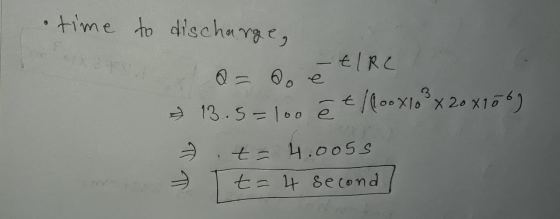
A 20μF capacitor has previously charged up to contain a total charge of Q=100μC on it....
A 20μF capacitor has previously charged up to contain a total charge of Q=100μC on it. The capacitor is then discharged by connecting it directly across a 100−kΩ resistor. At what point in time after the resistor is connected will the capacitor have 13.5μC of charge remaining on it?
Homework Answers
Add Answer to:
A 20μF capacitor has previously charged up to contain a total
charge of Q=100μC on it....
A 2.10 nF capacitor with an initial charge of 4.55 µC is discharged through a 1.18...
A 2.10 nF capacitor with an initial charge of 4.55 µC is discharged through a 1.18 kΩ resistor. (a) Calculate the current in the resistor 9.00 µs after the resistor is connected across the terminals of the capacitor. ____ mA (b) What charge remains on the capacitor after 8.00 µs? ____µC (c) What is the maximum current in the resistor?
1. A capacitor C has been charged up to potential Vo. At timet0, it is connected...
 1. A capacitor C has been charged up to potential Vo. At timet0, it is connected to a resistor R, and begins to discharge [see figure (a) below] +0 (a) i Determine the charge Q(t) on the capacitor as a function of time. ii. What is the current I(t) through the resistor? iii. Sketch Q(t) and I(t) as a function oft iv. Wha v. By integrating P VI, where P is the power delivered to the circuit and V the...
A 2.00-nF capacitor with an initial charge of 5.46 μC is discharged through a 1.33-kΩ resistor....
A 2.00-nF capacitor with an initial charge of 5.46 μC is discharged through a 1.33-kΩ resistor. (a) Calculate the magnitude of the current in the resistor 9.00 μs after the resistor is connected across the terminals of the capacitor. mA (b) What charge remains on the capacitor after 8.00 μs? μC (c) What is the maximum current in the resistor? A
A 2.00-nF capacitor with an initial charge of 4.99 µC is discharged through a 1.61-kΩ resistor....
A 2.00-nF capacitor with an initial charge of 4.99 µC is discharged through a 1.61-kΩ resistor. (a) Calculate the current in the resistor 9.00 µs after the resistor is connected across the terminals of the capacitor. (Let the positive direction of the current be define such that dQ dt > 0.) (b) What charge remains on the capacitor after 8.00 µs? (c) What is the (magnitude of the) maximum current in the resistor?
A 2.00-nF capacitor with an initial charge of 5.71 µC is discharged through a 2.41-kΩ resistor....
A 2.00-nF capacitor with an initial charge of 5.71 µC is discharged through a 2.41-kΩ resistor. (a) Calculate the current in the resistor 9.00 µs after the resistor is connected across the terminals of the capacitor. (Let the positive direction of the current be defined such that (dQ/dt) > 0.) mA (b) What charge remains on the capacitor after 8.00 µs? µC (c) What is the (magnitude of the) maximum current in the resistor? A
(a) A capacitor of capacitance 220 μF is connected in series with a 150 kΩ resistor, a switch and an ammeter. A d.c. power supply of negligible internal resistance is connected to the circuit as show...
 (a) A capacitor of capacitance 220 μF is connected in series with a 150 kΩ resistor, a switch and an ammeter. A d.c. power supply of negligible internal resistance is connected to the circuit as shown below 1 50 kΩ 220HF A stopclock is started and after 10 seconds the switch S is closed Ammeter readings are noted at regular intervals until a time of 80s is shown on the stopclock. The graph below shows how the current in the...
A charged capacitor is connected to a resistor and switch, all in series. The circuit has...
 A charged capacitor is connected to a resistor and switch, all in series. The circuit has a time constant T = 1.80 s. Soon after the switch is closed, the charge on the capacitor is 65.0% of its initial charge qu = 100°C. a) Find the time interval required for the capacitor to reach this charge. b) If R = 210 22, what is the value of C? c) What is the current when the charge on the capacitor is...
A 2.00-nF capacitor with an initial charge of 4.51 uC is discharged through a 1.06-k2 resistor....
 A 2.00-nF capacitor with an initial charge of 4.51 uC is discharged through a 1.06-k2 resistor. (a) Calculate the current in the resistor 9.00 us after the resistor is connected across the terminals of the capacitor. dQ (Let the positive direction of the current be define such that >0.) dt x How is the instantaneous current related to the potential difference across the capacitor? ma (b) What charge remains on the capacitor after 8.00 us? X What is the equation...
A 14.1 ?F capacitor in an RC circuit is initially charged up to a potential difference...
 A 14.1 ?F capacitor in an RC circuit is initially charged up to a potential difference of 105 V. Then it is discharged through a resistor with a resistance of 49.1 k2. What is the voltage across the capacitor 423 ms after the discharge begins?
To study the behavior of circuit containing a resistor and a charged capacitor when the capacitor...
 To study the behavior of circuit containing a resistor and a charged capacitor when the capacitor begins to discharge. A capacitor with capacitance C is initially charged with charge q. At time t = 0, a switch is thrown to close the circuit connecting the capacitor in series with a resistor of resistance R (Figure 1) Part AWhat happens to the charge on the capacitor immediately after the switch is thrown? The electrons on the negative plate of the capacitor are...
 1. A capacitor C has been charged up to potential Vo. At timet0, it is connected to a resistor R, and begins to discharge [see figure (a) below] +0 (a) i Determine the charge Q(t) on the capacitor as a function of time. ii. What is the current I(t) through the resistor? iii. Sketch Q(t) and I(t) as a function oft iv. Wha v. By integrating P VI, where P is the power delivered to the circuit and V the...
 (a) A capacitor of capacitance 220 μF is connected in series with a 150 kΩ resistor, a switch and an ammeter. A d.c. power supply of negligible internal resistance is connected to the circuit as shown below 1 50 kΩ 220HF A stopclock is started and after 10 seconds the switch S is closed Ammeter readings are noted at regular intervals until a time of 80s is shown on the stopclock. The graph below shows how the current in the...
 A charged capacitor is connected to a resistor and switch, all in series. The circuit has a time constant T = 1.80 s. Soon after the switch is closed, the charge on the capacitor is 65.0% of its initial charge qu = 100°C. a) Find the time interval required for the capacitor to reach this charge. b) If R = 210 22, what is the value of C? c) What is the current when the charge on the capacitor is...
 A 2.00-nF capacitor with an initial charge of 4.51 uC is discharged through a 1.06-k2 resistor. (a) Calculate the current in the resistor 9.00 us after the resistor is connected across the terminals of the capacitor. dQ (Let the positive direction of the current be define such that >0.) dt x How is the instantaneous current related to the potential difference across the capacitor? ma (b) What charge remains on the capacitor after 8.00 us? X What is the equation...
 A 14.1 ?F capacitor in an RC circuit is initially charged up to a potential difference of 105 V. Then it is discharged through a resistor with a resistance of 49.1 k2. What is the voltage across the capacitor 423 ms after the discharge begins?
Most questions answered within 3 hours.
-
Where is the error in this code sequence?
String s1 = "Hello";
String s2 = "ello";...
asked 11 months ago -
Financial data for Joel de Paris, Inc., for last year
follow:
Joel de Paris, Inc.
Balance...
asked 11 months ago -
Consider this reaction:
Al2(SO4)3 (aq)+ BaCl3
(aq) Al2Cl6 (aq)- +
3BaSO4(s) . What is the...
asked 11 months ago -
Suppose that Savneet is considering increasing her
recent random sample from 20 car rentals to 40...
asked 11 months ago -
Trucks arrive at an unloading terminal at an average rate of 120
per hour.
Trucks arrive...
asked 11 months ago -
Why are methanol and ethanol completely soluble in water while
octanol is not very little soluble....
asked 11 months ago -
A facilities manager at a university reads in a research report
that the mean amount of...
asked 11 months ago -
When the CuSO4 is rehydrated by adding water to the anhydrous
compound, is this an endothermic...
asked 11 months ago -
A ray of sunlight is passing from diamond into crown glass; the
angle of incidence is...
asked 11 months ago -
A block of mass 0.249 kg is placed on top of a light, vertical
spring of...
asked 11 months ago -
how do the kidneys compensate in the presences of acidosis
a) trigger hyperventilate
b) reserve acid...
asked 11 months ago -
Question 501 pts
The rental rate of capital to the firm increases. Which of the
following...
asked 11 months ago