
Homework Answers
Add Answer to:
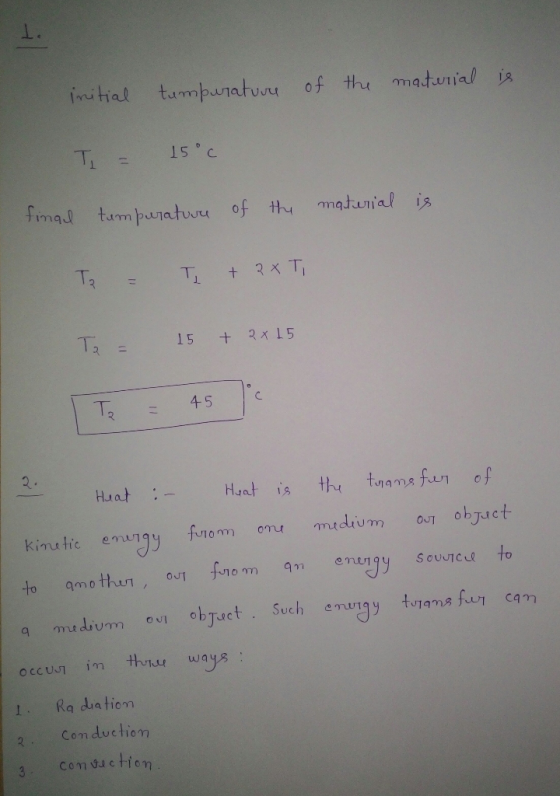
. Certain material is at 15 ° C. If its temperature increases twice, it will be...
If a cube of a certain metal increases its volume from 15 cm3 to 17 cm3...
If a cube of a certain metal increases its volume from 15 cm3 to 17 cm3 as the temperature increases from 12°C to 28°C, what is the metal's linear expansion coefficient?
An object absorbs 1.70×10⁴J of heat and as a result, its temperature is increases from 45.0∘C...
An object absorbs 1.70×10⁴J of heat and as a result, its temperature is increases from 45.0∘C to 75.0∘C. What is its heat capacity of the object?
You heat 1 L of water and its temperature increases to 10 ° C. if the...
You heat 1 L of water and its temperature increases to 10 ° C. if the same heat is applied with 2 L of water. How much did the temperature rise? to 3 L of water? Write your response next to the blank spaces below. 1L = 10°C 2L = 3L = 2. a Big bucket contains 1 L of water at 20 ° C. What will be the temperature of the mix when 1 L of water at 20...
8. a. Given that the specific heat of one material is twice that of another compare...
 8. a. Given that the specific heat of one material is twice that of another compare the amounts of heat required to raise the temperatures of equal masses of each material by 1°C. b. If the same amount of heat were added to samples of both materials and each sample had the same increase in temperature, compare the masses of each sample.
How much heat does 29.0 of water absorb, if its temperature increases from 20.0 C to...
How much heat does 29.0 of water absorb, if its temperature increases from 20.0 C to 46.0 C ? The specific heat capacity of water is 4.18 J/(g.C)
If 2600 J of heat are added to a 190-g object, its temperature increases by 14...
If 2600 J of heat are added to a 190-g object, its temperature increases by 14 ∘C . You may want to review What is the heat capacity of this object? In kJ/K What is the object's specific heat? In kJ/kg
How much heat does 47.0 of water absorb, if its temperature increases from 22.0 C to...
How much heat does 47.0 of water absorb, if its temperature increases from 22.0 C to 57.0 C? The specific heat capacity of water is 4.18 J/(g.C). Please type an answer with only three significant figures. _____J
A sample of carbon monoxide gas is heated at constant pressure until its temperature increases by...
 A sample of carbon monoxide gas is heated at constant pressure until its temperature increases by 62.3 degree C. A sample of neon gas is heated at constant volume until its temperature increases by 22 degree C. If each sample of gas absorbs the same amount of heat, what is the ratio of the number of moles of neon to the number of moles of carbon monoxide?
For an ideal gas, whose temperature increases from T1 to T2, what would be its enthalpy...
For an ideal gas, whose temperature increases from T1 to T2, what would be its enthalpy change? (a) Cv (T2-T1) (b) Cv (T1-T2) (c) Cp (T2-T1) if the heat capacities stay constant during the temperature range
A liquid has its temperature raised from 15°C to 65°C by passing it through a heater...
A liquid has its temperature raised from 15°C to 65°C by passing it through a heater in which the heating surface is maintained at 125°C by condensing steam. If the overall coefficient of heat transfer can be assumed to vary as the velocity raised to the power 0.8, what will be the exit temperature of the liquid if its velocity is doubled? Assume liquid thermal properties are temperature-independent over the range concerned. [ans. 60.15 C]
 8. a. Given that the specific heat of one material is twice that of another compare the amounts of heat required to raise the temperatures of equal masses of each material by 1°C. b. If the same amount of heat were added to samples of both materials and each sample had the same increase in temperature, compare the masses of each sample.
 A sample of carbon monoxide gas is heated at constant pressure until its temperature increases by 62.3 degree C. A sample of neon gas is heated at constant volume until its temperature increases by 22 degree C. If each sample of gas absorbs the same amount of heat, what is the ratio of the number of moles of neon to the number of moles of carbon monoxide?
Most questions answered within 3 hours.
-
Where is the error in this code sequence?
String s1 = "Hello";
String s2 = "ello";...
asked 11 months ago -
Financial data for Joel de Paris, Inc., for last year
follow:
Joel de Paris, Inc.
Balance...
asked 11 months ago -
Consider this reaction:
Al2(SO4)3 (aq)+ BaCl3
(aq) Al2Cl6 (aq)- +
3BaSO4(s) . What is the...
asked 11 months ago -
Suppose that Savneet is considering increasing her
recent random sample from 20 car rentals to 40...
asked 11 months ago -
Trucks arrive at an unloading terminal at an average rate of 120
per hour.
Trucks arrive...
asked 11 months ago -
Why are methanol and ethanol completely soluble in water while
octanol is not very little soluble....
asked 11 months ago -
A facilities manager at a university reads in a research report
that the mean amount of...
asked 11 months ago -
When the CuSO4 is rehydrated by adding water to the anhydrous
compound, is this an endothermic...
asked 11 months ago -
A ray of sunlight is passing from diamond into crown glass; the
angle of incidence is...
asked 11 months ago -
A block of mass 0.249 kg is placed on top of a light, vertical
spring of...
asked 11 months ago -
how do the kidneys compensate in the presences of acidosis
a) trigger hyperventilate
b) reserve acid...
asked 11 months ago -
Question 501 pts
The rental rate of capital to the firm increases. Which of the
following...
asked 11 months ago