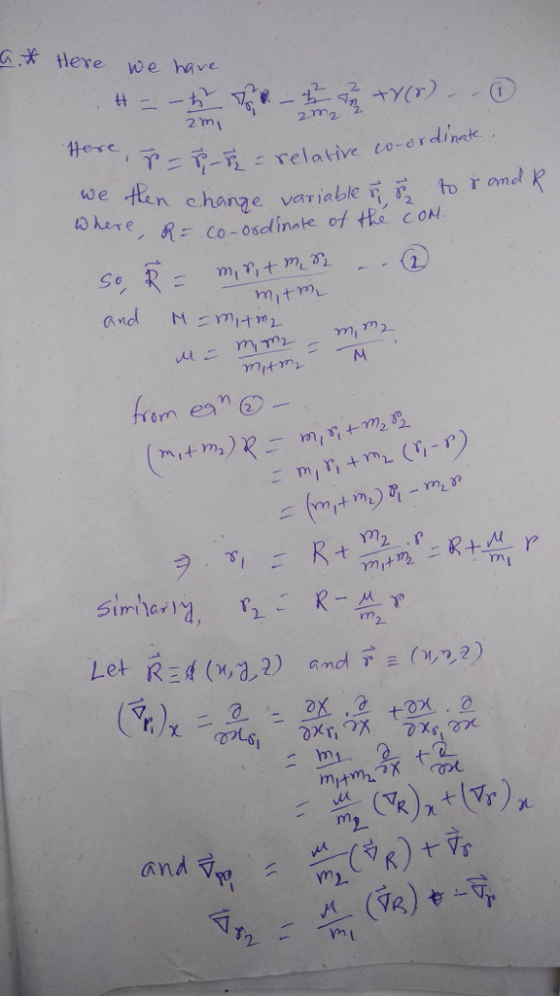
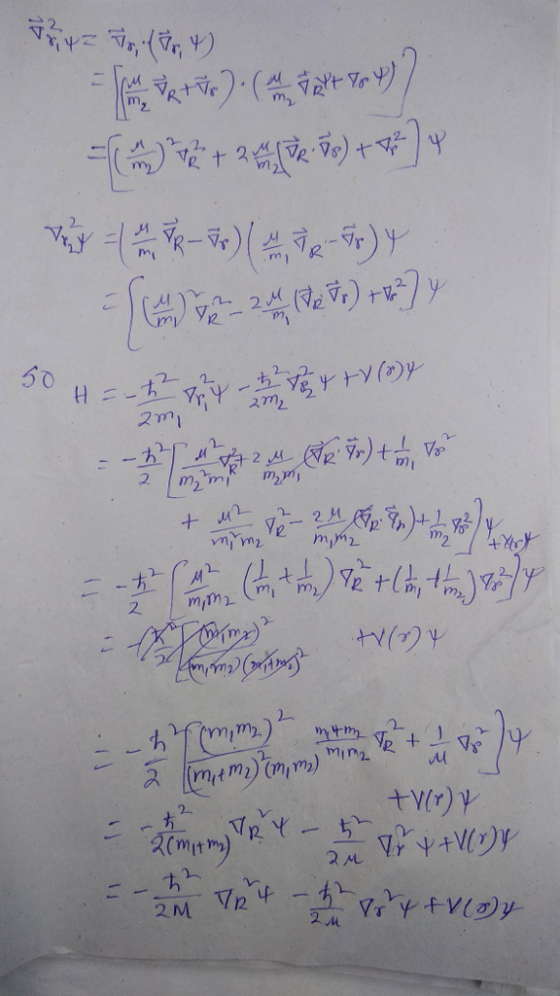
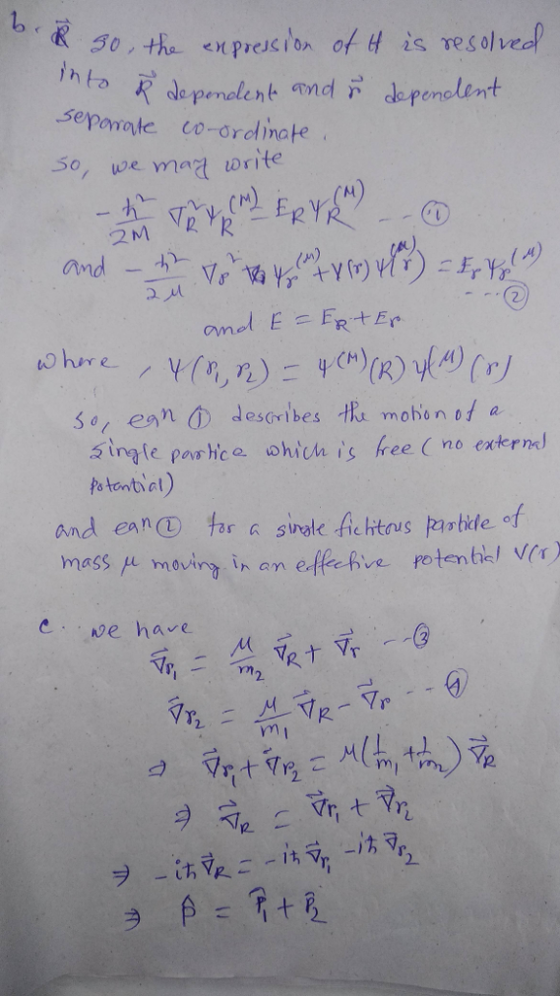
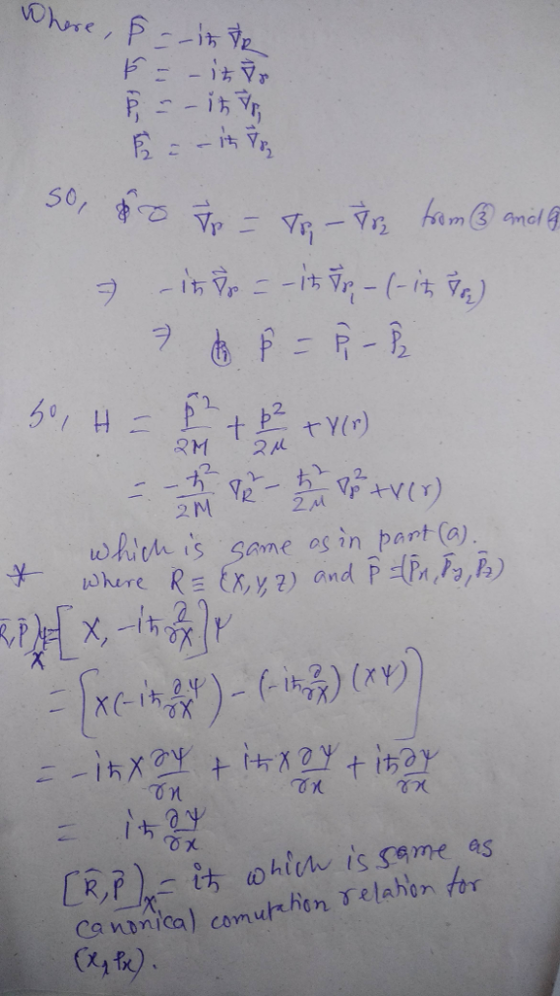
![A system consists of two particles of mass mi and m2 interacting with an interaction potential V(r) that depends only on the relative distancer- Iri-r2l between the particles, where r- (ri,/i,21) and r2 22,ひ2,22 are the coordinates of the two particles in three dimensions (3D) (a) /3 pointsl Show that for such an interaction potential, the Hamiltonian of the system H- am▽ri _ 2m2 ▽22 + V(r) can be, put in the form 2M where ▽ and ▽ are the Lulacians referring, respectively, to the center of mass (OM) R (miri + m2r2)/(mı + m2) and the relative r = ri-r2 α)(rdinates, whereas M = m1 + m2 is the total inass and μ TIL 1 Tn2/(m1 + m2) is the reduced mass. Note that the vector R is the mass weighted average of the positions of the two particles. If the 3D coordinates of R are denoted by R (X, Y Z), the corresponding laplacian operator is given by ▽ t OP/aX2 +OP/oya +伊/02°, similarly, for r-x, y, z), the corresponding Laplasian is given by ▽2 /dz2+OP/0y2+OP/az21 Thus the Hamiltonian falls into the sum of two independent parts, one depending only on R and the other - only on r, and hence the system is separable in COM and relative coordinates. (b) [2 points] Write down the time independent Schrödinger equation for the two particle wave function ψ(ri r2) with energy E (recall that E is a separation constant with respect to the coor dinate and time variables, for the time dependent Schrödinger equation in a stationary external potential; here, the role of the external potential is taken by the interaction potential between the two particles), and then look for separable solutions with respect to the COM and relative coordinates: ψ(ri, r2) ψ(M) (R)ψ(u) r). Write down the equations of motions that the functions (M) (R) and ψ(x) r) must separately satisfy; fr)m these equations, one should be able to see that the equation for ψ(M) (R) describes the motion o a re no external potential fictitious particle o mass M whereas the equation for (μ) r is the Schrodinger equation for a single fictitious particle of mass moving in an elfective external potential given by the same teraction potential V(r), i.e., the same probleln as described in your textbook, starting froin Eq. (48), which itself then leads to the problem of motion of an electron in a hydrogen atom Thus, the quantum two particle problem in which the interaction potential between the particles, V(r), depends only on the relative distance between the particles can always be reduced to two independent one particle problems: one being a free particle problem, and the other - particle in a spherically symmetric (also referred to as centrally symmetric) external potential V(r) (c) [2 pointsl What are the center of mass (P) and relative (p) momenta in terms of the momenta pi and pz of the wo particles? Check to confirm that the system Hamiltonian, written down in terms of COM and relative momenta, is the same as the one you derived in part (a) in position basis. Check that the commutation relations between the components of R and P (and between the components of f and p) are the same ones as the canonical commutation relations for the components of the coordinates and momenta of any single particle.](http://img.homeworklib.com/questions/7eddd830-ce62-11ea-a5d8-c1615656d7ad.png?x-oss-process=image/resize,w_560)
Homework Answers
Add Answer to:
A system consists of two particles of mass mi and m2 interacting with an interaction potential...
4. Consider two particles of masses my and m2 and positions rı and r2 respectively. Suppose...
 4. Consider two particles of masses my and m2 and positions rı and r2 respectively. Suppose m2 exerts a force F on mı. Suppose further that the two particles are in a uniform gravitational field g. (a) Write down the equations of motion for the two particles. (b) Show that the equations of motion can be written as MR = Mg ur = F where M is the total mass, R is the centre of mass, he is the reduced...
Due April 19th, 2019 1. (3 pts) Consider two particles of mass mi and m2 (in one dimension) that ...
 Due April 19th, 2019 1. (3 pts) Consider two particles of mass mi and m2 (in one dimension) that interact via a potential that depends only on the dstance between the particles V(l 2), so that the Hamiltonian is Acting on a two-particle wave function the translation operator would be (a) Show that the translation operator can be written as where P- p p2 is the total momentum operator of the syste (b) Show that the total momentum is conserved...
Two-body problem in Classical mechanics. Conisder two masses mi and m2 interacting through a potential that...
 Two-body problem in Classical mechanics. Conisder two masses mi and m2 interacting through a potential that depends only upon their relatie separation (21 – x2) so that V(x1, x2) = V(x1 - x2). • Given that the force acting on particle ; is f; = show that f1 = -f2. What does this result mean? • Following the example in the Chapter 5.3 of the book reduce the two-problem expressed in terms of (x1, x2) coordintes and masses (mi andm2)...
Consider two particles without external forcer andre relative to center of mass lagrangian is L= (mixma)k...
 Consider two particles without external forcer andre relative to center of mass lagrangian is L= (mixma)k 2 it r m2 2 mir al 2 v(r) (m, +m₂) prove that: I 2 m.mz (m, + m2)
Problem 3. Consider two atoms with masses mi and m2, each moving along the x-direction, and that are connected by a har...
 Problem 3. Consider two atoms with masses mi and m2, each moving along the x-direction, and that are connected by a harmonic spring with spring constant k and equilibrium length lo: mi m2 Ömimo → X1 X2 The Hamiltonian operator for this system is ÎN = Pí 1 2 1 2 +5k (ĉ2 – ĉ1 – 10)? 2m2' 2" 2m, and the time-independent Schrödinger equation for the two-atom wavefunction (x1, x2) is ÊV(21, x2) = EV (21, x2) This equation...
Two bodies of mass mi = 3 kg and m2 5 kg are joined to a...
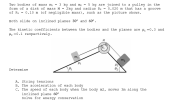 Two bodies of mass mi = 3 kg and m2 5 kg are joined to a pulley in the form of a disk of mass M 2 kg and radius R2 0.020 m that has a groove of Ri 0.10 m (of negligible mass), such as the picture shows. = = Both slide on inclined planes 30° and 60°. The kinetic coefficients between the bodies and the planes are Mi =0.3 and H2 =0.1 respectively. M R2 (R mi m2...
#1 A particle of mass, m, moves in a field whose potential energy in spherical coordinates...
 #1 A particle of mass, m, moves in a field whose potential energy in spherical coordinates has a 2 , where r and are the standard variables of spherical coordinates and k is a positive constant. Find Hamiltonian and Hamilton's equations of motion for this particle. form of V --k cose
I. Show that the angular momentum of a two-particle system is given by where m- mi...
 I. Show that the angular momentum of a two-particle system is given by where m- mi + m2. v is the relative velocity (the velocity of one of the particles with respect to the other), is the relative position, and μ is the reduced mass. Q7- CM
wCT S the particle's 4-velocity 12.13 Specalize the Darwin Lagrangian (12.82) to the interaction of two...
 wCT S the particle's 4-velocity 12.13 Specalize the Darwin Lagrangian (12.82) to the interaction of two charged particles (m, q) and (m, qa). Introduce reduced particle coordinates X1X2, V -2 and also center of mass coordinates. Write out the Lagrangian in the reference frame in which the velocity of the center of mass vanishes and evaluate the canonical momentum components, p, aLlau (a) r = etc. action is known as the Breit interaction (1930). For system of interacting charged particles...
Exercise 3.2. This problem is challenging! Two identical particles of mass m are connected by a...
 Exercise 3.2. This problem is challenging! Two identical particles of mass m are connected by a light spring with stiffness k (neglect the spring's mass) and equilibrium length 2. Ev- erything is lined up on the z-axis. Let the position of particle 1 be r(t) and the position of particle 2 be f(t). If at time t = 0, the positions are (0) = ? and r2(0) = l, and the velocities are non-zero with vi(0) = v1 +0 and...
 4. Consider two particles of masses my and m2 and positions rı and r2 respectively. Suppose m2 exerts a force F on mı. Suppose further that the two particles are in a uniform gravitational field g. (a) Write down the equations of motion for the two particles. (b) Show that the equations of motion can be written as MR = Mg ur = F where M is the total mass, R is the centre of mass, he is the reduced...
 Due April 19th, 2019 1. (3 pts) Consider two particles of mass mi and m2 (in one dimension) that interact via a potential that depends only on the dstance between the particles V(l 2), so that the Hamiltonian is Acting on a two-particle wave function the translation operator would be (a) Show that the translation operator can be written as where P- p p2 is the total momentum operator of the syste (b) Show that the total momentum is conserved...
 Two-body problem in Classical mechanics. Conisder two masses mi and m2 interacting through a potential that depends only upon their relatie separation (21 – x2) so that V(x1, x2) = V(x1 - x2). • Given that the force acting on particle ; is f; = show that f1 = -f2. What does this result mean? • Following the example in the Chapter 5.3 of the book reduce the two-problem expressed in terms of (x1, x2) coordintes and masses (mi andm2)...
 Consider two particles without external forcer andre relative to center of mass lagrangian is L= (mixma)k 2 it r m2 2 mir al 2 v(r) (m, +m₂) prove that: I 2 m.mz (m, + m2)
 Problem 3. Consider two atoms with masses mi and m2, each moving along the x-direction, and that are connected by a harmonic spring with spring constant k and equilibrium length lo: mi m2 Ömimo → X1 X2 The Hamiltonian operator for this system is ÎN = Pí 1 2 1 2 +5k (ĉ2 – ĉ1 – 10)? 2m2' 2" 2m, and the time-independent Schrödinger equation for the two-atom wavefunction (x1, x2) is ÊV(21, x2) = EV (21, x2) This equation...
 Two bodies of mass mi = 3 kg and m2 5 kg are joined to a pulley in the form of a disk of mass M 2 kg and radius R2 0.020 m that has a groove of Ri 0.10 m (of negligible mass), such as the picture shows. = = Both slide on inclined planes 30° and 60°. The kinetic coefficients between the bodies and the planes are Mi =0.3 and H2 =0.1 respectively. M R2 (R mi m2...
 #1 A particle of mass, m, moves in a field whose potential energy in spherical coordinates has a 2 , where r and are the standard variables of spherical coordinates and k is a positive constant. Find Hamiltonian and Hamilton's equations of motion for this particle. form of V --k cose
 I. Show that the angular momentum of a two-particle system is given by where m- mi + m2. v is the relative velocity (the velocity of one of the particles with respect to the other), is the relative position, and μ is the reduced mass. Q7- CM
 wCT S the particle's 4-velocity 12.13 Specalize the Darwin Lagrangian (12.82) to the interaction of two charged particles (m, q) and (m, qa). Introduce reduced particle coordinates X1X2, V -2 and also center of mass coordinates. Write out the Lagrangian in the reference frame in which the velocity of the center of mass vanishes and evaluate the canonical momentum components, p, aLlau (a) r = etc. action is known as the Breit interaction (1930). For system of interacting charged particles...
 Exercise 3.2. This problem is challenging! Two identical particles of mass m are connected by a light spring with stiffness k (neglect the spring's mass) and equilibrium length 2. Ev- erything is lined up on the z-axis. Let the position of particle 1 be r(t) and the position of particle 2 be f(t). If at time t = 0, the positions are (0) = ? and r2(0) = l, and the velocities are non-zero with vi(0) = v1 +0 and...
Most questions answered within 3 hours.
-
Where is the error in this code sequence?
String s1 = "Hello";
String s2 = "ello";...
asked 11 months ago -
Financial data for Joel de Paris, Inc., for last year
follow:
Joel de Paris, Inc.
Balance...
asked 11 months ago -
Consider this reaction:
Al2(SO4)3 (aq)+ BaCl3
(aq) Al2Cl6 (aq)- +
3BaSO4(s) . What is the...
asked 11 months ago -
Suppose that Savneet is considering increasing her
recent random sample from 20 car rentals to 40...
asked 11 months ago -
Trucks arrive at an unloading terminal at an average rate of 120
per hour.
Trucks arrive...
asked 11 months ago -
Why are methanol and ethanol completely soluble in water while
octanol is not very little soluble....
asked 11 months ago -
A facilities manager at a university reads in a research report
that the mean amount of...
asked 11 months ago -
When the CuSO4 is rehydrated by adding water to the anhydrous
compound, is this an endothermic...
asked 11 months ago -
A ray of sunlight is passing from diamond into crown glass; the
angle of incidence is...
asked 11 months ago -
A block of mass 0.249 kg is placed on top of a light, vertical
spring of...
asked 11 months ago -
how do the kidneys compensate in the presences of acidosis
a) trigger hyperventilate
b) reserve acid...
asked 11 months ago -
Question 501 pts
The rental rate of capital to the firm increases. Which of the
following...
asked 11 months ago