Draw a well-labeled diagram of a synapse and explain the generation of an excitatory post synaptic...
Draw a well-labeled diagram of a synapse and explain the generation of an excitatory post synaptic potential (EPSP).
Homework Answers
Synapse is a site of neuro transmission of electric nerve impulses between two nerve cells or between a neuron and effector. synaptic connection between a neuron and muscle is known as neuromuscular junction. the synapse consists of three elements: 1) Presynaptic membrane formed by axon, 2) postsynaptic membrane which is composed of a segment of dendrite, and a space between these two structures called the synaptic cleft.

An excitatory postsynaptic potential is the potential that is generated in a postsynaptic neuron during the transmission of a nerve impulse. This is a temporary depolarization of postsynaptic membrane potential, induced by neurotransmitters that open calcium channels. When calcium channels are opened by a neurotransmitter ca+ influx occurs with depolarization across the membrane. EPSP makes the postsynaptic neuron to fire an action potential.
Add Answer to:
Draw a well-labeled diagram of a synapse and explain the
generation of an excitatory post synaptic...
Describe the steps involved in neurotransmitter release from a synapse and generation of a postsynaptic excitatory...
Describe the steps involved in neurotransmitter release from a synapse and generation of a postsynaptic excitatory postsynaptic current
Describe the steps involved in neurotransmitter release from a synapse and generation of postsynaptic excitatory postsynaptic...
Describe the steps involved in neurotransmitter release from a synapse and generation of postsynaptic excitatory postsynaptic current?
2. Long-term Potentiation is a process that strengthens the transmission of a single synapse in a circuit. This is achieved when pre-synaptic cells and post-synaptic cells fire action potentials at t...
 2. Long-term Potentiation is a process that strengthens the transmission of a single synapse in a circuit. This is achieved when pre-synaptic cells and post-synaptic cells fire action potentials at the same time. Usually multiple pre-synaptic cells synapse onto one post-synaptic cell, increasing the probability of inducing an action potential in the post- synaptic cell. You may need to refer to your textbooks or online resources for this question, as we do not cover this in explicit detail in class....
Neurotransmitters that open Cl- channels in the post-synaptic cell membrane a) Depolarize the post-synaptic cell membrane...
Neurotransmitters that open Cl- channels in the post-synaptic cell membrane a) Depolarize the post-synaptic cell membrane b) Do not affect the electrical potential of the post-synaptic cell membrane c) Produce a similar effect as neurotransmitters that open K+ channels in the post-synaptic cell membrane d) Are called excitatory neurotransmitters.
What is typically the role of an inhibitory synapse? to open Na+ channels in the post-synaptic...
What is typically the role of an inhibitory synapse? to open Na+ channels in the post-synaptic membrane to depolarize the post-synaptic membrane to generate an EPSP to hyperpolarize the post-synaptic membrane If a post-synaptic nerve cell receives a large number of EPSPs from synapses on different dendrites, what is the most likely result? A hyperpolarization Mechanical summation Spatial summation An IPSP Why might natural selection have favored cephalization? It allows animals to better detect stimuli behind them, if they are...
While the classic synapse is one between an axon and a dendrite, axons can create synapses...
While the classic synapse is one between an axon and a dendrite, axons can create synapses with any part of a neuron. The major kinds are axo-somatic (axon synapses with the soma of the post-synaptic neuron), axo-dendritic (the classic synapse), and axo-axonic (creates a synapse with the post-synaptic neurons axon). How do you think location of these synapses would affect the generation of an action potential?
Twenty neurons synapse with a single receptor neuron. Fifteen of the twenty neurons release neurotransmitters that...
Twenty neurons synapse with a single receptor neuron. Fifteen of the twenty neurons release neurotransmitters that produce EPSPs in the post-synaptic cell, whereas the remaining five neurons release neurotransmitters that produce IPSPs in the post-synaptic cells. When each of the twenty neurons is stimulated, it release enough neurotransmitters to produce a 2mV change (either positive or negative) in the postsynaptic membrane potential. If the threshold of the post-synaptic cell is 10mV greater than its resting potential, how many excitatory neurons...
If the synapse is a neuromuscular junction, then there is a(an) _________ at step ____ in...
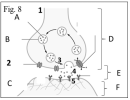 If the synapse is a neuromuscular junction, then there is a(an)
_________ at step ____ in response to release of ________ at step
_______.
A) action potential; 1; acetylcholine; 4
B) inhibitory post-synaptic potential; 2;
norepinephrine; 5
C) second messenger released; 5; epinephrine; 4
D) exhibitory post-synaptic potential; 5;
acetylcholine; 4
please explain!
EF 4.5 3 2
If the synapse is a neuromuscular junction, then there is a(an)
_________ at step ____ in response to release of ________ at step
_______.
A) action potential; 1; acetylcholine; 4
B) inhibitory post-synaptic potential; 2;
norepinephrine; 5
C) second messenger released; 5; epinephrine; 4
D) exhibitory post-synaptic potential; 5;
acetylcholine; 4
please explain!
EF 4.5 3 2
4. Draw a synapse between 2 neurons. Label the following: Presynaptic neuron, Postsynaptic neuron, Synaptic vesicles,...
 4. Draw a synapse between 2 neurons. Label the following: Presynaptic neuron, Postsynaptic neuron, Synaptic vesicles, Voltage-regulated calcium channel, Chemical-regulated sodium channel. 5. Draw a diagram of the preganglionic neuron, postganglionic neuron, and effector for both Sympathetic Nervous System and Parasympathetic Nervous System. indicate which neurotransmitter is released by each neuron and label the receptors at all locations for the neurotransmitter. 6. Which cells have a resting membrane potential? Which cells can have an action potential? 7. Circle which of...
Please answers all the questions. Thank you 13. List the events that happen in the post-synaptic...
 Please answers all the questions. Thank you
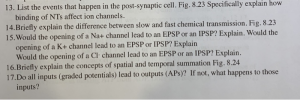
13. List the events that happen in the post-synaptic cell. Fig. 8.23 Specifically explain how binding of NTs affection channels. 14.Briefly explain the difference between slow and fast chemical transmission. Fig. 8.23 15. Would the opening of a Na+ channel lead to an EPSP or an IPSP? Explain. Would the opening of a K+ channel lead to an EPSP or IPSP? Explain Would the opening of a Cl channel lead to an EPSP...
Please answers all the questions. Thank you
13. List the events that happen in the post-synaptic cell. Fig. 8.23 Specifically explain how binding of NTs affection channels. 14.Briefly explain the difference between slow and fast chemical transmission. Fig. 8.23 15. Would the opening of a Na+ channel lead to an EPSP or an IPSP? Explain. Would the opening of a K+ channel lead to an EPSP or IPSP? Explain Would the opening of a Cl channel lead to an EPSP...
 2. Long-term Potentiation is a process that strengthens the transmission of a single synapse in a circuit. This is achieved when pre-synaptic cells and post-synaptic cells fire action potentials at the same time. Usually multiple pre-synaptic cells synapse onto one post-synaptic cell, increasing the probability of inducing an action potential in the post- synaptic cell. You may need to refer to your textbooks or online resources for this question, as we do not cover this in explicit detail in class....
 If the synapse is a neuromuscular junction, then there is a(an)
_________ at step ____ in response to release of ________ at step
_______.
A) action potential; 1; acetylcholine; 4
B) inhibitory post-synaptic potential; 2;
norepinephrine; 5
C) second messenger released; 5; epinephrine; 4
D) exhibitory post-synaptic potential; 5;
acetylcholine; 4
please explain!
EF 4.5 3 2
If the synapse is a neuromuscular junction, then there is a(an)
_________ at step ____ in response to release of ________ at step
_______.
A) action potential; 1; acetylcholine; 4
B) inhibitory post-synaptic potential; 2;
norepinephrine; 5
C) second messenger released; 5; epinephrine; 4
D) exhibitory post-synaptic potential; 5;
acetylcholine; 4
please explain!
EF 4.5 3 2
 4. Draw a synapse between 2 neurons. Label the following: Presynaptic neuron, Postsynaptic neuron, Synaptic vesicles, Voltage-regulated calcium channel, Chemical-regulated sodium channel. 5. Draw a diagram of the preganglionic neuron, postganglionic neuron, and effector for both Sympathetic Nervous System and Parasympathetic Nervous System. indicate which neurotransmitter is released by each neuron and label the receptors at all locations for the neurotransmitter. 6. Which cells have a resting membrane potential? Which cells can have an action potential? 7. Circle which of...
 Please answers all the questions. Thank you
13. List the events that happen in the post-synaptic cell. Fig. 8.23 Specifically explain how binding of NTs affection channels. 14.Briefly explain the difference between slow and fast chemical transmission. Fig. 8.23 15. Would the opening of a Na+ channel lead to an EPSP or an IPSP? Explain. Would the opening of a K+ channel lead to an EPSP or IPSP? Explain Would the opening of a Cl channel lead to an EPSP...
Please answers all the questions. Thank you
13. List the events that happen in the post-synaptic cell. Fig. 8.23 Specifically explain how binding of NTs affection channels. 14.Briefly explain the difference between slow and fast chemical transmission. Fig. 8.23 15. Would the opening of a Na+ channel lead to an EPSP or an IPSP? Explain. Would the opening of a K+ channel lead to an EPSP or IPSP? Explain Would the opening of a Cl channel lead to an EPSP...
Most questions answered within 3 hours.
-
Where is the error in this code sequence?
String s1 = "Hello";
String s2 = "ello";...
asked 11 months ago -
Financial data for Joel de Paris, Inc., for last year
follow:
Joel de Paris, Inc.
Balance...
asked 11 months ago -
Consider this reaction:
Al2(SO4)3 (aq)+ BaCl3
(aq) Al2Cl6 (aq)- +
3BaSO4(s) . What is the...
asked 11 months ago -
Suppose that Savneet is considering increasing her
recent random sample from 20 car rentals to 40...
asked 11 months ago -
Trucks arrive at an unloading terminal at an average rate of 120
per hour.
Trucks arrive...
asked 11 months ago -
Why are methanol and ethanol completely soluble in water while
octanol is not very little soluble....
asked 11 months ago -
A facilities manager at a university reads in a research report
that the mean amount of...
asked 11 months ago -
When the CuSO4 is rehydrated by adding water to the anhydrous
compound, is this an endothermic...
asked 11 months ago -
A ray of sunlight is passing from diamond into crown glass; the
angle of incidence is...
asked 11 months ago -
A block of mass 0.249 kg is placed on top of a light, vertical
spring of...
asked 11 months ago -
how do the kidneys compensate in the presences of acidosis
a) trigger hyperventilate
b) reserve acid...
asked 11 months ago -
Question 501 pts
The rental rate of capital to the firm increases. Which of the
following...
asked 11 months ago