5) A raindrop having no initial mass and zero velocity falls through a stationary cloud. It...
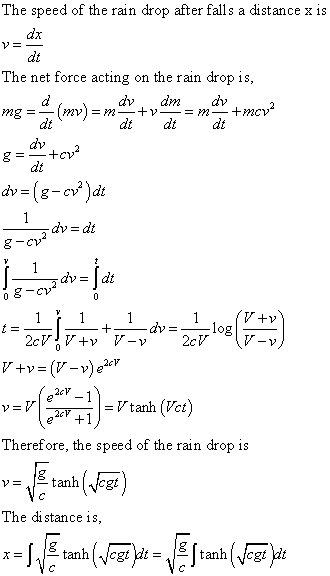
5) A raindrop having no initial mass and zero velocity falls through a stationary cloud. It accumulates mass at a constant rate k. It is subject to air resistance having magnitude cv, where v is the speed of the raindrop and c is a constant. Find an expression for the velocity and position of the raindrop at time t.
Homework Answers
Add Answer to:
5) A raindrop having no initial mass and zero velocity falls
through a stationary cloud. It...
2.) As a raindrop falls through a cloud, it collides with smaller droplets of mist and...
 2.) As a raindrop falls through a cloud, it collides with smaller droplets of mist and grows in mass (a) Derive a differential equation that relates the mass and velocity of the drop as it falls and accretes mass. Hint: Do NOT just differentiate d(mv)/dt, but start with the impulse-momentum theorem in differential form, like we did in the derivation of the rocket equation. Your "system" should include the raindrop itself and a small mass Δm of droplets with which...
A raindrop falls vertically through a stationary mist
A raindrop falls vertically through stationary mist, collecting mass as it falls. The raindrop remains spherical and the rate of mass accretion is proportional toits speed and the square of its radius. Show that, if the drop starts from rest with a negligible radius, then it has constant acceleration g/7. [Tricky ODE.]
A raindrop with initial mass 'M', from rest begins to fall due to gravity. The drop...
A raindrop with initial mass 'M', from rest begins to fall due to gravity. The drop gains mass due to the cloud, which is proportional to its mass and velocity: where 'k' is a constant. a) Show that the rain drops acceleration follows the case when the air resistance is given by: . b) Even though we are not assuming air resistance, what is the terminal velocity? We were unable to transcribe this imageC2U
A spherical raindrop (r = 0.0015 m) falls from a cloud. The drag coefficient is 0.60....
A spherical raindrop (r = 0.0015 m) falls from a cloud. The drag coefficient is 0.60. The density of the water is 1000 kg/m^3 and the density of the air it falls through is 1.2 kg/m^3. The shape of the drop doesn’t change during the fall, and the terminal velocity is 7.3 m/s. At this terminal speed, what is the magnitude of the resistive force acting on the drop?
A spherical raindrop of mass 0.00985 g and radius 1.33 mm falls from a cloud that...
A spherical raindrop of mass 0.00985 g and radius 1.33 mm falls from a cloud that is at a height of 1299 m above the ground. Assume the drag coefficient for the raindrop is 0.60 and the density of the air is 1.3 kg/m3. What is the raindrop's terminal speed? Please describe a steps
1) As a raindrop falls through the atmosphere, its speed initially changes as it falls toward...
 1) As a raindrop falls through the atmosphere, its speed initially changes as it falls toward the Earth. Before the raindrop reaches its terminal speed, the magnitude of its acceleration A. increases B. decreases C. stays constant at zero D. stays constant at 9.8 m/s? E. stays constant at a value not equal to zero nor 9.8 m/s2 The position vector of a particle is given by r(t) = 2tî + 3t2ġ where ř is measured in metres and t...
(7%) Problem 14: A spherical rain drop of radius R and mass M falls vertically through...
 (7%) Problem 14: A spherical rain drop of radius R and mass M falls vertically through a cloud layer. The drop enters the cloud layer at a height H from the ground and exits the cloud at a height h. While inside the cloud the drop accumulates water molecules so that its mass and size grow with time. The mass of the rain drop at time t when inside the cloud is given as follows: m(t) = M + at...
5. In certain circumstances, we can model the velocity of a falling mass subject to air...
 5. In certain circumstances, we can model the velocity of a falling mass subject to air resistance as - dv m7 = mg – kv?, where v (t) is the velocity of the object, m is the mass of the object, g is acceleration due to gravity, and k is a constant of proportionality. Assume the positive direction is downward. (a) Solve this equation subect to the initial condition v (0) = vo. (b) What is the terminal velocity of...
In (14) of Section 1.3 we saw that a differential equation describing the velocity v of...
 In (14) of Section 1.3 we saw that a differential equation describing the velocity v of a falling mass subject to air resistance proportional to the instantaneous velocity is dv dt where k> 0 is a constant of proportionality. The positive direction is downward (a) Solve the equation subject to the initial condition vo)o (b) Use the solution in part (a) to determine the limiting, or terminal, velocity of the mass c) If the distance s measured from the point...
(2 points) A body of mass 4 kg is projected vertically upward with an initial velocity 40 meters ...
 (2 points) A body of mass 4 kg is projected vertically upward with an initial velocity 40 meters per second. The gravitational constant is g-9.8m/82. The air resistance is equal to kļul where k is a constant. Find a formula for the velocity at any time ( in terms of k ): Find the limit of this velocity for a fixed time t0 as the air resistance coefficient k goes to O. (Enter t0 as tzero.) (t0) How does this...
 2.) As a raindrop falls through a cloud, it collides with smaller droplets of mist and grows in mass (a) Derive a differential equation that relates the mass and velocity of the drop as it falls and accretes mass. Hint: Do NOT just differentiate d(mv)/dt, but start with the impulse-momentum theorem in differential form, like we did in the derivation of the rocket equation. Your "system" should include the raindrop itself and a small mass Δm of droplets with which...
 1) As a raindrop falls through the atmosphere, its speed initially changes as it falls toward the Earth. Before the raindrop reaches its terminal speed, the magnitude of its acceleration A. increases B. decreases C. stays constant at zero D. stays constant at 9.8 m/s? E. stays constant at a value not equal to zero nor 9.8 m/s2 The position vector of a particle is given by r(t) = 2tî + 3t2ġ where ř is measured in metres and t...
 (7%) Problem 14: A spherical rain drop of radius R and mass M falls vertically through a cloud layer. The drop enters the cloud layer at a height H from the ground and exits the cloud at a height h. While inside the cloud the drop accumulates water molecules so that its mass and size grow with time. The mass of the rain drop at time t when inside the cloud is given as follows: m(t) = M + at...
 5. In certain circumstances, we can model the velocity of a falling mass subject to air resistance as - dv m7 = mg – kv?, where v (t) is the velocity of the object, m is the mass of the object, g is acceleration due to gravity, and k is a constant of proportionality. Assume the positive direction is downward. (a) Solve this equation subect to the initial condition v (0) = vo. (b) What is the terminal velocity of...
 In (14) of Section 1.3 we saw that a differential equation describing the velocity v of a falling mass subject to air resistance proportional to the instantaneous velocity is dv dt where k> 0 is a constant of proportionality. The positive direction is downward (a) Solve the equation subject to the initial condition vo)o (b) Use the solution in part (a) to determine the limiting, or terminal, velocity of the mass c) If the distance s measured from the point...
 (2 points) A body of mass 4 kg is projected vertically upward with an initial velocity 40 meters per second. The gravitational constant is g-9.8m/82. The air resistance is equal to kļul where k is a constant. Find a formula for the velocity at any time ( in terms of k ): Find the limit of this velocity for a fixed time t0 as the air resistance coefficient k goes to O. (Enter t0 as tzero.) (t0) How does this...
Most questions answered within 3 hours.
-
Where is the error in this code sequence?
String s1 = "Hello";
String s2 = "ello";...
asked 11 months ago -
Financial data for Joel de Paris, Inc., for last year
follow:
Joel de Paris, Inc.
Balance...
asked 11 months ago -
Consider this reaction:
Al2(SO4)3 (aq)+ BaCl3
(aq) Al2Cl6 (aq)- +
3BaSO4(s) . What is the...
asked 11 months ago -
Suppose that Savneet is considering increasing her
recent random sample from 20 car rentals to 40...
asked 11 months ago -
Trucks arrive at an unloading terminal at an average rate of 120
per hour.
Trucks arrive...
asked 11 months ago -
Why are methanol and ethanol completely soluble in water while
octanol is not very little soluble....
asked 11 months ago -
A facilities manager at a university reads in a research report
that the mean amount of...
asked 11 months ago -
When the CuSO4 is rehydrated by adding water to the anhydrous
compound, is this an endothermic...
asked 11 months ago -
A ray of sunlight is passing from diamond into crown glass; the
angle of incidence is...
asked 11 months ago -
A block of mass 0.249 kg is placed on top of a light, vertical
spring of...
asked 11 months ago -
how do the kidneys compensate in the presences of acidosis
a) trigger hyperventilate
b) reserve acid...
asked 11 months ago -
Question 501 pts
The rental rate of capital to the firm increases. Which of the
following...
asked 11 months ago