Open-Response Homework Problem 14.4 A concave lens has a focal length of magnitude |f| = |5cm|....
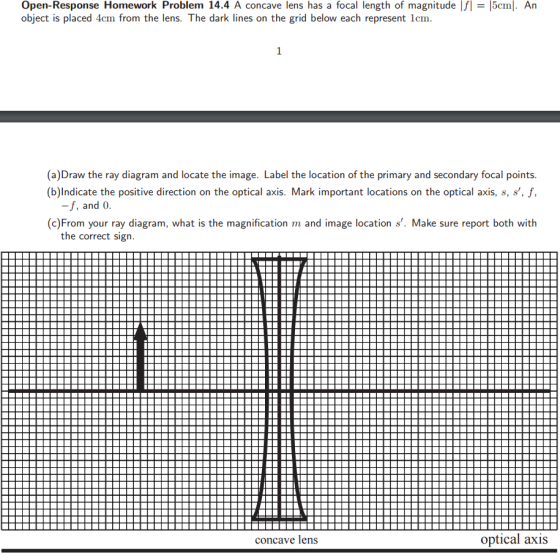
Open-Response Homework Problem 14.4 A concave lens has a focal length of magnitude |f| = |5cm|. An object is placed 4cm from the lens. The dark lines on the grid below each represent 1cm.
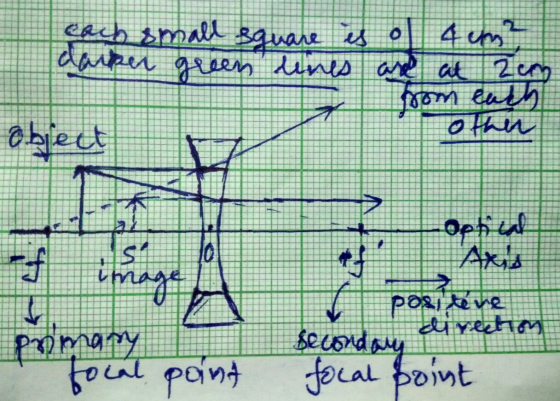
(a)Draw the ray diagram and locate the image. Label the location of the primary and secondary focal points.
(b)Indicate the positive direction on the optical axis. Mark important locations on the optical axis, s, s ? , f, ?f, and 0.
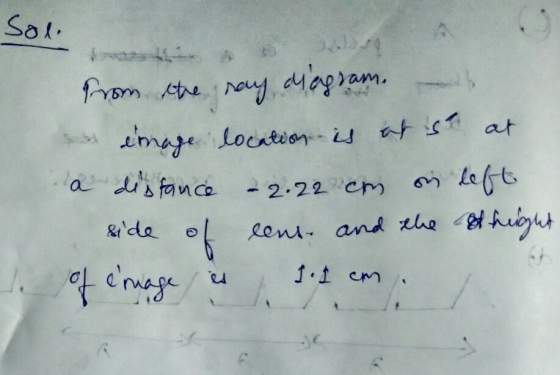
(c)From your ray diagram, what is the magnification m and image location s ? . Make sure report both with the correct sign.
Homework Answers
Please find the attached images
Add Answer to:
Open-Response Homework Problem 14.4 A concave lens has a focal
length of magnitude |f| = |5cm|....
Friday Homework Problem 13.14 A convex lens has a focal length of magnitude f = 3cm....
 Friday
Homework Problem 13.14 A convex lens has a focal length of
magnitude f = 3cm. An object is placed 5cm from the lens. The dark
lines on the grid below each represent 1cm. (a)[7 pt(s) ]Draw the
ray diagram and locate the image. Label the location of the primary
and secondary focal points. (b)[1 pt(s) ]Indicate the positive
direction on the optical axis. Mark important locations on the
optical axis. (c)[2 pt(s) ]From your ray diagram, what is the...
Friday
Homework Problem 13.14 A convex lens has a focal length of
magnitude f = 3cm. An object is placed 5cm from the lens. The dark
lines on the grid below each represent 1cm. (a)[7 pt(s) ]Draw the
ray diagram and locate the image. Label the location of the primary
and secondary focal points. (b)[1 pt(s) ]Indicate the positive
direction on the optical axis. Mark important locations on the
optical axis. (c)[2 pt(s) ]From your ray diagram, what is the...
Open Response Questions Wednesday Homework Problem 12.11 A convex lens has a focal length of magnitude...
 Open Response Questions Wednesday Homework Problem 12.11 A convex lens has a focal length of magnitude f = 3cm. An object is placed 8cm from the lens. The dark lines on the grid below each represent 1cm. (a) Draw the ray diagram and locate the image. Label the location of the primary and secondary focal points. (b)Indicate the positive direction on the optical axis. Mark important locations on the optical axis. (c)From your ray diagram, what is the magnification and...
Friday Homework Problem 13.12 A convex mirror has a focal length of magnitude |f| = 20cm....
 Friday
Homework Problem 13.12 A convex mirror has a focal length of
magnitude |f| = 20cm. An object is placed 13cm from the mirror.
(a)[10 pt(s) ]Draw the ray diagram with all possible rays and
locate the image. Label all relevant points and mark important
locations on the optical axis. The large block in the figure below
are 5cm. (b)[2 pt(s) ]From your ray diagram, what is the
magnification and image location? Make sure to report both with the
correct...
Friday
Homework Problem 13.12 A convex mirror has a focal length of
magnitude |f| = 20cm. An object is placed 13cm from the mirror.
(a)[10 pt(s) ]Draw the ray diagram with all possible rays and
locate the image. Label all relevant points and mark important
locations on the optical axis. The large block in the figure below
are 5cm. (b)[2 pt(s) ]From your ray diagram, what is the
magnification and image location? Make sure to report both with the
correct...
Problem 1. A concave-convex lens with index of refraction n = 3/2, radii of curvature R1...
Problem 1. A concave-convex lens with index of refraction n = 3/2, radii of curvature R1 = ?3cm and R2 = 1cm is 4cm to the left of a diverging lens having focal length ?2cm. An object is placed to the left of both lenses at a distance 7 cm from the concave-convex lens. (a) Where is the final image formed by this combination of lenses? (b) Is the final image upright or inverted? (c) Is the final image real...
A spherical lens has a magnification is +3.0. (a) Determine the focal length in terms of...
A spherical lens has a magnification is +3.0. (a) Determine the focal length in terms of the object distance. (b) Suppose the object is located 6.0 cm to the left of the mirror. What are the focal length and image distance? (c) Is the lens concave or convex? (d) Using a ray diagram, confirm the locations of the image and focal point.
a) Suppose an object is placed 7.50cm from a converging lens with a 5cm focal length....
a) Suppose an object is placed 7.50cm from a converging lens with a 5cm focal length. Use ray tracing to get the image and measure image distance. Describe the image: (upright or inverted, real or virtual, bigger or smaller). b) Use the lens equations to calculate the location of the image and its magnification. Describe the image: (upright or inverted, real or virtual, bigger or smaller).
A converging lens L_1 has a focal length of 10 cm. A 5cm tall object is...
 A converging lens L_1 has a focal length of 10 cm. A 5cm tall object is located 15cm to the left of L_1. Construct a ray diagram indicating the position and vertical orientation of the image produced by lens L_1. Calculate this position and see that it matches your diagram. A diverging lens L_2 with a focal length of -20 cm is placed 40cm on the right of lens L_1. The image in (a) above now serves as the object...
A concave mirror has a focal length of 45 cm. An object is placed 35 cm...
A concave mirror has a focal length of 45 cm. An object is placed 35 cm from the mirror. a. Draw the ray tracing diagram to locate the image. Is the image real or virtual? b. Calculate the image location and the magnification for the image. Compare your results with part a. c. What would the image location and magnification be if the object were 55 cm from the mirror?
The focal length of a diverging lens is negative. If f = −23 cm for a...
The focal length of a diverging lens is negative. If f = −23 cm for a particular diverging lens, where will the image be formed of an object located 32 cm to the left of the lens on the optical axis? ______cm to the left of the lens? What is the magnification of the image? b. A small object is placed to the left of a convex lens and on its optical axis. The object is 29 cm from the...
A diverging lens has a focal length of 65 cm. It is located 90 cm from...
A diverging lens has a focal length of 65 cm. It is located 90 cm from an object. a. Draw the ray tracing diagram to locate the image. Is the image real or virtual? b. Calculate the image location and the magnification for the image. Compare your results with part a.
 Friday
Homework Problem 13.14 A convex lens has a focal length of
magnitude f = 3cm. An object is placed 5cm from the lens. The dark
lines on the grid below each represent 1cm. (a)[7 pt(s) ]Draw the
ray diagram and locate the image. Label the location of the primary
and secondary focal points. (b)[1 pt(s) ]Indicate the positive
direction on the optical axis. Mark important locations on the
optical axis. (c)[2 pt(s) ]From your ray diagram, what is the...
Friday
Homework Problem 13.14 A convex lens has a focal length of
magnitude f = 3cm. An object is placed 5cm from the lens. The dark
lines on the grid below each represent 1cm. (a)[7 pt(s) ]Draw the
ray diagram and locate the image. Label the location of the primary
and secondary focal points. (b)[1 pt(s) ]Indicate the positive
direction on the optical axis. Mark important locations on the
optical axis. (c)[2 pt(s) ]From your ray diagram, what is the...
 Open Response Questions Wednesday Homework Problem 12.11 A convex lens has a focal length of magnitude f = 3cm. An object is placed 8cm from the lens. The dark lines on the grid below each represent 1cm. (a) Draw the ray diagram and locate the image. Label the location of the primary and secondary focal points. (b)Indicate the positive direction on the optical axis. Mark important locations on the optical axis. (c)From your ray diagram, what is the magnification and...
 Friday
Homework Problem 13.12 A convex mirror has a focal length of
magnitude |f| = 20cm. An object is placed 13cm from the mirror.
(a)[10 pt(s) ]Draw the ray diagram with all possible rays and
locate the image. Label all relevant points and mark important
locations on the optical axis. The large block in the figure below
are 5cm. (b)[2 pt(s) ]From your ray diagram, what is the
magnification and image location? Make sure to report both with the
correct...
Friday
Homework Problem 13.12 A convex mirror has a focal length of
magnitude |f| = 20cm. An object is placed 13cm from the mirror.
(a)[10 pt(s) ]Draw the ray diagram with all possible rays and
locate the image. Label all relevant points and mark important
locations on the optical axis. The large block in the figure below
are 5cm. (b)[2 pt(s) ]From your ray diagram, what is the
magnification and image location? Make sure to report both with the
correct...
 A converging lens L_1 has a focal length of 10 cm. A 5cm tall object is located 15cm to the left of L_1. Construct a ray diagram indicating the position and vertical orientation of the image produced by lens L_1. Calculate this position and see that it matches your diagram. A diverging lens L_2 with a focal length of -20 cm is placed 40cm on the right of lens L_1. The image in (a) above now serves as the object...
Most questions answered within 3 hours.
-
Where is the error in this code sequence?
String s1 = "Hello";
String s2 = "ello";...
asked 10 months ago -
Financial data for Joel de Paris, Inc., for last year
follow:
Joel de Paris, Inc.
Balance...
asked 10 months ago -
Consider this reaction:
Al2(SO4)3 (aq)+ BaCl3
(aq) Al2Cl6 (aq)- +
3BaSO4(s) . What is the...
asked 10 months ago -
Suppose that Savneet is considering increasing her
recent random sample from 20 car rentals to 40...
asked 10 months ago -
Trucks arrive at an unloading terminal at an average rate of 120
per hour.
Trucks arrive...
asked 10 months ago -
Why are methanol and ethanol completely soluble in water while
octanol is not very little soluble....
asked 10 months ago -
A facilities manager at a university reads in a research report
that the mean amount of...
asked 10 months ago -
When the CuSO4 is rehydrated by adding water to the anhydrous
compound, is this an endothermic...
asked 10 months ago -
A ray of sunlight is passing from diamond into crown glass; the
angle of incidence is...
asked 10 months ago -
A block of mass 0.249 kg is placed on top of a light, vertical
spring of...
asked 10 months ago -
how do the kidneys compensate in the presences of acidosis
a) trigger hyperventilate
b) reserve acid...
asked 10 months ago -
Question 501 pts
The rental rate of capital to the firm increases. Which of the
following...
asked 10 months ago