
Homework Answers
Chapter 09, Problem 058 In the figure, block 2 (mass 1.40 kg) is at rest on...
 Chapter 09, Problem 058 In the figure, block 2 (mass 1.40 kg) is at rest on a frictionless surface and touching the end of an unstretched spring of spring constant 109 N/m. The other end of the spring is foxed to a wall. Block 1 (mass 1.20 kg), traveling at speed v1 - 4.10 m/s, collides with block 2, and the two blocks stick together. When the blocks momentarily stop, by what distance is the spring compressed? Number Units
Block 2 (mass 1.10 kg) is at rest on a frictionless surface and touching the end...
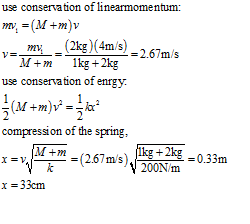
Block 2 (mass 1.10 kg) is at rest on a frictionless surface and touching the end of an unstretched spring of spring constant 144 N/m. The other end of the spring is fixed to a wall. Block 1 (mass 1.70 kg), traveling at speed v1 = 3.60 m/s, collides with block 2, and the two blocks stick together. When the blocks momentarily stop, by what distance is the spring compressed? Answer 0.305 m My question is how did they solve...
PRINTER VERSION 4 BACK NEXT Chapter 09, Problem 058 In the figure, block 2 (mass 1.70...
 PRINTER VERSION 4 BACK NEXT Chapter 09, Problem 058 In the figure, block 2 (mass 1.70 kg) is at rest on a frictionless surface and touching the end of an unstretched spring of spring constant 264 N/m. The other end of the spring is fixed to a wall. Block 1 (mass 1.70 kg), traveling at speed - 4,30 m/s, colides with block 2, and the two blocks stick together. When the blocks momentarily stop, by what distance is the spring...
A solid block of mass m2 = 2.3 kg, at rest on a horizontalfrictionless surface,...
A solid block of mass m2 = 2.3 kg, at rest on a horizontal frictionless surface, is connected to a relaxed spring (with spring constant k = 260 N/m whose other end is fixed. Another solid block of mass m1 = 2.2 kg and speed v1 = 3.3 m/s collides with the 2.30 kg block. If the blocks stick together, what is their speed immediately after the collision?What is the maximum compression of the spring?
siqnment FULL SCREEN PRINTER VERSION i BACK CES Chapter 09, Probdem 05n In the figure, block...
 siqnment FULL SCREEN PRINTER VERSION i BACK CES Chapter 09, Probdem 05n In the figure, block 2 tmass 1.90 kg) is at rest on a frictionless saface and tosheng the end of an unstretched spring of song constant 160 N/n the ether end of the spring is foed to a wall Block1 (mass 1.60 kg), traveng at speed v 5.20 m/s, colldes with toik 2, nt the twe ecks sck together When the ocks momentanly soo, by mhat dsances the...
6. Consider a horizontal spring with spring constant k. A block with mass m is pushed...
 6. Consider a horizontal spring with spring constant k. A block with mass m is pushed far to the left against the spring until the spring is compressed a distance r relative to its relaxed length. A second block, which is stationary and also has a mass m, is located to the right of the spring im rrm a) We release the first block from rest. Due to the force from the spring, it slides to the right and eventually...
Block A in (Figure 1) has mass 1.00 kg, and block B has mass 3.00 kg....
 Block A in (Figure 1) has mass 1.00 kg, and block
B has mass 3.00 kg. The blocks are forced together,
compressing a spring S between them; then the system is
released from rest on a level, frictionless surface. The spring,
which has negligible mass, is not fastened to either block and
drops to the surface after it has expanded. The spring has force
constant 711 N/m and is initially compressed 0.225 m from its
original length.
a.What is the...
Block A in (Figure 1) has mass 1.00 kg, and block
B has mass 3.00 kg. The blocks are forced together,
compressing a spring S between them; then the system is
released from rest on a level, frictionless surface. The spring,
which has negligible mass, is not fastened to either block and
drops to the surface after it has expanded. The spring has force
constant 711 N/m and is initially compressed 0.225 m from its
original length.
a.What is the...
Block A of mass, mA = 1.7 kg is shot from a spring device of spring...
Block A of mass, mA = 1.7 kg is shot from a spring device of spring constant, k = 700 N/m along a frictionless horizontal surface. The initial compression of the spring is 0.300 m. The shot makes the block rise to another horizontal level at a height h= 1m above the first. On this horizontal it collides with another stationary block B of mass mB = 3.5 kg. The blocks stick together and encounter a rough surface. The blocks...
6. Consider a horizontal spring with spring constant k. A block with mass m is pushed far to the left against the spring until the spring is compressed a distance r relative to its relaxed length. A...
 6. Consider a horizontal spring with spring constant k. A block with mass m is pushed far to the left against the spring until the spring is compressed a distance r relative to its relaxed length. A second block, which is stationary and also has a mass m, is located to the right of the spring im rrm a) We release the first block from rest. Due to the force from the spring, it slides to the right and eventually...
Question 5 In the figure, a block of mass m = 3.50 kg slides from rest...
 Question 5 In the figure, a block of mass m = 3.50 kg slides from rest a distance d down a frictionless incline at angle 9 = 27.0° where it runs into a spring of spring constant 470 N/m. When the block momentarily stops, it has compressed the spring by 20.0 cm. What are (a) distance d and (b) the distance between the point of the first block-spring contact and the point where the block's speed is greatest? A (a)...
 Chapter 09, Problem 058 In the figure, block 2 (mass 1.40 kg) is at rest on a frictionless surface and touching the end of an unstretched spring of spring constant 109 N/m. The other end of the spring is foxed to a wall. Block 1 (mass 1.20 kg), traveling at speed v1 - 4.10 m/s, collides with block 2, and the two blocks stick together. When the blocks momentarily stop, by what distance is the spring compressed? Number Units
 PRINTER VERSION 4 BACK NEXT Chapter 09, Problem 058 In the figure, block 2 (mass 1.70 kg) is at rest on a frictionless surface and touching the end of an unstretched spring of spring constant 264 N/m. The other end of the spring is fixed to a wall. Block 1 (mass 1.70 kg), traveling at speed - 4,30 m/s, colides with block 2, and the two blocks stick together. When the blocks momentarily stop, by what distance is the spring...
 siqnment FULL SCREEN PRINTER VERSION i BACK CES Chapter 09, Probdem 05n In the figure, block 2 tmass 1.90 kg) is at rest on a frictionless saface and tosheng the end of an unstretched spring of song constant 160 N/n the ether end of the spring is foed to a wall Block1 (mass 1.60 kg), traveng at speed v 5.20 m/s, colldes with toik 2, nt the twe ecks sck together When the ocks momentanly soo, by mhat dsances the...
 6. Consider a horizontal spring with spring constant k. A block with mass m is pushed far to the left against the spring until the spring is compressed a distance r relative to its relaxed length. A second block, which is stationary and also has a mass m, is located to the right of the spring im rrm a) We release the first block from rest. Due to the force from the spring, it slides to the right and eventually...
 Block A in (Figure 1) has mass 1.00 kg, and block
B has mass 3.00 kg. The blocks are forced together,
compressing a spring S between them; then the system is
released from rest on a level, frictionless surface. The spring,
which has negligible mass, is not fastened to either block and
drops to the surface after it has expanded. The spring has force
constant 711 N/m and is initially compressed 0.225 m from its
original length.
a.What is the...
Block A in (Figure 1) has mass 1.00 kg, and block
B has mass 3.00 kg. The blocks are forced together,
compressing a spring S between them; then the system is
released from rest on a level, frictionless surface. The spring,
which has negligible mass, is not fastened to either block and
drops to the surface after it has expanded. The spring has force
constant 711 N/m and is initially compressed 0.225 m from its
original length.
a.What is the...
 6. Consider a horizontal spring with spring constant k. A block with mass m is pushed far to the left against the spring until the spring is compressed a distance r relative to its relaxed length. A second block, which is stationary and also has a mass m, is located to the right of the spring im rrm a) We release the first block from rest. Due to the force from the spring, it slides to the right and eventually...
 Question 5 In the figure, a block of mass m = 3.50 kg slides from rest a distance d down a frictionless incline at angle 9 = 27.0° where it runs into a spring of spring constant 470 N/m. When the block momentarily stops, it has compressed the spring by 20.0 cm. What are (a) distance d and (b) the distance between the point of the first block-spring contact and the point where the block's speed is greatest? A (a)...
Most questions answered within 3 hours.
-
Where is the error in this code sequence?
String s1 = "Hello";
String s2 = "ello";...
asked 11 months ago -
Financial data for Joel de Paris, Inc., for last year
follow:
Joel de Paris, Inc.
Balance...
asked 11 months ago -
Consider this reaction:
Al2(SO4)3 (aq)+ BaCl3
(aq) Al2Cl6 (aq)- +
3BaSO4(s) . What is the...
asked 11 months ago -
Suppose that Savneet is considering increasing her
recent random sample from 20 car rentals to 40...
asked 11 months ago -
Trucks arrive at an unloading terminal at an average rate of 120
per hour.
Trucks arrive...
asked 11 months ago -
Why are methanol and ethanol completely soluble in water while
octanol is not very little soluble....
asked 11 months ago -
A facilities manager at a university reads in a research report
that the mean amount of...
asked 11 months ago -
When the CuSO4 is rehydrated by adding water to the anhydrous
compound, is this an endothermic...
asked 11 months ago -
A ray of sunlight is passing from diamond into crown glass; the
angle of incidence is...
asked 11 months ago -
A block of mass 0.249 kg is placed on top of a light, vertical
spring of...
asked 11 months ago -
how do the kidneys compensate in the presences of acidosis
a) trigger hyperventilate
b) reserve acid...
asked 11 months ago -
Question 501 pts
The rental rate of capital to the firm increases. Which of the
following...
asked 11 months ago