HOW TO find the Derivatives instrument that AT&T treaded and what is it position (heging ......)...
HOW TO find the Derivatives instrument that AT&T treaded and what is it position (heging ......)
can you show me the data since 2015-2018 that AT&T treaded ?
Homework Answers
Different types of derivatives have different pricing mechanisms. A derivative is a financial contract with a value based on an underlying asset. The most common derivative types are futures contracts, forward contracts, options and swaps. More exotic derivatives can be based on factors such as weather or carbon emissions.
Futures contracts are financial contracts to buy or sell an underlying commodity at a certain price in the future. Therefore, the futures contract's value is based on the commodity's cash price. For example, consider a corn futures contract that represents 5,000 bushels of corn. If corn is trading at $5 per bushel, the value of the contract is $25,000. Futures contracts are standardized to include a certain amount and quality of the underlying commodity, so they can be traded on a centralized exchange. The futures price moves in relation to the spot price for the commodity based on supply and demand for that commodity.
Options on stocks and exchange-traded funds are also common derivative contracts. Options give the buyer the right, as opposed to the obligation, to buy or sell 100 shares of a stock at a strike price for a predetermined amount of time.
The best-known pricing model for options is the Black-Scholes method. This method considers the underlying stock price, option strike price, time until the option expires, underlying stock volatility and risk-free interest rate to provide a value for the option.
AT&T Wireless Services uses derivative instruments primarily to manage exposure to fluctuations in interest rates, to lower its overall costs of financing, and to manage the mix of floating- and fixed-rate debt in its portfolio. Derivative instruments are not used for trading or speculative purposes. In accordance with SFAS No. 133, “Accounting for Derivative Instruments and Hedging Activities,” all derivatives, whether designated in hedging relationships or not, are recorded on the balance sheet at fair value. To qualify for hedge accounting treatment, each derivative must be designated as a hedge at inception and evaluated for effectiveness throughout the hedge period. If the derivative is designated as a fair value hedge, the changes in the fair value of the derivative and of the hedged item attributable to the hedged risk are recognized in the statement of operations. If the derivative is designated as a cash flow hedge, the effective portions of changes in the fair value of the derivative are recorded in other comprehensive income (loss) and are recognized in the statement of operations when the hedged item affects earnings. Changes in fair values of derivative instruments that are not designated as hedging instruments and ineffective portions of hedges, if any, are immediately recognized in the statement of operations.
Hedge accounting is discontinued prospectively if and when it is determined that either the derivative instrument no longer meets the requirements for hedge accounting as defined by SFAS No. 133; the derivative instrument expires or is sold, terminated, or exercised; or management determines that the designation of the derivative instrument as a hedging instrument is no longer appropriate. When hedge accounting is discontinued, the derivative instrument will continue to be carried at fair value on the balance sheet, with changes in fair value immediately recognized in the statement of operations, unless the derivative instrument has expired or been sold, terminated, or exercised. The related hedged item will be accounted for as follows, as applicable. Upon discontinuance of a fair value hedge of a recognized asset or liability, the hedged item will no longer be adjusted for changes in fair value. The previously recognized fair value adjustment will continue to be carried on the balance sheet and be amortized into the statement of operations over the remaining life of the underlying hedged item. Upon discontinuance of a hedge of a firm commitment because the hedged item no longer meets the definition of a firm commitment, any asset or liability that was recognized (as a result of an adjustment to the carrying amount for the firm commitment) will be derecognized with the corresponding gain or loss immediately recognized in the statement of operations. Finally, upon discontinuance of a hedge of a forecasted transaction because the transaction is no longer probable of occurring, any gains and losses that were accumulated in other comprehensive income (loss) will be recognized immediately in the statement of operations.
Cash flows from derivative instruments designated in hedging relationships are classified in the statements of cash flows under the same categories as the cash flows from the related assets, liabilities, or anticipated transactions.
In April 2003, the FASB issued SFAS No. 149, “Amendment of Statement 133 on Derivative Instruments and Hedging Activities.” This statement amends and clarifies accounting for derivative instruments, including certain derivative instruments embedded in other contracts, and for hedging activities under SFAS No. 133. AT&T Wireless Services’ initial adoption of this statement on July 1, 2003, did not have a material impact on its results of operations, financial position, or cash flows.
Add Answer to:
HOW TO find the Derivatives instrument that AT&T treaded and
what is it position (heging ......)...
In this assignment, you will discuss the current levels of derivatives in the United States. Go...
In this assignment, you will discuss the current levels of derivatives in the United States. Go to the Office of the Comptroller of the Currency Web site. Find the most recent levels of futures, forwards, options, swaps, and credit derivatives using the following steps: Click on “Publications.” From there, click on “Other Publications/Reports.” Then, click on “Quarterly Report on Bank Derivatives Activities.” Click on the most recent date, and download the latest report. The tables containing the data are at...
how to do you find an estimation of a error instrument how do you find the...
how to do you find an estimation of a error instrument how do you find the smallest increment on a school ruler with inches and centimeters to find the error ?
Make sure you show me all of your computations (TR, TC, and your partial derivatives). You...
Make sure you show me all of your computations (TR, TC, and your partial derivatives). You will be using the same data for the Cournot and Cartel problem. Find the quantities for both firms in both market types that maxes profit. As a stretch question how much profit does each Cournot firm make and what is the joint profit for the cartel. Assume: Market demand: P = 100 -.5Q1 - .5 Q2 TC1 = 4Q1 and TC2 = .25Q22
ds/de = v(t). Now time to implement some calculus! Let s(t) be the position of your...
 ds/de = v(t). Now time to implement some calculus! Let s(t) be the position of your car at time t. Since we can find distance traveled by finding a position function that satisfies this derivative relationship, then use it to compute As over the At = 4 hr time interval. I 4. 5) Find a position function s(t) that satisfies ds/dt = 8t and use it to find the distance traveled.
4. The position of an object as a function of time is given by x(t) at-bt...
 4. The position of an object as a function of time is given by x(t) at-bt ct-d, where a 3.6 m/s, b 4 m/s, c = 60 m/s and d= 7 m. (a) Find the instantaneous velocity at t =24 s. (b) Find the average velocity over the first 2.4 seconds, (c) Find the instantaneous acceleration at 2.4 s, (d) Find the average acceleration over the first 2.4 seconds. (Be sure to include the correct signs) (a) and (c) are...
Seismometer Project Imagine that we have a delicate instrument carefully mounted on a low-friction surface, and...
 Seismometer Project Imagine that we have a delicate instrument carefully mounted on a low-friction surface, and held in place laterally by springs. Delicate Instrument Very low friction Mounting frame fixed to Earth Since the mounting frame is fixed to the Earth, seismic movements such as earthquakes are our input into the system! The delicate instrument of mass 'm', on the other hand, wants to stay fixed relative to inertial space. Let's assume that the inertial position of the delicate instrument...
A particle moves in the plane with position given by the vector valued function r(t)=cos^3(t)i+sin^3(t)j MA330...
 A particle moves in the plane with position given by the
vector valued function r(t)=cos^3(t)i+sin^3(t)j
MA330 Homework #2 particle moves in the plane with position given by the vector-valued function The curve it generates is called an astrid and is plotted for you below. (a) Find the position att x/4 by evaluating r(x/4). Then draw this vector on the graph (b) Find the velocity vector vt)-r)-.Be sure to apply the power and (e) Find the velocity at t /4 by...
A particle moves in the plane with position given by the
vector valued function r(t)=cos^3(t)i+sin^3(t)j
MA330 Homework #2 particle moves in the plane with position given by the vector-valued function The curve it generates is called an astrid and is plotted for you below. (a) Find the position att x/4 by evaluating r(x/4). Then draw this vector on the graph (b) Find the velocity vector vt)-r)-.Be sure to apply the power and (e) Find the velocity at t /4 by...
A particle is moving with the given data. Find the position of the particle. a(t) =...
 A particle is moving with the given data. Find the position of
the particle.
a(t) = t’ – 4t + 6, s(0) = 0, s(1) = 20
A particle is moving with the given data. Find the position of
the particle.
a(t) = t’ – 4t + 6, s(0) = 0, s(1) = 20
A particle is moving with the given data. Find the position of the particle. a(t) =...
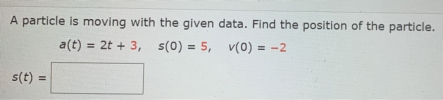 A particle is moving with the given data. Find the position of the particle. a(t) = 2t + 3, 5(0) = 5, V(0) = -2 s(t) =
Explain what is a fixed income derivative instrument? Your explanations should include numerous examples of such instru...
Explain what is a fixed income derivative instrument? Your explanations should include numerous examples of such instruments and a brief description of how they are valued, and under what context they are used. Discuss ways of measuring the different types of risks associated with such complex financial instruments. Provide examples to illustrate points Fixed income derivatives were instrumental in the financial crisis of 2008. Other than outright banning, what can be done to these instruments to ensure that they...
 ds/de = v(t). Now time to implement some calculus! Let s(t) be the position of your car at time t. Since we can find distance traveled by finding a position function that satisfies this derivative relationship, then use it to compute As over the At = 4 hr time interval. I 4. 5) Find a position function s(t) that satisfies ds/dt = 8t and use it to find the distance traveled.
 4. The position of an object as a function of time is given by x(t) at-bt ct-d, where a 3.6 m/s, b 4 m/s, c = 60 m/s and d= 7 m. (a) Find the instantaneous velocity at t =24 s. (b) Find the average velocity over the first 2.4 seconds, (c) Find the instantaneous acceleration at 2.4 s, (d) Find the average acceleration over the first 2.4 seconds. (Be sure to include the correct signs) (a) and (c) are...
 Seismometer Project Imagine that we have a delicate instrument carefully mounted on a low-friction surface, and held in place laterally by springs. Delicate Instrument Very low friction Mounting frame fixed to Earth Since the mounting frame is fixed to the Earth, seismic movements such as earthquakes are our input into the system! The delicate instrument of mass 'm', on the other hand, wants to stay fixed relative to inertial space. Let's assume that the inertial position of the delicate instrument...
 A particle moves in the plane with position given by the
vector valued function r(t)=cos^3(t)i+sin^3(t)j
MA330 Homework #2 particle moves in the plane with position given by the vector-valued function The curve it generates is called an astrid and is plotted for you below. (a) Find the position att x/4 by evaluating r(x/4). Then draw this vector on the graph (b) Find the velocity vector vt)-r)-.Be sure to apply the power and (e) Find the velocity at t /4 by...
A particle moves in the plane with position given by the
vector valued function r(t)=cos^3(t)i+sin^3(t)j
MA330 Homework #2 particle moves in the plane with position given by the vector-valued function The curve it generates is called an astrid and is plotted for you below. (a) Find the position att x/4 by evaluating r(x/4). Then draw this vector on the graph (b) Find the velocity vector vt)-r)-.Be sure to apply the power and (e) Find the velocity at t /4 by...
 A particle is moving with the given data. Find the position of
the particle.
a(t) = t’ – 4t + 6, s(0) = 0, s(1) = 20
A particle is moving with the given data. Find the position of
the particle.
a(t) = t’ – 4t + 6, s(0) = 0, s(1) = 20
 A particle is moving with the given data. Find the position of the particle. a(t) = 2t + 3, 5(0) = 5, V(0) = -2 s(t) =
Most questions answered within 3 hours.
-
Where is the error in this code sequence?
String s1 = "Hello";
String s2 = "ello";...
asked 11 months ago -
Financial data for Joel de Paris, Inc., for last year
follow:
Joel de Paris, Inc.
Balance...
asked 11 months ago -
Consider this reaction:
Al2(SO4)3 (aq)+ BaCl3
(aq) Al2Cl6 (aq)- +
3BaSO4(s) . What is the...
asked 11 months ago -
Suppose that Savneet is considering increasing her
recent random sample from 20 car rentals to 40...
asked 11 months ago -
Trucks arrive at an unloading terminal at an average rate of 120
per hour.
Trucks arrive...
asked 11 months ago -
Why are methanol and ethanol completely soluble in water while
octanol is not very little soluble....
asked 11 months ago -
A facilities manager at a university reads in a research report
that the mean amount of...
asked 11 months ago -
When the CuSO4 is rehydrated by adding water to the anhydrous
compound, is this an endothermic...
asked 11 months ago -
A ray of sunlight is passing from diamond into crown glass; the
angle of incidence is...
asked 11 months ago -
A block of mass 0.249 kg is placed on top of a light, vertical
spring of...
asked 11 months ago -
how do the kidneys compensate in the presences of acidosis
a) trigger hyperventilate
b) reserve acid...
asked 11 months ago -
Question 501 pts
The rental rate of capital to the firm increases. Which of the
following...
asked 11 months ago