
Homework Answers

![V. - 15.726_-112.1090] Nost In time domain ſ volt) = 15.726 Gs (t – 112.109) vor](http://img.homeworklib.com/questions/23593de0-d1c1-11ea-a34c-b90bc01dff7b.png?x-oss-process=image/resize,w_560)
Add Answer to:
please answer both questions in details
Q3. For the circuit below, find: a) The voltage V,...
Problem 4 (3 marks): Conducting spherical shells with radii a=10cm, b=20cm are maintained at potential difference...
 Problem 4 (3 marks): Conducting spherical shells with radii a=10cm, b=20cm are maintained at potential difference of 10V such that V(r=b)-0; V(r=a)=10V. The material between shells is dielectric with e-2.5 a. Find Vand D in the region between shells? b. Determine the total charge induced on the shells and capacitance of V= V(r) the shells? mn
Problem 4 (3 marks): Conducting spherical shells with radii a=10cm, b=20cm are maintained at potential difference of 10V such that V(r=b)-0; V(r=a)=10V. The material...
Problem 4 (3 marks): Conducting spherical shells with radii a=10cm, b=20cm are maintained at potential difference of 10V such that V(r=b)-0; V(r=a)=10V. The material between shells is dielectric with e-2.5 a. Find Vand D in the region between shells? b. Determine the total charge induced on the shells and capacitance of V= V(r) the shells? mn
Problem 4 (3 marks): Conducting spherical shells with radii a=10cm, b=20cm are maintained at potential difference of 10V such that V(r=b)-0; V(r=a)=10V. The material...
2) Consider a coaxial capacitor with two concentric metal cylinders of radii a and b (a...
 2) Consider a coaxial capacitor with two concentric metal cylinders of radii a and b (a < b), filled with a dielectric material whose permittivity e varies linearly from ea at r = a to Ep at r = b. a. Find the capacitance per unit length. b. Find the numerical value of the capacitance if the radii are 2 mm and 6 mm and the relative dielectric constant varies from 2.25 to 8.5, respectively.
The space between two concentric conducting spherical shells of radii b = 2.20 cm and a...
The space between two concentric conducting spherical shells of radii b = 2.20 cm and a = 1.20 cm is filled with a substance of dielectric constant κ = 24.2. A potential difference V = 50.0 V is applied across the inner and outer shells. Determine (a) the capacitance of the device, (b) the free charge q on the inner shell, and (c) the charge q induced along the surface of the inner shell.
The space between two concentric conducting spherical shells of radii b = 1.70 cm and a...
The space between two concentric conducting spherical shells of radii b = 1.70 cm and a = 1.20 cm is filled with a substance of dielectric constant κ = 20.5. A potential difference V = 62.0 V is applied across the inner and outer shells. (a) Determine the capacitance of the device. (b) Determine the free charge q on the inner shell. (c) Determine the charge q' induced along the surface of the inner shell.
A spherical capacitor is formed from two concentric spherical conducting shells separated by vacuum. The inner...
A spherical capacitor is formed from two concentric spherical conducting shells separated by vacuum. The inner sphere has a radius of ra = 12.4 cm , and the outer sphere has a radius of rb = 14.9 cm . A voltage of 120 V is applied to the capacitor. a) What is the capacitance of the capacitor? Use ϵ0 = 8.85×10⁻¹² F/m for the permittivity of free space b) What is the magnitude E1 of the electric field E⃗ at radius...
electromagnetic fields theory B: ANSWER ONLY ONE (1) QUESTION ON 5 120 MARKS gure 3 shows a spherical type capacitor...
 electromagnetic fields theory
B: ANSWER ONLY ONE (1) QUESTION ON 5 120 MARKS gure 3 shows a spherical type capacitor used to measure the volume of liquids, consists of wo spherical shells where the inner and outer radii given by a and b, respectively are Find the electric field E in the region a <r<bif the total charge on the surface ra is given by O 15 Marks C81, PO, 62 (ii) Express the potential difference V between r Derive...
electromagnetic fields theory
B: ANSWER ONLY ONE (1) QUESTION ON 5 120 MARKS gure 3 shows a spherical type capacitor used to measure the volume of liquids, consists of wo spherical shells where the inner and outer radii given by a and b, respectively are Find the electric field E in the region a <r<bif the total charge on the surface ra is given by O 15 Marks C81, PO, 62 (ii) Express the potential difference V between r Derive...
Please answer 1-3 A spherical capacitor is formed from two concentric spherical conducting shells separated by...
Please answer 1-3 A spherical capacitor is formed from two concentric spherical conducting shells separated by vacuum. The inner sphere has a radius of ra = 12.1 cm , and the outer sphere has a radius of rb = 15.1 cm . A potential difference of 120 V is applied to the capacitor. 1. What is the capacitance of the capacitor? Use ϵ0 = 8.85×10⁻¹² F/m for the permittivity of free space. 2.What is the magnitude E1 of the electric...
How do you solve these? The figure below displays a cross-section of a system composed of...
 How do you solve these?
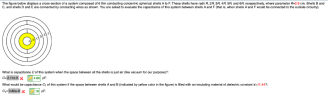
The figure below displays a cross-section of a system composed of 6 thin conducting concentric spherical shells A to F. These shells have radi R, 2R, 3R, 4R, 5R, and 6R, resepectively, where parameter R-2.6 cm. Shells B and C, and shells D and E are connected by conducting wires as shown. You are asked to evaluate the capacitance of this system between shells A and F (that is, when shells A and F would...
How do you solve these?
The figure below displays a cross-section of a system composed of 6 thin conducting concentric spherical shells A to F. These shells have radi R, 2R, 3R, 4R, 5R, and 6R, resepectively, where parameter R-2.6 cm. Shells B and C, and shells D and E are connected by conducting wires as shown. You are asked to evaluate the capacitance of this system between shells A and F (that is, when shells A and F would...
A spherical capacitor is formed from two concentric spherical conducting shells separated by vacuum. The inner...
A spherical capacitor is formed from two concentric spherical conducting shells separated by vacuum. The inner sphere has a radius of ra = 12.3 cm , and the outer sphere has a radius of rb = 15.0 cm . A potential difference of 120 V is applied to the capacitor. a) What is the capacitance of the capacitor? Use ϵ0 = 8.85×10⁻¹² F/m for the permittivity of free space. b)What is the magnitude E1 of the electric field E⃗ at radius...
FULL SCREEN PRINTER VERSION 4 BACK NEXT ASSIGNMENT RESOURCES Chapter 25, Problem 055 New Assignment 7-Ch....
 FULL SCREEN PRINTER VERSION 4 BACK NEXT ASSIGNMENT RESOURCES Chapter 25, Problem 055 New Assignment 7-Ch. 25 The space between two concentric conducting spherical shells of radii b2.40 cm and a 1.10 cm is filled with a substance of dielectric constant K 15.8. A potential difference V the inner and outer shells. Determine (a) the capacitance of the device, (b) the free charge q on the inner shell, and (the charge q induced along the surface of the inner shell...
 Problem 4 (3 marks): Conducting spherical shells with radii a=10cm, b=20cm are maintained at potential difference of 10V such that V(r=b)-0; V(r=a)=10V. The material between shells is dielectric with e-2.5 a. Find Vand D in the region between shells? b. Determine the total charge induced on the shells and capacitance of V= V(r) the shells? mn
Problem 4 (3 marks): Conducting spherical shells with radii a=10cm, b=20cm are maintained at potential difference of 10V such that V(r=b)-0; V(r=a)=10V. The material...
Problem 4 (3 marks): Conducting spherical shells with radii a=10cm, b=20cm are maintained at potential difference of 10V such that V(r=b)-0; V(r=a)=10V. The material between shells is dielectric with e-2.5 a. Find Vand D in the region between shells? b. Determine the total charge induced on the shells and capacitance of V= V(r) the shells? mn
Problem 4 (3 marks): Conducting spherical shells with radii a=10cm, b=20cm are maintained at potential difference of 10V such that V(r=b)-0; V(r=a)=10V. The material...
 2) Consider a coaxial capacitor with two concentric metal cylinders of radii a and b (a < b), filled with a dielectric material whose permittivity e varies linearly from ea at r = a to Ep at r = b. a. Find the capacitance per unit length. b. Find the numerical value of the capacitance if the radii are 2 mm and 6 mm and the relative dielectric constant varies from 2.25 to 8.5, respectively.
 electromagnetic fields theory
B: ANSWER ONLY ONE (1) QUESTION ON 5 120 MARKS gure 3 shows a spherical type capacitor used to measure the volume of liquids, consists of wo spherical shells where the inner and outer radii given by a and b, respectively are Find the electric field E in the region a <r<bif the total charge on the surface ra is given by O 15 Marks C81, PO, 62 (ii) Express the potential difference V between r Derive...
electromagnetic fields theory
B: ANSWER ONLY ONE (1) QUESTION ON 5 120 MARKS gure 3 shows a spherical type capacitor used to measure the volume of liquids, consists of wo spherical shells where the inner and outer radii given by a and b, respectively are Find the electric field E in the region a <r<bif the total charge on the surface ra is given by O 15 Marks C81, PO, 62 (ii) Express the potential difference V between r Derive...
 How do you solve these?
The figure below displays a cross-section of a system composed of 6 thin conducting concentric spherical shells A to F. These shells have radi R, 2R, 3R, 4R, 5R, and 6R, resepectively, where parameter R-2.6 cm. Shells B and C, and shells D and E are connected by conducting wires as shown. You are asked to evaluate the capacitance of this system between shells A and F (that is, when shells A and F would...
How do you solve these?
The figure below displays a cross-section of a system composed of 6 thin conducting concentric spherical shells A to F. These shells have radi R, 2R, 3R, 4R, 5R, and 6R, resepectively, where parameter R-2.6 cm. Shells B and C, and shells D and E are connected by conducting wires as shown. You are asked to evaluate the capacitance of this system between shells A and F (that is, when shells A and F would...
 FULL SCREEN PRINTER VERSION 4 BACK NEXT ASSIGNMENT RESOURCES Chapter 25, Problem 055 New Assignment 7-Ch. 25 The space between two concentric conducting spherical shells of radii b2.40 cm and a 1.10 cm is filled with a substance of dielectric constant K 15.8. A potential difference V the inner and outer shells. Determine (a) the capacitance of the device, (b) the free charge q on the inner shell, and (the charge q induced along the surface of the inner shell...
Most questions answered within 3 hours.
-
Where is the error in this code sequence?
String s1 = "Hello";
String s2 = "ello";...
asked 10 months ago -
Financial data for Joel de Paris, Inc., for last year
follow:
Joel de Paris, Inc.
Balance...
asked 10 months ago -
Consider this reaction:
Al2(SO4)3 (aq)+ BaCl3
(aq) Al2Cl6 (aq)- +
3BaSO4(s) . What is the...
asked 10 months ago -
Suppose that Savneet is considering increasing her
recent random sample from 20 car rentals to 40...
asked 10 months ago -
Trucks arrive at an unloading terminal at an average rate of 120
per hour.
Trucks arrive...
asked 10 months ago -
Why are methanol and ethanol completely soluble in water while
octanol is not very little soluble....
asked 10 months ago -
A facilities manager at a university reads in a research report
that the mean amount of...
asked 10 months ago -
When the CuSO4 is rehydrated by adding water to the anhydrous
compound, is this an endothermic...
asked 10 months ago -
A ray of sunlight is passing from diamond into crown glass; the
angle of incidence is...
asked 10 months ago -
A block of mass 0.249 kg is placed on top of a light, vertical
spring of...
asked 10 months ago -
how do the kidneys compensate in the presences of acidosis
a) trigger hyperventilate
b) reserve acid...
asked 10 months ago -
Question 501 pts
The rental rate of capital to the firm increases. Which of the
following...
asked 10 months ago