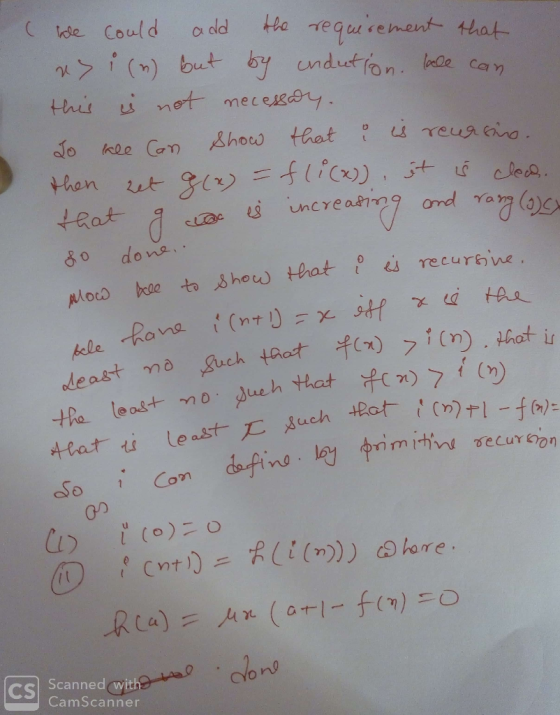
Is the following a theorem? Every infinite recursive subset of is the range of a strictly...
Is the following a theorem?
Every infinite recursive subset of is the
range of a strictly increasing primitive recursive function.
Homework Answers

Add Answer to:
Is the following a theorem?
Every infinite recursive subset of is the
range of a strictly...
Show that every infinite Turing-recognizable language is the range of some one-to-one computable function.
Show that every infinite Turing-recognizable language is the range of some one-to-one computable function.
Nearest point theorem: letF be a non-void closed subset of Rp and let x be a...
Nearest point theorem: letF be a non-void closed subset of Rp and let x be a point outside of F. Then there exists at least one point y belonging to F such that ||z - x|| greater than or equal to ||y -x|| for all z in F. Given the theorem, answer the question: Does the nearest point theorem in R imply that there is a strictly positive real number nearest zero?
Justify your answer to each of the following true/false statements: l. Every subset of a regular...
Justify your answer to each of the following true/false statements: l. Every subset of a regular set is regular 2. The intersection of a regular set with a finite set is regular 3. The union of a regular set with an infinite set is regular 4. The positive closure of a regular set is regular
Prove that every subset of N is either finite or countable. (Hint: use the ordering of...
Prove that every subset of N is either finite or countable. (Hint: use the ordering of N.) Conclude from this that there is no infinite set with cardinality less than that of N.
Real Analysis II Please do it without using Heine-Borel's theorem and do it only if you're sure Problem: Let E be a closed bounded subset of En and r be any function mapping E to (0,∞). Then t...
 Real Analysis II
Please do it without using Heine-Borel's theorem
and do it only if you're sure
Problem: Let E be a closed bounded subset of
En and r be any function mapping E to
(0,∞). Then there exists finitely many points yi ∈ E, i
= 1,...,N such that
Here Br(yi)(yi) is the open ball
(neighborhood) of radius r(yi) centered at
yi.
Also, following definitions & theorems should help
that
E CUBy Definition. A subset S of a topological...
Real Analysis II
Please do it without using Heine-Borel's theorem
and do it only if you're sure
Problem: Let E be a closed bounded subset of
En and r be any function mapping E to
(0,∞). Then there exists finitely many points yi ∈ E, i
= 1,...,N such that
Here Br(yi)(yi) is the open ball
(neighborhood) of radius r(yi) centered at
yi.
Also, following definitions & theorems should help
that
E CUBy Definition. A subset S of a topological...
Consider the integer knapsack problem. Give a recursive algorithm (call it Find-Optimal-Subset) that finds the optimal...
Consider the integer knapsack problem. Give a recursive algorithm (call it Find-Optimal-Subset) that finds the optimal subset of items through post-processing, that is, after filling in the memorization table to find the maximum total value of the optimal subset of items. (The algorithm we studied in class finds only the maximum total value, not the actual optimal subset of items.) Hint: Trace back through the array M[0..n,0..W] following the optimal structure.
A function f:R HR is said to be strictly increasing if f(x1) < f(12) whenever I]...
 A function f:R HR is said to be strictly increasing if f(x1) < f(12) whenever I] < 12. Prove: If a differentiable function f is strictly increasing, then f'(x) > 0. Then give counterexamples to show that the following statements are false, in general. (i) If a differentiable function f is strictly increasing, then f'(2) >0 for all 1. (ii) If f'(x) > 0 for all x, then f is strictly increasing -
answer question 5 please 3 and 4 are just included to refer to the theorems 3...
 answer question 5 please 3 and 4 are just included to
refer to the theorems
3 Prove the following theorem: Theorem 2.2. Let S be a ser. The following statements are equivalent: (1) S is a countable set, i. e. there exists an injective function :S (2) Either S is the empty ser 6 or there exists a surjective function g: N (3) Either S is a finite set or there exists a bijective function h: N S (4) Prove...
answer question 5 please 3 and 4 are just included to
refer to the theorems
3 Prove the following theorem: Theorem 2.2. Let S be a ser. The following statements are equivalent: (1) S is a countable set, i. e. there exists an injective function :S (2) Either S is the empty ser 6 or there exists a surjective function g: N (3) Either S is a finite set or there exists a bijective function h: N S (4) Prove...
Using strasses algorithm and know how to apply the Master Theorem on it. The recursive function...
Using strasses algorithm and know how to apply the Master Theorem on it. The recursive function is T(n) = 7T(n/2)+O(n^2) A = 7, b = 2, n^logba = n^2.81
Hint: Use the fundamental theorem of arithmetic. 15. Theorem 14.5 implies that Nx N is countably infinite. Construct an alternate proof of this fact by showing that the function ф : N x N 2n-1(...
 Hint: Use the fundamental theorem of arithmetic.
15. Theorem 14.5 implies that Nx N is countably infinite. Construct an alternate proof of this fact by showing that the function ф : N x N 2n-1(2m-1) is bijective. N defined as ф(m,n) It is also true that the Cartesian product of two countably infinite sets is itself countably infinite, as our next theorem states. Theorem 14.5 If A and B are both countably infinite, then so is A x B. Proof....
Hint: Use the fundamental theorem of arithmetic.
15. Theorem 14.5 implies that Nx N is countably infinite. Construct an alternate proof of this fact by showing that the function ф : N x N 2n-1(2m-1) is bijective. N defined as ф(m,n) It is also true that the Cartesian product of two countably infinite sets is itself countably infinite, as our next theorem states. Theorem 14.5 If A and B are both countably infinite, then so is A x B. Proof....
 Real Analysis II
Please do it without using Heine-Borel's theorem
and do it only if you're sure
Problem: Let E be a closed bounded subset of
En and r be any function mapping E to
(0,∞). Then there exists finitely many points yi ∈ E, i
= 1,...,N such that
Here Br(yi)(yi) is the open ball
(neighborhood) of radius r(yi) centered at
yi.
Also, following definitions & theorems should help
that
E CUBy Definition. A subset S of a topological...
Real Analysis II
Please do it without using Heine-Borel's theorem
and do it only if you're sure
Problem: Let E be a closed bounded subset of
En and r be any function mapping E to
(0,∞). Then there exists finitely many points yi ∈ E, i
= 1,...,N such that
Here Br(yi)(yi) is the open ball
(neighborhood) of radius r(yi) centered at
yi.
Also, following definitions & theorems should help
that
E CUBy Definition. A subset S of a topological...
 A function f:R HR is said to be strictly increasing if f(x1) < f(12) whenever I] < 12. Prove: If a differentiable function f is strictly increasing, then f'(x) > 0. Then give counterexamples to show that the following statements are false, in general. (i) If a differentiable function f is strictly increasing, then f'(2) >0 for all 1. (ii) If f'(x) > 0 for all x, then f is strictly increasing -
 answer question 5 please 3 and 4 are just included to
refer to the theorems
3 Prove the following theorem: Theorem 2.2. Let S be a ser. The following statements are equivalent: (1) S is a countable set, i. e. there exists an injective function :S (2) Either S is the empty ser 6 or there exists a surjective function g: N (3) Either S is a finite set or there exists a bijective function h: N S (4) Prove...
answer question 5 please 3 and 4 are just included to
refer to the theorems
3 Prove the following theorem: Theorem 2.2. Let S be a ser. The following statements are equivalent: (1) S is a countable set, i. e. there exists an injective function :S (2) Either S is the empty ser 6 or there exists a surjective function g: N (3) Either S is a finite set or there exists a bijective function h: N S (4) Prove...
 Hint: Use the fundamental theorem of arithmetic.
15. Theorem 14.5 implies that Nx N is countably infinite. Construct an alternate proof of this fact by showing that the function ф : N x N 2n-1(2m-1) is bijective. N defined as ф(m,n) It is also true that the Cartesian product of two countably infinite sets is itself countably infinite, as our next theorem states. Theorem 14.5 If A and B are both countably infinite, then so is A x B. Proof....
Hint: Use the fundamental theorem of arithmetic.
15. Theorem 14.5 implies that Nx N is countably infinite. Construct an alternate proof of this fact by showing that the function ф : N x N 2n-1(2m-1) is bijective. N defined as ф(m,n) It is also true that the Cartesian product of two countably infinite sets is itself countably infinite, as our next theorem states. Theorem 14.5 If A and B are both countably infinite, then so is A x B. Proof....
Most questions answered within 3 hours.
-
Where is the error in this code sequence?
String s1 = "Hello";
String s2 = "ello";...
asked 10 months ago -
Financial data for Joel de Paris, Inc., for last year
follow:
Joel de Paris, Inc.
Balance...
asked 10 months ago -
Consider this reaction:
Al2(SO4)3 (aq)+ BaCl3
(aq) Al2Cl6 (aq)- +
3BaSO4(s) . What is the...
asked 10 months ago -
Suppose that Savneet is considering increasing her
recent random sample from 20 car rentals to 40...
asked 10 months ago -
Trucks arrive at an unloading terminal at an average rate of 120
per hour.
Trucks arrive...
asked 10 months ago -
Why are methanol and ethanol completely soluble in water while
octanol is not very little soluble....
asked 10 months ago -
A facilities manager at a university reads in a research report
that the mean amount of...
asked 10 months ago -
When the CuSO4 is rehydrated by adding water to the anhydrous
compound, is this an endothermic...
asked 10 months ago -
A ray of sunlight is passing from diamond into crown glass; the
angle of incidence is...
asked 10 months ago -
A block of mass 0.249 kg is placed on top of a light, vertical
spring of...
asked 10 months ago -
how do the kidneys compensate in the presences of acidosis
a) trigger hyperventilate
b) reserve acid...
asked 10 months ago -
Question 501 pts
The rental rate of capital to the firm increases. Which of the
following...
asked 10 months ago