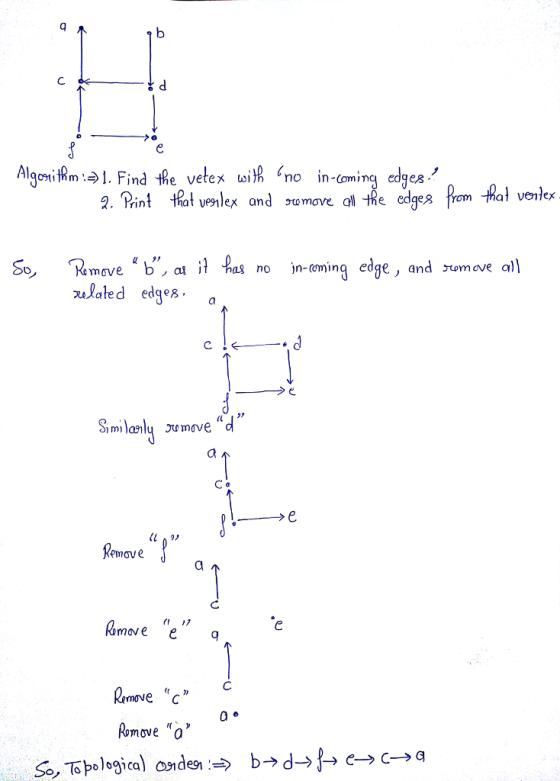
![5. [5 pts] Perform a topological sort on the poset below shown as a digraph, listing the vertices in a proper order.](http://img.homeworklib.com/questions/6d3b2c80-cf3c-11ea-98b2-ef8f841454c4.png?x-oss-process=image/resize,w_560)
Homework Answers
One of the possible order is below as there can be multiple possible topological sorted order:
Add Answer to:
5. [5 pts] Perform a topological sort on the poset below shown as a digraph, listing...
1. (5 pts) Perform topological sorting on the directed graph below. Show two orderings that can...
 1. (5 pts) Perform topological sorting on the directed graph below. Show two orderings that can result, such that no letter is in the same position in each ordering: e.g., D cannot be in the 3rd position in both orderings; if the algorithm does not finish, show the part of the graph that remains unprocessed (and explain why it remains unprocessed). Order 1 Order 2
2. (5 Points) Given adjacency list representation of a digraph below with 10 vertices from 0...
2. (5 Points) Given adjacency list representation of a digraph below with 10 vertices from 0 to 9, does it have a topological order? If so, provide one. Otherwise, explain why. 0: 4 2 1 3 1: 2 2: 3 3: 4: 2 5: 1 4 3 8 9 6: 3 2 1 9 7: 2 1 8: 2 1 4 6 9: 3 1 4
(A) Consider the following algorithm for computing a topological sort of a DAG G: add the...
(A) Consider the following algorithm for computing a topological sort of a DAG G: add the vertices to an initially empty list in non-decreasing order of their indegrees. Either argue that the algorithm correctly computes a topological sort of G, or provide an example on which the algorithm fails. (B) Can the number of strongly connected components of a graph decrease if a new edge is added? Why or why not? Can it increase? Why or why not? (C) What...
2. Is the topological sort in the Cormen textbook fig 22.7 unique? Are there other ways...
 2. Is the topological sort in
the Cormen textbook fig 22.7 unique? Are there other ways of
sorting? Explain why or why not considering the DFS approach.
613 22.4 Topological sort 11/16 undershorts socks) 17/18 watch 9/10 shoes 13/14 1215 Pants shirt 1/8 6/7 (belt (a) tie 2/5 jacket 3/4 (b) socks (undershorts ants shoes (watch (shirt belt tie acket 12/15 13/14 9/10 1/8 3/4 Figure 22.7 (a Professor Bumstead topologically sorts his clothing when getting dressed. Each directed edge...
2. Is the topological sort in
the Cormen textbook fig 22.7 unique? Are there other ways of
sorting? Explain why or why not considering the DFS approach.
613 22.4 Topological sort 11/16 undershorts socks) 17/18 watch 9/10 shoes 13/14 1215 Pants shirt 1/8 6/7 (belt (a) tie 2/5 jacket 3/4 (b) socks (undershorts ants shoes (watch (shirt belt tie acket 12/15 13/14 9/10 1/8 3/4 Figure 22.7 (a Professor Bumstead topologically sorts his clothing when getting dressed. Each directed edge...
Apply the topological sort algorithm to the graph. Follow the algorithm in you textbook and clearly...
 Apply the topological sort algorithm to the graph. Follow the
algorithm in you textbook and clearly show the content of the three
lists: resultList, noIncoming and remainingEdges after each
iteration.
2. Apply the topological sort algorithm to the graph below. Follow the algorithm in you textbook and clearly show the content of the three lists: resultList, nolncoming and remainingEdges after each iteration GraphTopologicalSort (graph) { resultList = empty list of vertices no Incoming = list of all vertices with no...
Apply the topological sort algorithm to the graph. Follow the
algorithm in you textbook and clearly show the content of the three
lists: resultList, noIncoming and remainingEdges after each
iteration.
2. Apply the topological sort algorithm to the graph below. Follow the algorithm in you textbook and clearly show the content of the three lists: resultList, nolncoming and remainingEdges after each iteration GraphTopologicalSort (graph) { resultList = empty list of vertices no Incoming = list of all vertices with no...
Question 4 3 pts Apply the source-removal algorithm to the digraph shown below. a b с...
 Question 4 3 pts Apply the source-removal algorithm to the digraph shown below. a b с d e g Edit Insert Format Tools Table 12pt Paragraph B I U A
13. (10 points) Apply dijkstra's algorithm to the digraph shown below in order to find the...
 13. (10 points) Apply dijkstra's algorithm to the digraph shown below in order to find the shortest path from S to T. A BE 7 8 E 3 00 5 4 S 6 T 9 9 D
Q6: 20 pts) For the directed graph assigned to you, run the Depth First Search algorithm....
 Q6: 20 pts) For the directed graph assigned to you, run the Depth First Search algorithm. (a) Clearly show the order in which the vertices are pushed and popped. (b) Clearly write the list of edges and their classification into one of the four categories as determined using DFS. (c) Determine whether the directed graph assigned to you is a DAG or not? If it is a DAG. write the topological sort of the vertices.
Student Name: Q5-15 pts) Run the Depth First Search algorithm on the following directed acyclic graph...
 Student Name: Q5-15 pts) Run the Depth First Search algorithm on the following directed acyclic graph (DAG) and determine a topological sort of the vertices as well as identify the tree edges, forward edges and cross edges 3 5 0 2 4 7
 1. (5 pts) Perform topological sorting on the directed graph below. Show two orderings that can result, such that no letter is in the same position in each ordering: e.g., D cannot be in the 3rd position in both orderings; if the algorithm does not finish, show the part of the graph that remains unprocessed (and explain why it remains unprocessed). Order 1 Order 2
 2. Is the topological sort in
the Cormen textbook fig 22.7 unique? Are there other ways of
sorting? Explain why or why not considering the DFS approach.
613 22.4 Topological sort 11/16 undershorts socks) 17/18 watch 9/10 shoes 13/14 1215 Pants shirt 1/8 6/7 (belt (a) tie 2/5 jacket 3/4 (b) socks (undershorts ants shoes (watch (shirt belt tie acket 12/15 13/14 9/10 1/8 3/4 Figure 22.7 (a Professor Bumstead topologically sorts his clothing when getting dressed. Each directed edge...
2. Is the topological sort in
the Cormen textbook fig 22.7 unique? Are there other ways of
sorting? Explain why or why not considering the DFS approach.
613 22.4 Topological sort 11/16 undershorts socks) 17/18 watch 9/10 shoes 13/14 1215 Pants shirt 1/8 6/7 (belt (a) tie 2/5 jacket 3/4 (b) socks (undershorts ants shoes (watch (shirt belt tie acket 12/15 13/14 9/10 1/8 3/4 Figure 22.7 (a Professor Bumstead topologically sorts his clothing when getting dressed. Each directed edge...
 Apply the topological sort algorithm to the graph. Follow the
algorithm in you textbook and clearly show the content of the three
lists: resultList, noIncoming and remainingEdges after each
iteration.
2. Apply the topological sort algorithm to the graph below. Follow the algorithm in you textbook and clearly show the content of the three lists: resultList, nolncoming and remainingEdges after each iteration GraphTopologicalSort (graph) { resultList = empty list of vertices no Incoming = list of all vertices with no...
Apply the topological sort algorithm to the graph. Follow the
algorithm in you textbook and clearly show the content of the three
lists: resultList, noIncoming and remainingEdges after each
iteration.
2. Apply the topological sort algorithm to the graph below. Follow the algorithm in you textbook and clearly show the content of the three lists: resultList, nolncoming and remainingEdges after each iteration GraphTopologicalSort (graph) { resultList = empty list of vertices no Incoming = list of all vertices with no...
 Question 4 3 pts Apply the source-removal algorithm to the digraph shown below. a b с d e g Edit Insert Format Tools Table 12pt Paragraph B I U A
 13. (10 points) Apply dijkstra's algorithm to the digraph shown below in order to find the shortest path from S to T. A BE 7 8 E 3 00 5 4 S 6 T 9 9 D
 Q6: 20 pts) For the directed graph assigned to you, run the Depth First Search algorithm. (a) Clearly show the order in which the vertices are pushed and popped. (b) Clearly write the list of edges and their classification into one of the four categories as determined using DFS. (c) Determine whether the directed graph assigned to you is a DAG or not? If it is a DAG. write the topological sort of the vertices.
 Student Name: Q5-15 pts) Run the Depth First Search algorithm on the following directed acyclic graph (DAG) and determine a topological sort of the vertices as well as identify the tree edges, forward edges and cross edges 3 5 0 2 4 7
Most questions answered within 3 hours.
-
Where is the error in this code sequence?
String s1 = "Hello";
String s2 = "ello";...
asked 10 months ago -
Financial data for Joel de Paris, Inc., for last year
follow:
Joel de Paris, Inc.
Balance...
asked 10 months ago -
Consider this reaction:
Al2(SO4)3 (aq)+ BaCl3
(aq) Al2Cl6 (aq)- +
3BaSO4(s) . What is the...
asked 10 months ago -
Suppose that Savneet is considering increasing her
recent random sample from 20 car rentals to 40...
asked 10 months ago -
Trucks arrive at an unloading terminal at an average rate of 120
per hour.
Trucks arrive...
asked 10 months ago -
Why are methanol and ethanol completely soluble in water while
octanol is not very little soluble....
asked 10 months ago -
A facilities manager at a university reads in a research report
that the mean amount of...
asked 10 months ago -
When the CuSO4 is rehydrated by adding water to the anhydrous
compound, is this an endothermic...
asked 10 months ago -
A ray of sunlight is passing from diamond into crown glass; the
angle of incidence is...
asked 10 months ago -
A block of mass 0.249 kg is placed on top of a light, vertical
spring of...
asked 10 months ago -
how do the kidneys compensate in the presences of acidosis
a) trigger hyperventilate
b) reserve acid...
asked 10 months ago -
Question 501 pts
The rental rate of capital to the firm increases. Which of the
following...
asked 10 months ago