Ceteris paribus, if the Fed was targeting the quantity of money supplied and money demand dropped,...
Ceteris paribus, if the Fed was targeting the quantity of money supplied and money demand dropped, the Fed would likely do nothing. If the Fed was instead targeting interest rates and money demand dropped, the Fed would likely decrease the money supply.True/False
Homework Answers
True
the above is answer..
because by decreasing the money supply interest rates will increase, resulting in money demand dropped
Add Answer to:
Ceteris paribus, if the Fed was targeting the quantity of money
supplied and money demand dropped,...
3. Which of the following would decrease the quantity supplied of smartphones, ceteris paribus? An increase...
3. Which of the following would decrease the quantity supplied of smartphones, ceteris paribus? An increase in the price of HDTVs, assuming that smartphones and HDTVs are substitutes in production. A decrease in the number of smartphone producers. A decrease in consumer income, assuming that smartphones are normal goods. An increase in the wages of smartphone production workers. All of the changes listed for this question will decrease the quantity supplied of smartphones. 4. According to the law of supply,...
50. Ceteris paribus, the total demand for money curve will increase (shift rightward): A. if interest...
 50. Ceteris paribus, the total demand for money curve will increase (shift rightward): A. if interest rates increase. B. if nominal GDP decreases. C. if the price level decreases. D. if nominal GDP increases. 51. Ceteris paribus, the total demand for money curve will decrease (shift leftward): A. if interest rates increase. B. if nominal GDP decreases. C. if the price level increases. D. if nominal GDP increases. 52. Which of the following is correct? A. The asset (speculative) demand...
The following table shows the quantity of money supplied and the quantity of money demanded for various interest rates 4...
 The following table shows the quantity of money supplied and the
quantity of money demanded for various interest rates
4. Study Questions and Problems #4 The following table shows the quantity of money supplied and the quantity of money demanded for various interest rates. Interest Rate (Percent) Demand for Money (Billions of dollars) Supply of Money (Billions of dollars) 500 100 300 500 500 700 900 500 500 500 The following graph depicts the money supply curve in orange. On...
The following table shows the quantity of money supplied and the
quantity of money demanded for various interest rates
4. Study Questions and Problems #4 The following table shows the quantity of money supplied and the quantity of money demanded for various interest rates. Interest Rate (Percent) Demand for Money (Billions of dollars) Supply of Money (Billions of dollars) 500 100 300 500 500 700 900 500 500 500 The following graph depicts the money supply curve in orange. On...
A rightward shift of the market demand curve for MP3 players, ceteris paribus, causes equilibrium Group...
A rightward shift of the market demand curve for MP3 players, ceteris paribus, causes equilibrium Group of answer choices a Price to increase and equilibrium quantity to decrease. b Price to increase and equilibrium quantity to increase. c Price to decrease and equilibrium quantity to decrease. d Price to decrease and equilibrium quantity to increase.
At full employment, an increase in the quantity of money (ceteris paribus) can start Select one:...
 At full employment, an increase in the quantity of money (ceteris paribus) can start Select one: a demand-pull inflation, as can an increase in government expenditure. b. demand-pull inflation, but an increase in government expenditure cannot. C. cost-push inflation, but an increase in government expenditure cannot. d. demand-pull and a cost-push inflation, as can an increase in government expenditure. e. cost-push inflation, as can an increase in government expenditure. Safari Touch ID moodle 31.upei.ca UPEI Accessdeck Old-Moodle English (en) Suppose...
– MC Demand Quantity Refer to the figure above. Ceteris paribus, what type of market structure...
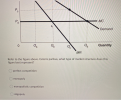 – MC Demand Quantity Refer to the figure above. Ceteris paribus, what type of market structure does this figure best represent? Operfect competition Omonopoly monopolistic competition oligopoly
Ceteris paribus, which of the following will cause the aggregate-demand curve to shift to the right...
Ceteris paribus, which of the following will cause the aggregate-demand curve to shift to the right (increase)? A decrease in consumer and business confidence because of a terrorist attack. An increase in the interest rate. A decrease in consumer and business taxes. All of the above.
In the money market diagram, the supply curve of money is vertical because the quantity of...
In the money market diagram, the supply curve of money is vertical because the quantity of money supplied increases only if the Fed increases the money supply. true false An extraordinarily high rate of inflation in Germany after the end of World War I likely contributed to the rise of Nazism and World War II. true false If P denotes the price of goods and services measured in terms of money, then 1/P represents the value of money and an...
Ceteris paribus, if demand and supply both increase at the same time, equilibrium price and equilibrium...
 Ceteris paribus, if demand and supply both increase at the same time, equilibrium price and equilibrium quantity_ a. increases; may rise, fall, or stay the same, depending on the size of the two shifts. decreases; may rise, fall, or stay the same, depending on the size of the two shifts. c. may rise, fall, or stay the same, depending on the size of the two shifts; increases may rise, fall, or stay the same, depending on the size of the...
1. Ceteris paribus, we should expect an excess supply of money generated by the central bank...
1. Ceteris paribus, we should expect an excess supply of money generated by the central bank to be associated with Group of answer choices reduced levels of investment spending. none of the other answers are correct. domestic deflationary pressures. an excess demand for bonds. appreciation of the home currency. 2. As a result of restrictive monetary policy, we should most likely expect (ceteris paribus) Group of answer choices appreciation of foreign currency. increased bond prices. depreciation of the home currency....
 50. Ceteris paribus, the total demand for money curve will increase (shift rightward): A. if interest rates increase. B. if nominal GDP decreases. C. if the price level decreases. D. if nominal GDP increases. 51. Ceteris paribus, the total demand for money curve will decrease (shift leftward): A. if interest rates increase. B. if nominal GDP decreases. C. if the price level increases. D. if nominal GDP increases. 52. Which of the following is correct? A. The asset (speculative) demand...
 The following table shows the quantity of money supplied and the
quantity of money demanded for various interest rates
4. Study Questions and Problems #4 The following table shows the quantity of money supplied and the quantity of money demanded for various interest rates. Interest Rate (Percent) Demand for Money (Billions of dollars) Supply of Money (Billions of dollars) 500 100 300 500 500 700 900 500 500 500 The following graph depicts the money supply curve in orange. On...
The following table shows the quantity of money supplied and the
quantity of money demanded for various interest rates
4. Study Questions and Problems #4 The following table shows the quantity of money supplied and the quantity of money demanded for various interest rates. Interest Rate (Percent) Demand for Money (Billions of dollars) Supply of Money (Billions of dollars) 500 100 300 500 500 700 900 500 500 500 The following graph depicts the money supply curve in orange. On...
 At full employment, an increase in the quantity of money (ceteris paribus) can start Select one: a demand-pull inflation, as can an increase in government expenditure. b. demand-pull inflation, but an increase in government expenditure cannot. C. cost-push inflation, but an increase in government expenditure cannot. d. demand-pull and a cost-push inflation, as can an increase in government expenditure. e. cost-push inflation, as can an increase in government expenditure. Safari Touch ID moodle 31.upei.ca UPEI Accessdeck Old-Moodle English (en) Suppose...
 – MC Demand Quantity Refer to the figure above. Ceteris paribus, what type of market structure does this figure best represent? Operfect competition Omonopoly monopolistic competition oligopoly
 Ceteris paribus, if demand and supply both increase at the same time, equilibrium price and equilibrium quantity_ a. increases; may rise, fall, or stay the same, depending on the size of the two shifts. decreases; may rise, fall, or stay the same, depending on the size of the two shifts. c. may rise, fall, or stay the same, depending on the size of the two shifts; increases may rise, fall, or stay the same, depending on the size of the...
Most questions answered within 3 hours.
-
Where is the error in this code sequence?
String s1 = "Hello";
String s2 = "ello";...
asked 10 months ago -
Financial data for Joel de Paris, Inc., for last year
follow:
Joel de Paris, Inc.
Balance...
asked 10 months ago -
Consider this reaction:
Al2(SO4)3 (aq)+ BaCl3
(aq) Al2Cl6 (aq)- +
3BaSO4(s) . What is the...
asked 10 months ago -
Suppose that Savneet is considering increasing her
recent random sample from 20 car rentals to 40...
asked 10 months ago -
Trucks arrive at an unloading terminal at an average rate of 120
per hour.
Trucks arrive...
asked 10 months ago -
Why are methanol and ethanol completely soluble in water while
octanol is not very little soluble....
asked 10 months ago -
A facilities manager at a university reads in a research report
that the mean amount of...
asked 10 months ago -
When the CuSO4 is rehydrated by adding water to the anhydrous
compound, is this an endothermic...
asked 10 months ago -
A ray of sunlight is passing from diamond into crown glass; the
angle of incidence is...
asked 10 months ago -
A block of mass 0.249 kg is placed on top of a light, vertical
spring of...
asked 10 months ago -
how do the kidneys compensate in the presences of acidosis
a) trigger hyperventilate
b) reserve acid...
asked 10 months ago -
Question 501 pts
The rental rate of capital to the firm increases. Which of the
following...
asked 10 months ago