he quantity demanded each week x (in units of a hundred) of the Mikado digital camera is related to the unit price p (in dollars) by the demand equation
x = (a)Is the demand elastic or inelastic when p = 50? Is the demand elastic or inelastic when p = 60? (b)When is the demand unitary? (c)If the unit price is lowered slightly from $60, will the revenue increase or decrease? (d)If the unit price is increased slightly from $50, will the revenue increase or decrease?
(0 ≤ p ≤ 80). 
400 − 5p
Homework Answers
Request Answer!
We need at least 10 more requests to produce the answer.
0 / 10 have requested this problem solution
The more requests, the faster the answer.
Add Answer to:
he quantity demanded each week x (in units of a hundred) of the Mikado digital camera is related to the unit price p (in dollars) by the demand equation
The quantity q demanded each week for a new digital camera is related to the price p of the camera (in dollars per camera) by the functionq /400 -Sp hundred cameras. a. Find the elasticity of de...
 The quantity q demanded each week for a new digital camera is related to the price p of the camera (in dollars per camera) by the functionq /400 -Sp hundred cameras. a. Find the elasticity of demand function, E(p) b. Find E for p-$40/camera and p $60/camera and state whether inelastic. c. For what price is there unit elasticity? d. At the price of S40/camera, ifthe price is increased by 3%, how will the demand change? Answer in a sentence...
The demand equation for a certain product is x = 100 -0.01p. (a) is the demand...
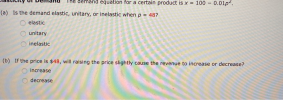 The demand equation for a certain product is x = 100 -0.01p. (a) is the demand elastic, unitary, or inelastic when p = 48? elastic unitary inelastic (b) If the price is $48, will raising the price slightly cause the revenue to increase or decrease? increase ОО decrease
15. When price = $12, quantity demanded = 1,200. When price = $14, quantity demanded =...
 15. When price = $12, quantity demanded = 1,200. When price = $14, quantity demanded = 1,025. When the firm lowered price from $14 to $12, it discovered that demand is_ _ _and total revenue __by a. elastic; increased; $14,400 b. elastic; decreased; $14,400 c. inelastic; increased; $50 d. elastic; increased; $50 e. inelastic; decreased; $3,150
13,000 34 cellular phones at a price p dollars per phone. The current price is $102. electronic store can sell q(0+41 (p+41) a) Is demand elastic or inelastic at p 102? (b) If the price is raised sli...
 13,000 34 cellular phones at a price p dollars per phone. The current price is $102. electronic store can sell q(0+41 (p+41) a) Is demand elastic or inelastic at p 102? (b) If the price is raised slightly, will revenue increase or decrease? (a) Is the demand elastic or inelastic at p 102? O A. Elastic, because E(p)when p 102, which is greater than 1. O B. Elastic, because E(p) when p 102, which is less than 1 OC. Inelastic,...
In this problem, p is in dollars and q is the number of units. (a) Find...
 In this problem, p is in dollars and q is the number of units. (a) Find the elasticity of the demand function 2p + 39 = 216 at the price p = 12. (b) How will a price increase affect total revenue? O Since the demand is elastic, an increase in price will decrease the total revenue. O Since the demand is unitary, there will be no change in the revenue with a price increase. Since the demand is elastic,...
Demand can either be elastic, inelastic or unit elastic Total revenue can increase, decrease, or stay...
 Demand can either be elastic, inelastic or unit elastic
Total revenue can increase, decrease, or stay the same
Please provide the work done :)
Refer to the demand schedule below Quantity demanded Price 80 70 60 50 40 30 20 10 50 100 150 200 250 300 350 400 a. Suppose the price increases from $10 to $20. Demand is inelasticand total revenue increases b. Suppose the price increases from $30 to $40. Demand is (inelastic $) and total revenue...
Demand can either be elastic, inelastic or unit elastic
Total revenue can increase, decrease, or stay the same
Please provide the work done :)
Refer to the demand schedule below Quantity demanded Price 80 70 60 50 40 30 20 10 50 100 150 200 250 300 350 400 a. Suppose the price increases from $10 to $20. Demand is inelasticand total revenue increases b. Suppose the price increases from $30 to $40. Demand is (inelastic $) and total revenue...
1. At a price of $5, quantity demanded is 70; and at a price of $7,...
1. At a price of $5, quantity demanded is 70; and at a price of $7, quantity demanded is 50. Since total revenue ________ by the price increase, demand must be ________. A.is unchanged; unit elastic B.is increased; elastic C.is decreased; inelastic D.is unchanged; elastic 2. Demand determines ________ entirely when ________ is perfectly inelastic. A.quantity; supply B.price; supply C.price and quantity; supply D.price and quantity; demand
For each of the following demand curves: i) Find the price-elasticity of demand in terms of...
For each of the following demand curves: i) Find the price-elasticity of demand in terms of P. ii) Determine the range of P values for which the demand curve is perfectly elastic, elastic, unitary elastic, inelastic and perfectly inelastic (your answer will look like, the demand is inelastic for 0 < P < 10, unitary elastic at P = 10, etc). iii) Calculate the price-elasticity of demand at P = 3 and give an interpretation in words of what that...
For each of the following demand curves: i) Find the price-elasticity of demand in terms of...
For each of the following demand curves: i) Find the price-elasticity of demand in terms of P. ii) Determine the range of P values for which the demand curve is perfectly elastic, elastic, unitary elastic, inelastic and perfectly inelastic (your answer will look like, the demand is inelastic for 0 < P < 10, unitary elastic at P = 10, etc). iii) Calculate the price-elasticity of demand at P = 3 and give an interpretation in words of what that...
3. For each of the following demand curves i) Find the price-elasticity of demand in terms...
 3. For each of the following demand curves i) Find the price-elasticity of demand in terms of P ii) Determine the range of P values for which the de- mand curve is perfectly elastic, elastic, unitary elas tic, inelastic and perfectly inelastic (your answer will look like, the demand is inelastic for 0< P < 10, unitary elastic at P 10, etc) iii) Calculate the price-elasticity of demand at P-3 and give an interpretation in words of what that means...
 The quantity q demanded each week for a new digital camera is related to the price p of the camera (in dollars per camera) by the functionq /400 -Sp hundred cameras. a. Find the elasticity of demand function, E(p) b. Find E for p-$40/camera and p $60/camera and state whether inelastic. c. For what price is there unit elasticity? d. At the price of S40/camera, ifthe price is increased by 3%, how will the demand change? Answer in a sentence...
 The demand equation for a certain product is x = 100 -0.01p. (a) is the demand elastic, unitary, or inelastic when p = 48? elastic unitary inelastic (b) If the price is $48, will raising the price slightly cause the revenue to increase or decrease? increase ОО decrease
 15. When price = $12, quantity demanded = 1,200. When price = $14, quantity demanded = 1,025. When the firm lowered price from $14 to $12, it discovered that demand is_ _ _and total revenue __by a. elastic; increased; $14,400 b. elastic; decreased; $14,400 c. inelastic; increased; $50 d. elastic; increased; $50 e. inelastic; decreased; $3,150
 13,000 34 cellular phones at a price p dollars per phone. The current price is $102. electronic store can sell q(0+41 (p+41) a) Is demand elastic or inelastic at p 102? (b) If the price is raised slightly, will revenue increase or decrease? (a) Is the demand elastic or inelastic at p 102? O A. Elastic, because E(p)when p 102, which is greater than 1. O B. Elastic, because E(p) when p 102, which is less than 1 OC. Inelastic,...
 In this problem, p is in dollars and q is the number of units. (a) Find the elasticity of the demand function 2p + 39 = 216 at the price p = 12. (b) How will a price increase affect total revenue? O Since the demand is elastic, an increase in price will decrease the total revenue. O Since the demand is unitary, there will be no change in the revenue with a price increase. Since the demand is elastic,...
 Demand can either be elastic, inelastic or unit elastic
Total revenue can increase, decrease, or stay the same
Please provide the work done :)
Refer to the demand schedule below Quantity demanded Price 80 70 60 50 40 30 20 10 50 100 150 200 250 300 350 400 a. Suppose the price increases from $10 to $20. Demand is inelasticand total revenue increases b. Suppose the price increases from $30 to $40. Demand is (inelastic $) and total revenue...
Demand can either be elastic, inelastic or unit elastic
Total revenue can increase, decrease, or stay the same
Please provide the work done :)
Refer to the demand schedule below Quantity demanded Price 80 70 60 50 40 30 20 10 50 100 150 200 250 300 350 400 a. Suppose the price increases from $10 to $20. Demand is inelasticand total revenue increases b. Suppose the price increases from $30 to $40. Demand is (inelastic $) and total revenue...
 3. For each of the following demand curves i) Find the price-elasticity of demand in terms of P ii) Determine the range of P values for which the de- mand curve is perfectly elastic, elastic, unitary elas tic, inelastic and perfectly inelastic (your answer will look like, the demand is inelastic for 0< P < 10, unitary elastic at P 10, etc) iii) Calculate the price-elasticity of demand at P-3 and give an interpretation in words of what that means...
Most questions answered within 3 hours.
-
Where is the error in this code sequence?
String s1 = "Hello";
String s2 = "ello";...
asked 11 months ago -
Financial data for Joel de Paris, Inc., for last year
follow:
Joel de Paris, Inc.
Balance...
asked 11 months ago -
Consider this reaction:
Al2(SO4)3 (aq)+ BaCl3
(aq) Al2Cl6 (aq)- +
3BaSO4(s) . What is the...
asked 11 months ago -
Suppose that Savneet is considering increasing her
recent random sample from 20 car rentals to 40...
asked 11 months ago -
Trucks arrive at an unloading terminal at an average rate of 120
per hour.
Trucks arrive...
asked 11 months ago -
Why are methanol and ethanol completely soluble in water while
octanol is not very little soluble....
asked 11 months ago -
A facilities manager at a university reads in a research report
that the mean amount of...
asked 11 months ago -
When the CuSO4 is rehydrated by adding water to the anhydrous
compound, is this an endothermic...
asked 11 months ago -
A ray of sunlight is passing from diamond into crown glass; the
angle of incidence is...
asked 11 months ago -
A block of mass 0.249 kg is placed on top of a light, vertical
spring of...
asked 11 months ago -
how do the kidneys compensate in the presences of acidosis
a) trigger hyperventilate
b) reserve acid...
asked 11 months ago -
Question 501 pts
The rental rate of capital to the firm increases. Which of the
following...
asked 11 months ago