Question 5.1a: The figure shows a box of mass m = 5.10 kg pulled to the...
Question 5.1a:
The figure shows a box of mass
m = 5.10 kg
pulled to the right across a horizontal surface by a constant tension force of magnitude
T = 21.0 N.
The tension force is inclined at an angle
? = 16.0
Homework Answers
So, for the first question, the normal force and the gravity force do no work because they are perpendicular to the motion of the box. Now, the friction force acts opposite the direction of motion, so its work will be negative (friction forces always create negative work). So the work done by friction is simply the magnitude of the force multiplied by the distance traveled: Wf=(-14.0N)(1.95m). Now the tension also does work, but only the x-component of the tension. To find the x-component of the tension, all you have to do is take the magnitude of the tensional force and multiply it by the cosine of the angle it makes with the horizontal. So, Tx=(21.0N)(cos(16)). Now that you have the x-component of the tension, just multiply that value by the distance traveled. This work will be positive since the force is in the direction of motion. So, WT=(21.0N)(cos(16))(1.95m). Thats all you have to do for the first one!
Now, for the second question, you are basically doing the same thing. The only difference is that you will want to choose the direction down the incline as your positive x direction. So for this question, all you have to do is find the component of the gravity force that acts down the incline. This is simply the magnitude of the gravity force multiplied by the sine of the angle it makes with the incline, which is the same as the angle the incline makes with the horizontal, 27 degrees. So the component of gravity down the incline is just (2.2X10⁴N)(sin(27)). Now that you have the component of gravity acting parallel to the incline, you simply multiply this value by the distance traveled to find the work done. So, Wg=(2.2X10⁴N)(sin(27))(14.5m)
There ya go, hope that helps! If so please leave me a rating!
Add Answer to:
Question 5.1a:
The figure shows a box of mass
m = 5.10 kg
pulled to the...
Question 5.1a The figure shows a box of mass m-4.80 kg puled to the right across...
 Question 5.1a The figure shows a box of mass m-4.80 kg puled to the right across a horontal surface by a constant tension force of magnitude r·30.0 N. The tension fren inclined at an angle θ-24.0° above the horizontal and the friction force has magnitude 4-14.0 N. The box is pulled a distance d·1.55-. Determine the work done on the box by the tension force, the normal force, and the kinetic friction ferce. we'l use Wr W,r and w, to...
00-64 Figure 5-56 shows a box of mass m2 = 1.0 kg on a friction- less...
 00-64 Figure 5-56 shows a box of mass m2 = 1.0 kg on a friction- less plane inclined at angle θ= 30°. It is connected by a cord of negligible mass to a box of mass m 3.0 kg on a horizontal fric- tionless surface. The pulley is frictionless and massless. (a) If the magnitude of horizontal force F is 2.3 N, what is the tension in the connecting cord? (b) What is the largest value the magnitude of F...
1. The figure shows a box with mass m1 on a frictionless plane inclined at angle...
 1. The figure shows a box with mass m1 on a
frictionless plane inclined at angle ?1. The
box is
connected via a cord of negligible mass to another
box with mass m2 on a frictionless plane
inclined at
angle ?2 (> ?1). The pulley
is frictionless and has
negligible mass and assumes that the setup is on the
surface of the earth.
a) Provide free-body force diagram for both boxes.
b) What is the acceleration in terms of m1,...
1. The figure shows a box with mass m1 on a
frictionless plane inclined at angle ?1. The
box is
connected via a cord of negligible mass to another
box with mass m2 on a frictionless plane
inclined at
angle ?2 (> ?1). The pulley
is frictionless and has
negligible mass and assumes that the setup is on the
surface of the earth.
a) Provide free-body force diagram for both boxes.
b) What is the acceleration in terms of m1,...
The figure below shows an object of mass m1 = 1.0 kg on an inclined surface....
 The figure below shows an
object of mass m1 = 1.0 kg on an inclined surface. The angle of the
inclined surface is θ = 30° with the horizontal. The object m1 is
connected to a second object of mass m2 = 2.5 kg on a horizontal
surface below an overhang that is formed by the inclined surface.
Further, an external force of magnitude Fext = 10 N is exerted on
the object with mass m1. We observe both objects...
The figure below shows an
object of mass m1 = 1.0 kg on an inclined surface. The angle of the
inclined surface is θ = 30° with the horizontal. The object m1 is
connected to a second object of mass m2 = 2.5 kg on a horizontal
surface below an overhang that is formed by the inclined surface.
Further, an external force of magnitude Fext = 10 N is exerted on
the object with mass m1. We observe both objects...
A box of mass m = 5.0 kg initially at rest is being pulled along a...
A box of mass m = 5.0 kg initially at rest is being pulled along a smooth horizontal surface by a rope that makes an angle of 30° with the horizontal and exerts a force of 20 N on the box. Determine the – a) acceleration of the box and – b) the normal force.
Question 13 13 pts A box of mass 0.8 kg is being pulled up a slope...
 Question 13 13 pts A box of mass 0.8 kg is being pulled up a slope that is inclined by 60° compared to the horizontal. The tension in the rope pulling the box is 40 N and the rope is parallel to the incline. The slope is NOT frictionless and the coefficient of kinetic friction between the box and the slope is 0.35. Round off your answers to two decimal places. (a) What is the magnitude of the weight of...
A box of mass ?=22.5 kg is pulled up a ramp that is inclined at an...
A box of mass ?=22.5 kg is pulled up a ramp that is inclined at an angle ?=17.0∘angle with respect to the horizontal. The coefficient of kinetic friction between the box and the ramp is ?k=0.305 , and the rope pulling the box is parallel to the ramp. If the box accelerates up the ramp at a rate of ?=2.49 m/s2, calculate the tension ?T in the rope. Use ?=9.81 m/s2 for the acceleration due to gravity. FT=_____N
A large box of mass M is pulled across a horizontal, frictionless surface by a horizontal...
A large box of mass M is pulled across a horizontal, frictionless surface by a horizontal rope with tension T. A small box of mass m sits on top of the large box. The coefficients of static and kinetic friction between the two boxes are μs and μk, respectively. PART A: Find an expression for the maximum tension Tmax for which the small box rides on top of the large box without slipping. Express your answer in terms of the...
In the figure here, a box of Cheerios (mass mC = 1.3 kg) and a box...
 In the figure here, a box of
Cheerios (mass mC = 1.3 kg) and a box of Wheaties (mass mW = 2.6
kg) are accelerated across a horizontal surface by a horizontal
force applied to the Cheerios box. The magnitude of the frictional
force on the Cheerios box is 2.7 N, and the magnitude of the
frictional force on the Wheaties box is 4.5 N. If the magnitude of
is 12.8 N, what is the magnitude of the force on...
In the figure here, a box of
Cheerios (mass mC = 1.3 kg) and a box of Wheaties (mass mW = 2.6
kg) are accelerated across a horizontal surface by a horizontal
force applied to the Cheerios box. The magnitude of the frictional
force on the Cheerios box is 2.7 N, and the magnitude of the
frictional force on the Wheaties box is 4.5 N. If the magnitude of
is 12.8 N, what is the magnitude of the force on...
physics online make up 2020 july.pdf Close 6. Figure shows a box of mass m2 =...
 physics
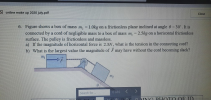
online make up 2020 july.pdf Close 6. Figure shows a box of mass m2 = 1.0kg on a frictionless plane inclined at angle 0 = 30°. It is connected by a cord of negligible mass to a box of mass m, = 2.5kg on a horizontal frictionless surface. The pulley is frictionless and massless. a) If the magnitude of horizontal force is 2.3N, what is the tension in the connecting cord? b) What is the largest value the magnitude...
physics
online make up 2020 july.pdf Close 6. Figure shows a box of mass m2 = 1.0kg on a frictionless plane inclined at angle 0 = 30°. It is connected by a cord of negligible mass to a box of mass m, = 2.5kg on a horizontal frictionless surface. The pulley is frictionless and massless. a) If the magnitude of horizontal force is 2.3N, what is the tension in the connecting cord? b) What is the largest value the magnitude...
 Question 5.1a The figure shows a box of mass m-4.80 kg puled to the right across a horontal surface by a constant tension force of magnitude r·30.0 N. The tension fren inclined at an angle θ-24.0° above the horizontal and the friction force has magnitude 4-14.0 N. The box is pulled a distance d·1.55-. Determine the work done on the box by the tension force, the normal force, and the kinetic friction ferce. we'l use Wr W,r and w, to...
 00-64 Figure 5-56 shows a box of mass m2 = 1.0 kg on a friction- less plane inclined at angle θ= 30°. It is connected by a cord of negligible mass to a box of mass m 3.0 kg on a horizontal fric- tionless surface. The pulley is frictionless and massless. (a) If the magnitude of horizontal force F is 2.3 N, what is the tension in the connecting cord? (b) What is the largest value the magnitude of F...
 1. The figure shows a box with mass m1 on a
frictionless plane inclined at angle ?1. The
box is
connected via a cord of negligible mass to another
box with mass m2 on a frictionless plane
inclined at
angle ?2 (> ?1). The pulley
is frictionless and has
negligible mass and assumes that the setup is on the
surface of the earth.
a) Provide free-body force diagram for both boxes.
b) What is the acceleration in terms of m1,...
1. The figure shows a box with mass m1 on a
frictionless plane inclined at angle ?1. The
box is
connected via a cord of negligible mass to another
box with mass m2 on a frictionless plane
inclined at
angle ?2 (> ?1). The pulley
is frictionless and has
negligible mass and assumes that the setup is on the
surface of the earth.
a) Provide free-body force diagram for both boxes.
b) What is the acceleration in terms of m1,...
 The figure below shows an
object of mass m1 = 1.0 kg on an inclined surface. The angle of the
inclined surface is θ = 30° with the horizontal. The object m1 is
connected to a second object of mass m2 = 2.5 kg on a horizontal
surface below an overhang that is formed by the inclined surface.
Further, an external force of magnitude Fext = 10 N is exerted on
the object with mass m1. We observe both objects...
The figure below shows an
object of mass m1 = 1.0 kg on an inclined surface. The angle of the
inclined surface is θ = 30° with the horizontal. The object m1 is
connected to a second object of mass m2 = 2.5 kg on a horizontal
surface below an overhang that is formed by the inclined surface.
Further, an external force of magnitude Fext = 10 N is exerted on
the object with mass m1. We observe both objects...
 Question 13 13 pts A box of mass 0.8 kg is being pulled up a slope that is inclined by 60° compared to the horizontal. The tension in the rope pulling the box is 40 N and the rope is parallel to the incline. The slope is NOT frictionless and the coefficient of kinetic friction between the box and the slope is 0.35. Round off your answers to two decimal places. (a) What is the magnitude of the weight of...
 In the figure here, a box of
Cheerios (mass mC = 1.3 kg) and a box of Wheaties (mass mW = 2.6
kg) are accelerated across a horizontal surface by a horizontal
force applied to the Cheerios box. The magnitude of the frictional
force on the Cheerios box is 2.7 N, and the magnitude of the
frictional force on the Wheaties box is 4.5 N. If the magnitude of
is 12.8 N, what is the magnitude of the force on...
In the figure here, a box of
Cheerios (mass mC = 1.3 kg) and a box of Wheaties (mass mW = 2.6
kg) are accelerated across a horizontal surface by a horizontal
force applied to the Cheerios box. The magnitude of the frictional
force on the Cheerios box is 2.7 N, and the magnitude of the
frictional force on the Wheaties box is 4.5 N. If the magnitude of
is 12.8 N, what is the magnitude of the force on...
 physics
online make up 2020 july.pdf Close 6. Figure shows a box of mass m2 = 1.0kg on a frictionless plane inclined at angle 0 = 30°. It is connected by a cord of negligible mass to a box of mass m, = 2.5kg on a horizontal frictionless surface. The pulley is frictionless and massless. a) If the magnitude of horizontal force is 2.3N, what is the tension in the connecting cord? b) What is the largest value the magnitude...
physics
online make up 2020 july.pdf Close 6. Figure shows a box of mass m2 = 1.0kg on a frictionless plane inclined at angle 0 = 30°. It is connected by a cord of negligible mass to a box of mass m, = 2.5kg on a horizontal frictionless surface. The pulley is frictionless and massless. a) If the magnitude of horizontal force is 2.3N, what is the tension in the connecting cord? b) What is the largest value the magnitude...
Most questions answered within 3 hours.
-
Where is the error in this code sequence?
String s1 = "Hello";
String s2 = "ello";...
asked 11 months ago -
Financial data for Joel de Paris, Inc., for last year
follow:
Joel de Paris, Inc.
Balance...
asked 11 months ago -
Consider this reaction:
Al2(SO4)3 (aq)+ BaCl3
(aq) Al2Cl6 (aq)- +
3BaSO4(s) . What is the...
asked 11 months ago -
Suppose that Savneet is considering increasing her
recent random sample from 20 car rentals to 40...
asked 11 months ago -
Trucks arrive at an unloading terminal at an average rate of 120
per hour.
Trucks arrive...
asked 11 months ago -
Why are methanol and ethanol completely soluble in water while
octanol is not very little soluble....
asked 11 months ago -
A facilities manager at a university reads in a research report
that the mean amount of...
asked 11 months ago -
When the CuSO4 is rehydrated by adding water to the anhydrous
compound, is this an endothermic...
asked 11 months ago -
A ray of sunlight is passing from diamond into crown glass; the
angle of incidence is...
asked 11 months ago -
A block of mass 0.249 kg is placed on top of a light, vertical
spring of...
asked 11 months ago -
how do the kidneys compensate in the presences of acidosis
a) trigger hyperventilate
b) reserve acid...
asked 11 months ago -
Question 501 pts
The rental rate of capital to the firm increases. Which of the
following...
asked 11 months ago