
Homework Answers
Add Answer to:
9) A-Ch 2 (6 pts) The graph below is for an object moving for 8.0 seconds....
A student measures the velocity of an object moving along a track. At time t =...
 A student measures the velocity of an object moving along a track. At time t = 0 s, the object is moving at a constant 4.0 m/s in the positive x-direction. At time t = 3.0 s, the object begins to slow, stops at t = 5.0 s, and then moves in the opposite direction. At t = 6.0 s, the object as reached a speed of -2.0 m/s. It moves at this speed until the student quits taking data...
5. The following graph represents the velocity of an object, moving along a horizontal line as...
 5. The following graph represents the velocity of an object, moving along a horizontal line as a function of time. Express all answers to two significant figures. East is the positive direction and West is negative. (6 marks) Velocity Vs. Time 10 Velocity. (m/s) 10 12 14 -6 Time, t(s) a) Determine the acceleration of the object at 1.0s. b) Determine the average velocity of the object between 4.0 and 8.0 s. c) Over what time interval(s), if any, is...
5. The following graph represents the velocity of an object, moving along a horizontal line as...
 5. The following graph represents the velocity of an object, moving along a horizontal line as a function of time. Express all answers to two significant figures. East is the positive direction and West is negative. (6 marks) Velocity Vs. Time 10 8 6 Velocity. (m/s) 10 12 14 -2 -6 .8 Time, t, (s) a) Determine the acceleration of the object at 1.0. b) Determine the average velocity of the object between 4.0 and 8.0 s. c) Over what...
In the graph shown below, t0 = 2.1 seconds, the object stops at 8 seconds, and...
 In the graph shown below, t0 = 2.1 seconds, the
object stops at 8 seconds, and t' = 22 seconds. First,
find the value of the object's velocity at 2.1 seconds such that
the object's total displacement from 0to 22 seconds is -55.7
meters. Then, using this value find the acceleration
from t = 0 to 2.1 seconds. Answer in
m/s2.
please show work and explain
In the graph shown below, t0 = 2.1 seconds, the
object stops at 8 seconds, and t' = 22 seconds. First,
find the value of the object's velocity at 2.1 seconds such that
the object's total displacement from 0to 22 seconds is -55.7
meters. Then, using this value find the acceleration
from t = 0 to 2.1 seconds. Answer in
m/s2.
please show work and explain
Question 2 (1 point) [OLMPC1] The Canadian Bobsled team produces the following data for a warm...
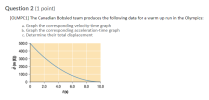 Question 2 (1 point) [OLMPC1] The Canadian Bobsled team produces the following data for a warm up run in the Olympics: a. Graph the corresponding velocity-time graph b. Graph the corresponding acceleration-time graph c. Determine their total displacement 500.0 400.0 300.0 200.0 (El) P 100.0 0 0 2.0 4.0 8.0 10.0 6.0 t(s)
Following figure shows velocity -time graph of an object.
 Following figure shows velocity -time graph of an object. a) Sketch the acceleration-time graph that correspond to this motion. b) Assuming the initial position is zero, determine the displacement of the object from beginning to t=8.0 seconds after it starts.
GOAL Apply the definition of instantaneous acceleration D (m v (m/s PROBLEM A baseball player moves...
 GOAL Apply the definition of instantaneous acceleration D (m v (m/s PROBLEM A baseball player moves in a straight-line path in order to catch a fly ball hit to the outfield. His velocity asa function of time is shown in figure (a) Find his instantaneous acceleration at points ®, ®, and C 3 t(s) 0 23 0 STRATEGY At each point, the velocity vs. time graph is a straight line segment, so the instantaneous acceleration will be the slope of...
The figure shows the velocity of an object moving along a straight line as a function of time. Determine:
 The figure shows the velocity of an object moving along a straight line as a function of time. Determine: a) The displacement of the object for the first 9 secondsb) The object's average velocity from t = 0 s tot=9 s.c) The object's average acceleration from t = 0 tot = 5 seconds.c) The acceleration of the object at t =8 seconds.
An object begins at an initial position of s = -2.0 m
 An object begins at an initial position of s = -2.0 m. The plot shows the object's velocity in the s-direction as a function of time. Find the object's: a. Displacement (Δs) at t = 9.0 s b. Position (s) at t = 9.0 s c. Average velocity (vs,ave) between t = 0 s and t = 9.0s d. Acceleration (a) at t = 2.0, 6.0, and 8.0 s
The velocity vs. time graph for an object moving along a straight path is shown in...
 The velocity vs. time graph for an object moving along a straight path is shown in the figure below. r(m/s 6 t(s) 0 1320 (a) Find the average acceleration of this object during the time intervals 0 to 5.0 s, 5.0 s to 15 s, and 0 to 20 s. 0 s to 5.0s 5.0 s to 15.0s 0st0 20.0 s m/s2 m/s2 m/s2 (b) Find the instantaneous accelerations at 2.0 s, 10 s, and 18 s. 2.0 s 10.0s...
 A student measures the velocity of an object moving along a track. At time t = 0 s, the object is moving at a constant 4.0 m/s in the positive x-direction. At time t = 3.0 s, the object begins to slow, stops at t = 5.0 s, and then moves in the opposite direction. At t = 6.0 s, the object as reached a speed of -2.0 m/s. It moves at this speed until the student quits taking data...
 5. The following graph represents the velocity of an object, moving along a horizontal line as a function of time. Express all answers to two significant figures. East is the positive direction and West is negative. (6 marks) Velocity Vs. Time 10 Velocity. (m/s) 10 12 14 -6 Time, t(s) a) Determine the acceleration of the object at 1.0s. b) Determine the average velocity of the object between 4.0 and 8.0 s. c) Over what time interval(s), if any, is...
 5. The following graph represents the velocity of an object, moving along a horizontal line as a function of time. Express all answers to two significant figures. East is the positive direction and West is negative. (6 marks) Velocity Vs. Time 10 8 6 Velocity. (m/s) 10 12 14 -2 -6 .8 Time, t, (s) a) Determine the acceleration of the object at 1.0. b) Determine the average velocity of the object between 4.0 and 8.0 s. c) Over what...
 In the graph shown below, t0 = 2.1 seconds, the
object stops at 8 seconds, and t' = 22 seconds. First,
find the value of the object's velocity at 2.1 seconds such that
the object's total displacement from 0to 22 seconds is -55.7
meters. Then, using this value find the acceleration
from t = 0 to 2.1 seconds. Answer in
m/s2.
please show work and explain
In the graph shown below, t0 = 2.1 seconds, the
object stops at 8 seconds, and t' = 22 seconds. First,
find the value of the object's velocity at 2.1 seconds such that
the object's total displacement from 0to 22 seconds is -55.7
meters. Then, using this value find the acceleration
from t = 0 to 2.1 seconds. Answer in
m/s2.
please show work and explain
 Question 2 (1 point) [OLMPC1] The Canadian Bobsled team produces the following data for a warm up run in the Olympics: a. Graph the corresponding velocity-time graph b. Graph the corresponding acceleration-time graph c. Determine their total displacement 500.0 400.0 300.0 200.0 (El) P 100.0 0 0 2.0 4.0 8.0 10.0 6.0 t(s)
 GOAL Apply the definition of instantaneous acceleration D (m v (m/s PROBLEM A baseball player moves in a straight-line path in order to catch a fly ball hit to the outfield. His velocity asa function of time is shown in figure (a) Find his instantaneous acceleration at points ®, ®, and C 3 t(s) 0 23 0 STRATEGY At each point, the velocity vs. time graph is a straight line segment, so the instantaneous acceleration will be the slope of...
 The velocity vs. time graph for an object moving along a straight path is shown in the figure below. r(m/s 6 t(s) 0 1320 (a) Find the average acceleration of this object during the time intervals 0 to 5.0 s, 5.0 s to 15 s, and 0 to 20 s. 0 s to 5.0s 5.0 s to 15.0s 0st0 20.0 s m/s2 m/s2 m/s2 (b) Find the instantaneous accelerations at 2.0 s, 10 s, and 18 s. 2.0 s 10.0s...
Most questions answered within 3 hours.
-
Where is the error in this code sequence?
String s1 = "Hello";
String s2 = "ello";...
asked 10 months ago -
Financial data for Joel de Paris, Inc., for last year
follow:
Joel de Paris, Inc.
Balance...
asked 10 months ago -
Consider this reaction:
Al2(SO4)3 (aq)+ BaCl3
(aq) Al2Cl6 (aq)- +
3BaSO4(s) . What is the...
asked 10 months ago -
Suppose that Savneet is considering increasing her
recent random sample from 20 car rentals to 40...
asked 10 months ago -
Trucks arrive at an unloading terminal at an average rate of 120
per hour.
Trucks arrive...
asked 10 months ago -
Why are methanol and ethanol completely soluble in water while
octanol is not very little soluble....
asked 10 months ago -
A facilities manager at a university reads in a research report
that the mean amount of...
asked 10 months ago -
When the CuSO4 is rehydrated by adding water to the anhydrous
compound, is this an endothermic...
asked 10 months ago -
A ray of sunlight is passing from diamond into crown glass; the
angle of incidence is...
asked 10 months ago -
A block of mass 0.249 kg is placed on top of a light, vertical
spring of...
asked 10 months ago -
how do the kidneys compensate in the presences of acidosis
a) trigger hyperventilate
b) reserve acid...
asked 10 months ago -
Question 501 pts
The rental rate of capital to the firm increases. Which of the
following...
asked 10 months ago