
Homework Answers


Solve the following Deterministic Finite Automata ( DFA ). For Σ = {0, 1} Construct a...
Solve the following Deterministic Finite Automata ( DFA ). For Σ = {0, 1} Construct a DFA M such that L(M) = { w : w ends with 101 followed by an ODD number of 0's} Draw the state diagram and transition table..... 1) Given A Formal Definition M = (Q, Σ, ? , q, F) 2) Trace the Path (Listing States) taken by words state whether each word is accepted or rejected. w = 101010 v = 1010100 u...
Construct a deterministic finite-state automaton for the language L = {w ∈ {0, 1} | w...
Construct a deterministic finite-state automaton for the language L = {w ∈ {0, 1} | w starts with but does not end with 010}
Question 1: Design a DFA with at most 5 states for the language L1 = {w...
Question 1: Design a DFA with at most 5 states for the language L1 = {w ∈ {0, 1}∗ | w contains at most one 1 and |w| is odd}. Provide a state diagram for your DFA. Approaching the Solution --since we haven’t really practiced this type of assignment (i.e. had to define our machine based on only having the language given; not the formal 5 tuples), I am providing the steps for how to work through this; you are...
Question 1. Let S = {a,b}, and consider the language L = {w E E* :...
 Question 1. Let S = {a,b}, and consider the language L = {w E E* : w contains at least one b and an even number of a's}. Draw a graph representing a DFA (not NFA) that accepts this language. Question 2. Let L be the language given below. L = {a”62m : n > 0} = {1, abb, aabbbb, aaabbbbbb, ...} Find production rules for a grammar that generates L.
Question 1. Let Σ = {a, b}, and consider the language L = {w ∈ Σ...
Question 1. Let Σ = {a, b}, and consider the language L = {w ∈ Σ ∗ : w contains at least one b and an even number of a’s}. Draw a graph representing a DFA (not NFA) that accepts this language. Question 2. Let L be the language given below. L = {a n b 2n : n ≥ 0} = {λ, abb, aabbbb, aaabbbbbb, . . .} Find production rules for a grammar that generates L.
Question 1. Let Σ = {a, b}, and consider the language L = {w ∈ Σ...
Question 1. Let Σ = {a, b}, and consider the language L = {w ∈ Σ ∗ : w contains at least one b and an even number of a’s}. Draw a graph representing a DFA (not NFA) that accepts this language.
Let F IN = {M | L(M) is finite}, and recall HP = {M#w | M...
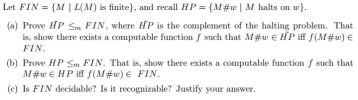 Let F IN = {M | L(M) is finite}, and recall HP = {M#w | M halts
on w}.
(a) Prove HP¯ ≤m F IN, where HP¯ is the complement of the
halting problem. That is, show there exists a computable function f
such that M#w ∈ HP¯ iff f(M#w) ∈ F IN.
(b) Prove HP ≤m F IN. That is, show there exists a computable
function f such that M#w ∈ HP iff f(M#w) ∈ F IN.
(c) Is...
Let F IN = {M | L(M) is finite}, and recall HP = {M#w | M halts
on w}.
(a) Prove HP¯ ≤m F IN, where HP¯ is the complement of the
halting problem. That is, show there exists a computable function f
such that M#w ∈ HP¯ iff f(M#w) ∈ F IN.
(b) Prove HP ≤m F IN. That is, show there exists a computable
function f such that M#w ∈ HP iff f(M#w) ∈ F IN.
(c) Is...
Write a class for DFA type objects. Deterministic Finite Automata are commonly defined as a quintuple...
 Write a class for DFA type
objects. Deterministic Finite Automata are commonly defined as a
quintuple consisting of a set of states, a set of symbals, a
transition function, a start state and a set of accept states
For this implementation let the alphabet be given as a string of
symbols, the transition function as list of lists which represent
an n by m matrix where the n rows represent the states and the m
columns represent the alphabet symbols,...
Write a class for DFA type
objects. Deterministic Finite Automata are commonly defined as a
quintuple consisting of a set of states, a set of symbals, a
transition function, a start state and a set of accept states
For this implementation let the alphabet be given as a string of
symbols, the transition function as list of lists which represent
an n by m matrix where the n rows represent the states and the m
columns represent the alphabet symbols,...
Give a DFA for the following language over the alphabet Σ = {0, 1}: L={ w...
Give a DFA for the following language over the alphabet Σ = {0, 1}: L={ w | w starts with 0 and has odd length, or starts with 1 and has even length }. E.g., strings 0010100, 111010 are in L, while 0100 and 11110 are not in L.
Question 1: Every language is regular T/F Question 2: There exists a DFA that has only...
Question 1: Every language is regular T/F Question 2: There exists a DFA that has only one final state T/F Question 3: Let M be a DFA, and define flip(M) as the DFA which is identical to M except you flip that final state. Then for every M, the language L(M)^c (complement) = L( flip (M)). T/F Question 4: Let G be a right linear grammar, and reverse(G)=reverse of G, i.e. if G has a rule A -> w B...
 Question 1. Let S = {a,b}, and consider the language L = {w E E* : w contains at least one b and an even number of a's}. Draw a graph representing a DFA (not NFA) that accepts this language. Question 2. Let L be the language given below. L = {a”62m : n > 0} = {1, abb, aabbbb, aaabbbbbb, ...} Find production rules for a grammar that generates L.
 Let F IN = {M | L(M) is finite}, and recall HP = {M#w | M halts
on w}.
(a) Prove HP¯ ≤m F IN, where HP¯ is the complement of the
halting problem. That is, show there exists a computable function f
such that M#w ∈ HP¯ iff f(M#w) ∈ F IN.
(b) Prove HP ≤m F IN. That is, show there exists a computable
function f such that M#w ∈ HP iff f(M#w) ∈ F IN.
(c) Is...
Let F IN = {M | L(M) is finite}, and recall HP = {M#w | M halts
on w}.
(a) Prove HP¯ ≤m F IN, where HP¯ is the complement of the
halting problem. That is, show there exists a computable function f
such that M#w ∈ HP¯ iff f(M#w) ∈ F IN.
(b) Prove HP ≤m F IN. That is, show there exists a computable
function f such that M#w ∈ HP iff f(M#w) ∈ F IN.
(c) Is...
 Write a class for DFA type
objects. Deterministic Finite Automata are commonly defined as a
quintuple consisting of a set of states, a set of symbals, a
transition function, a start state and a set of accept states
For this implementation let the alphabet be given as a string of
symbols, the transition function as list of lists which represent
an n by m matrix where the n rows represent the states and the m
columns represent the alphabet symbols,...
Write a class for DFA type
objects. Deterministic Finite Automata are commonly defined as a
quintuple consisting of a set of states, a set of symbals, a
transition function, a start state and a set of accept states
For this implementation let the alphabet be given as a string of
symbols, the transition function as list of lists which represent
an n by m matrix where the n rows represent the states and the m
columns represent the alphabet symbols,...
Most questions answered within 3 hours.
-
Where is the error in this code sequence?
String s1 = "Hello";
String s2 = "ello";...
asked 10 months ago -
Financial data for Joel de Paris, Inc., for last year
follow:
Joel de Paris, Inc.
Balance...
asked 10 months ago -
Consider this reaction:
Al2(SO4)3 (aq)+ BaCl3
(aq) Al2Cl6 (aq)- +
3BaSO4(s) . What is the...
asked 10 months ago -
Suppose that Savneet is considering increasing her
recent random sample from 20 car rentals to 40...
asked 10 months ago -
Trucks arrive at an unloading terminal at an average rate of 120
per hour.
Trucks arrive...
asked 10 months ago -
Why are methanol and ethanol completely soluble in water while
octanol is not very little soluble....
asked 10 months ago -
A facilities manager at a university reads in a research report
that the mean amount of...
asked 10 months ago -
When the CuSO4 is rehydrated by adding water to the anhydrous
compound, is this an endothermic...
asked 10 months ago -
A ray of sunlight is passing from diamond into crown glass; the
angle of incidence is...
asked 10 months ago -
A block of mass 0.249 kg is placed on top of a light, vertical
spring of...
asked 10 months ago -
how do the kidneys compensate in the presences of acidosis
a) trigger hyperventilate
b) reserve acid...
asked 10 months ago -
Question 501 pts
The rental rate of capital to the firm increases. Which of the
following...
asked 10 months ago