
Homework Answers
Option A.
The portion circled in red interacts with the oil while the portion circled in green interacts with the water. The green portion has alcoholic groups which can make hydrogen bonds with water. This portion is polar in nature and water also. Thus it interacts with water. Like dissolves like. The red portion is hydrocarbon chain which is non polar in nature. So it interacts with the oil which is also non polar.
Add Answer to:
Question 5(1 point) HO HO OH How does the emulsifier shown here work to form a...
How many chirality centers are present in the molecule shown here? OH Question 1 How were...
 How many chirality centers are present in the molecule shown here? OH Question 1 How were the Himalayas formed
QUESTION 14 CH3 What is the name of the compound shown? сня HC OH HO 5-methyl-2,4-hexanediol...
 QUESTION 14 CH3 What is the name of the compound shown? сня HC OH HO 5-methyl-2,4-hexanediol 2-methyl-3,5-hexanediol 2.4-dihydroxyl-5-methylhexane 2-methyl-3,5-dihydroxylhexane QUESTION 15 Select the alcohol below that would have the highest boiling point. CH3CH2CH2OH CH3CH2(OH)CH2OH е сHзон CH(OH)CH(OH)CH2(OH) Click Save and Submit to save and submit. Click Save All Answers to aun allansters,
Question 16 1.67 pts Time Atten 1 Ho How does the loop of Henle enable the...
 Question 16 1.67 pts Time Atten 1 Ho How does the loop of Henle enable the mammalian kidney to produce hyperosmotic urine? 1-The ascending limb of the loop actively extrudes Nat. Il-The descending limb interacts with the ascending limb to raise the osmolarity of the extracellular fluid in the renal medulla. III- The concentration is further enhanced by the presence of urea, which draws water out of the collecting ducts by osmosis. 24/7 just III justi lland I and II...
Question 7 (1 point) The structures of galactose (left) and glucose (right) are shown below. How...
 Question 7 (1 point) The structures of galactose (left) and glucose (right) are shown below. How are the two monosaccharides related? SHO SHO H-C-OH H-C-OH HO-C-H HO-C-H HOC-HH- OH H-C-OHH-C-OH CH,OH CH,OH ( 1) structural isomers 2) stereoisomers ( 3) enantiomers 4) anomers
1500 1000 500 5 10 15 20 Distance (Mpc) Figure 7.6: A Hubble diagram showing the...
 1500 1000 500 5 10 15 20 Distance (Mpc) Figure 7.6: A Hubble diagram showing the relationship between galaxy distance and re- cessional velocity, where distances were derived from the period-luminosity relationship for Cepheid variable stars identified within each galaxy. The M100 point is circled in red, and based in part on the data shown in Figures 17.4 and 7.5. The slope of the relationship is 79 +4 km sec1 per Mpc, and the correlation coefficient R is 78 %...
Please answer the following question correctly and completely. (Please write neatly) 1. Take a look at...
 Please answer the following question correctly and completely.
(Please write neatly)
1. Take a look at this figure and do the followng:
A. Write the appropriate reaction conditions/reagents listed
over each arrow (Circled in red).
B. There are four stereoisomers shown for intermediate "4" but
only one for "5". The word "resolved" is written over the arrow
between them. What does resolved mean? How might we be converting a
mixture of four structures into only one structure?
C. Write step-by-step...
Please answer the following question correctly and completely.
(Please write neatly)
1. Take a look at this figure and do the followng:
A. Write the appropriate reaction conditions/reagents listed
over each arrow (Circled in red).
B. There are four stereoisomers shown for intermediate "4" but
only one for "5". The word "resolved" is written over the arrow
between them. What does resolved mean? How might we be converting a
mixture of four structures into only one structure?
C. Write step-by-step...
Question 8 (1 point) According to the following reaction, how many moles of Fe(OH)2 can form...
 Question 8 (1 point) According to the following reaction, how many moles of Fe(OH)2 can form from 175.0 mL of 0.227 M LIOH solution? Assume that there is excess FeCl2 FeCl2(aq) + 2 LiOH(aq) - Fe(OH)2(s) + 2 LiCl(aq) 05.03 * 10-2 moles 2.52 x 10⁻² moles O 1.99 x 10⁻² moles 6.49 * 10-2 moles 3.97 * 10-2 moles Previous Page Next Page Page 8 of 28
Question 1 (1 point) A 52.30 g sample of Ba(OH)2 is dissolved in enough water to...
 Question 1 (1 point) A 52.30 g sample of Ba(OH)2 is dissolved in enough water to make 1.20 L of solution. How many milliliters of this solution must be diluted with water in order to make 1.00 L of 0.100 M Ba(OH)2? 62.8 mL 254 mL O 305 ml O 523 mL O 393 mL O Question 2 (1 point) A chemist needs 225 mL of 2.3 M HCl. What volume of 12 M HCl must be dissolved in water...
5,6,7,8,9,10 PLEASEEEE!!!!!! Question 5 (1 point) Classify, in order each of the following as an element...
 5,6,7,8,9,10 PLEASEEEE!!!!!!
Question 5 (1 point) Classify, in order each of the following as an element (E), compound (C), a homogeneous mixture (HO) or a heterogeneous mixture (HE). sweet ice tea, potassium bromide, riverbed rocks, germanium, bronze A) HO, C, HE, E, HO OB) HO, C, HE, E, E C) C, C, HE, E, HO D) HO, C, HE, E, C Question 6 (1 point) Determine, in order, if the following are chemical or physical changes. biting a gum drop,...
5,6,7,8,9,10 PLEASEEEE!!!!!!
Question 5 (1 point) Classify, in order each of the following as an element (E), compound (C), a homogeneous mixture (HO) or a heterogeneous mixture (HE). sweet ice tea, potassium bromide, riverbed rocks, germanium, bronze A) HO, C, HE, E, HO OB) HO, C, HE, E, E C) C, C, HE, E, HO D) HO, C, HE, E, C Question 6 (1 point) Determine, in order, if the following are chemical or physical changes. biting a gum drop,...
Question 5 Here is the top view of a spring-mass system. The spring is free to...
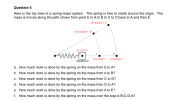 Question 5 Here is the top view of a spring-mass system. The spring is free to rotate around the origin. The mass is moves along the path shown from point E to A to B to C to D back to A and then E. 18 m@30°) (13 m@30°) В (8 m@0° equbium13 meo (18 m@o) a. b. c. d. e. f. How much work is done by the spring on the mass from E to A? How much work...
 How many chirality centers are present in the molecule shown here? OH Question 1 How were the Himalayas formed
 QUESTION 14 CH3 What is the name of the compound shown? сня HC OH HO 5-methyl-2,4-hexanediol 2-methyl-3,5-hexanediol 2.4-dihydroxyl-5-methylhexane 2-methyl-3,5-dihydroxylhexane QUESTION 15 Select the alcohol below that would have the highest boiling point. CH3CH2CH2OH CH3CH2(OH)CH2OH е сHзон CH(OH)CH(OH)CH2(OH) Click Save and Submit to save and submit. Click Save All Answers to aun allansters,
 Question 16 1.67 pts Time Atten 1 Ho How does the loop of Henle enable the mammalian kidney to produce hyperosmotic urine? 1-The ascending limb of the loop actively extrudes Nat. Il-The descending limb interacts with the ascending limb to raise the osmolarity of the extracellular fluid in the renal medulla. III- The concentration is further enhanced by the presence of urea, which draws water out of the collecting ducts by osmosis. 24/7 just III justi lland I and II...
 Question 7 (1 point) The structures of galactose (left) and glucose (right) are shown below. How are the two monosaccharides related? SHO SHO H-C-OH H-C-OH HO-C-H HO-C-H HOC-HH- OH H-C-OHH-C-OH CH,OH CH,OH ( 1) structural isomers 2) stereoisomers ( 3) enantiomers 4) anomers
 1500 1000 500 5 10 15 20 Distance (Mpc) Figure 7.6: A Hubble diagram showing the relationship between galaxy distance and re- cessional velocity, where distances were derived from the period-luminosity relationship for Cepheid variable stars identified within each galaxy. The M100 point is circled in red, and based in part on the data shown in Figures 17.4 and 7.5. The slope of the relationship is 79 +4 km sec1 per Mpc, and the correlation coefficient R is 78 %...
 Please answer the following question correctly and completely.
(Please write neatly)
1. Take a look at this figure and do the followng:
A. Write the appropriate reaction conditions/reagents listed
over each arrow (Circled in red).
B. There are four stereoisomers shown for intermediate "4" but
only one for "5". The word "resolved" is written over the arrow
between them. What does resolved mean? How might we be converting a
mixture of four structures into only one structure?
C. Write step-by-step...
Please answer the following question correctly and completely.
(Please write neatly)
1. Take a look at this figure and do the followng:
A. Write the appropriate reaction conditions/reagents listed
over each arrow (Circled in red).
B. There are four stereoisomers shown for intermediate "4" but
only one for "5". The word "resolved" is written over the arrow
between them. What does resolved mean? How might we be converting a
mixture of four structures into only one structure?
C. Write step-by-step...
 Question 8 (1 point) According to the following reaction, how many moles of Fe(OH)2 can form from 175.0 mL of 0.227 M LIOH solution? Assume that there is excess FeCl2 FeCl2(aq) + 2 LiOH(aq) - Fe(OH)2(s) + 2 LiCl(aq) 05.03 * 10-2 moles 2.52 x 10⁻² moles O 1.99 x 10⁻² moles 6.49 * 10-2 moles 3.97 * 10-2 moles Previous Page Next Page Page 8 of 28
 Question 1 (1 point) A 52.30 g sample of Ba(OH)2 is dissolved in enough water to make 1.20 L of solution. How many milliliters of this solution must be diluted with water in order to make 1.00 L of 0.100 M Ba(OH)2? 62.8 mL 254 mL O 305 ml O 523 mL O 393 mL O Question 2 (1 point) A chemist needs 225 mL of 2.3 M HCl. What volume of 12 M HCl must be dissolved in water...
 5,6,7,8,9,10 PLEASEEEE!!!!!!
Question 5 (1 point) Classify, in order each of the following as an element (E), compound (C), a homogeneous mixture (HO) or a heterogeneous mixture (HE). sweet ice tea, potassium bromide, riverbed rocks, germanium, bronze A) HO, C, HE, E, HO OB) HO, C, HE, E, E C) C, C, HE, E, HO D) HO, C, HE, E, C Question 6 (1 point) Determine, in order, if the following are chemical or physical changes. biting a gum drop,...
5,6,7,8,9,10 PLEASEEEE!!!!!!
Question 5 (1 point) Classify, in order each of the following as an element (E), compound (C), a homogeneous mixture (HO) or a heterogeneous mixture (HE). sweet ice tea, potassium bromide, riverbed rocks, germanium, bronze A) HO, C, HE, E, HO OB) HO, C, HE, E, E C) C, C, HE, E, HO D) HO, C, HE, E, C Question 6 (1 point) Determine, in order, if the following are chemical or physical changes. biting a gum drop,...
 Question 5 Here is the top view of a spring-mass system. The spring is free to rotate around the origin. The mass is moves along the path shown from point E to A to B to C to D back to A and then E. 18 m@30°) (13 m@30°) В (8 m@0° equbium13 meo (18 m@o) a. b. c. d. e. f. How much work is done by the spring on the mass from E to A? How much work...
Most questions answered within 3 hours.
-
Where is the error in this code sequence?
String s1 = "Hello";
String s2 = "ello";...
asked 10 months ago -
Financial data for Joel de Paris, Inc., for last year
follow:
Joel de Paris, Inc.
Balance...
asked 10 months ago -
Consider this reaction:
Al2(SO4)3 (aq)+ BaCl3
(aq) Al2Cl6 (aq)- +
3BaSO4(s) . What is the...
asked 10 months ago -
Suppose that Savneet is considering increasing her
recent random sample from 20 car rentals to 40...
asked 10 months ago -
Trucks arrive at an unloading terminal at an average rate of 120
per hour.
Trucks arrive...
asked 10 months ago -
Why are methanol and ethanol completely soluble in water while
octanol is not very little soluble....
asked 10 months ago -
A facilities manager at a university reads in a research report
that the mean amount of...
asked 10 months ago -
When the CuSO4 is rehydrated by adding water to the anhydrous
compound, is this an endothermic...
asked 10 months ago -
A ray of sunlight is passing from diamond into crown glass; the
angle of incidence is...
asked 10 months ago -
A block of mass 0.249 kg is placed on top of a light, vertical
spring of...
asked 10 months ago -
how do the kidneys compensate in the presences of acidosis
a) trigger hyperventilate
b) reserve acid...
asked 10 months ago -
Question 501 pts
The rental rate of capital to the firm increases. Which of the
following...
asked 10 months ago