Problem Description proving program correctness Consider the following program specification: Input: An integer n > 0...
Problem Description
proving program correctness
Consider the following program specification:
Input: An integer n > 0 and an array A[0..(n - 1)] of n integers.
Output: The smallest index s such that A[s] is the largest value in A[0..(n - 1)].
For example, if n = 9 and A = [ 4, 8, 1, 3, 8, 5, 4, 7, 2 ] (so A[0] = 4, A[1] = 8, etc.), then the program would return 1, since the largest value in A is 8 and the smallest index at which 8 appears is index 1.
Consider the following implementation:
| indexOfMax(n, A) | ||||
| (1) | i ← n - 2 | |||
| (2) | m ← A[n - 1] | |||
| (3) | s ← n - 1 | |||
| (4) | while i ≥ 0 | |||
| (5) | if A[i] ≥ m then | |||
| (6) | m ← A[i] | |||
| (7) | s ← i | |||
| (8) | end | |||
| (9) | i ← i - 1 | |||
| (10) | end | |||
| (11) | return s | |||
In the implementation above, line numbers are given so you can refer to specific lines in your answers and ← is used to indicate assignment.
Part A
Use induction to establish the following loop invariant right before the while test in line (4) is executed:
i. -1 ≤ i < n - 1
ii. m = A[s]
iii. m = max A[(i + 1) .. (n - 1)] (i.e., m is the maximum value in that appears in the array A between indices i + 1 and n - 1, inclusive)
iv. s is the smallest index at which max A[(i + 1) .. (n - 1)] appears
Hints and tips:
Use only one induction proof and prove each of the four parts of the invariant in your base case and inductive step.
You may assume that i and s will always be integers (i.e., you don't have to prove this).
Part B
Prove the correctness of the implementation by arguing partial correctness and termination.
Homework Answers


Add Answer to:
Problem Description
proving program correctness
Consider the following program specification:
Input: An integer n > 0...
Argue the correctness of Heapsort using the following loop invariant for the second loop in the...
Argue the correctness of Heapsort using the following loop invariant for the second loop in the algorithm (after the array has been heapified): "At the start of each iteration of the for loop, the subarray A[0 ... i-1] is a max-heap containing the i smallest elements of the original array, and the subarray A[i ... n-1] contains the n-i largest elements of the original array in sorted order
10. (10 points) Computational problem solving: Proving correctness: Function g (n: nonnegative integer) if n si...
 10. (10 points) Computational problem solving: Proving correctness: Function g (n: nonnegative integer) if n si then return(n) else return(5*g(n-1) - 6*g(n-2)) Prove by induction that algorithm g is correct, if it is intended to compute the function 3"-2" for all n 20. Base Case Proof: Inductive Hypothesis: Inductive Step:
An array A of n integers is called semi-sorted if it is increasing until some index...
An array A of n integers is called semi-sorted if it is increasing until some index and then decreasing afterwards. In other words, there is some index 1 ≤ p ≤ n such that: • A[i] < A[i + 1] for 1 ≤ i < p, and • A[i] > A[i + 1] for p ≤ i < n. Note that in this case, A[p] is the maximum element of A. Give an algorithm with running time O(logn) that finds...
Java question Given an array of integer numbers, write a linear running time complexity program in...
 Java question
Given an array of integer numbers, write a linear running time complexity program in Java to find the stability index in the given input array. For an array A consisting n integers elements, index i is a stability index in A itf ATO] + A[1] + +A[iI-1] Ali+1]+ Ali+2] +... + A[n-1]; where 0 <i< n-1 Similarly, 0 is an stability index if (A[1] A[2]A[n-1]) 0 and n-1 is an stability index if (A[0] A[1]+... A[n-21) 0 Example:...
Java question
Given an array of integer numbers, write a linear running time complexity program in Java to find the stability index in the given input array. For an array A consisting n integers elements, index i is a stability index in A itf ATO] + A[1] + +A[iI-1] Ali+1]+ Ali+2] +... + A[n-1]; where 0 <i< n-1 Similarly, 0 is an stability index if (A[1] A[2]A[n-1]) 0 and n-1 is an stability index if (A[0] A[1]+... A[n-21) 0 Example:...
Given an array of integer numbers, write a linear running time complexity program in Java to...
Given an array of integer numbers, write a linear running time complexity program in Java to find the stability index in the given input array. For an array A consisting n integers elements, index i is a stability index in A if A[0] + A[1] + ... + A[i-1] = A[i+1] + A[i+2] + ... + A[n-1]; where 0 < i < n-1. Similarly, 0 is an stability index if (A[1] + A[2] + ... + A[n-1]) = 0 and...
Prove procedure to compute Fibinocci(n) where F0 = 0, F1 = 1, Fn = Fn-2 +...
Prove procedure to compute Fibinocci(n) where F0 = 0, F1 = 1, Fn = Fn-2 + Fn-1. Prove by establishing and proving loop invariant then using induction to prove soundness and termination. 1: Procedure Fib(n) 2: i←0,j←1,k←1,m←n 3: while m ≥ 3 do 4: m←m−3 5: i←j+k 6: j←i+k 7: k←i+j 8: if m = 0 then 9: return i 10: else if m = 1 then 11: return j 12: else 13. return k
Prove procedure to compute Fibinocci(n) where F0 = 0, F1 = 1, Fn = Fn-2 +...
Prove procedure to compute Fibinocci(n) where F0 = 0, F1 = 1, Fn = Fn-2 + Fn-1. Prove by establishing and proving loop invariant then using induction to prove soundness and termination. 1: Procedure Fib(n) 2: i←0,j←1,k←1,m←n 3: while m ≥ 3 do 4: m←m−3 5: i←j+k 6: j←i+k 7: k←i+j 8: if m = 0 then 9: return i 10: else if m = 1 then 11: return j 12: else 13. return k
(15 points) Consider the algorithm for insertion sort shown below. The input to this algorithm is...
 (15 points) Consider the algorithm for insertion sort shown below. The input to this algorithm is an earray A. You must assume that indexing begins at 1. 1: for j = 2: A.length do key = A i=j-1 while i > 0 and A[i] > key do Ali + 1] = Ai i=i-1 7: A[i+1] = key (a) Follow this algorithm for A[1..4) =< 7,9,6,8 >. Specifically, please indicate the contents of the array after each iteration of the outer...
PLEASE USE INDUCTION, NO PROGRAMS ALLOWED Consider the following program, where a and n are positive...
 PLEASE USE INDUCTION, NO PROGRAMS ALLOWED
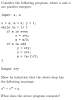
Consider the following program, where a and n are positive integers. Input: a, n x = a; m = n; y = 1; while (m > 1) {if m is even x = x*x; m = m/2; if m is odd y = x*y; x = x*x; m = (m - 1)/2;} Output x*y Show by induction that the above loop has the following invariant: a^n = x^m times y. What does the above...
PLEASE USE INDUCTION, NO PROGRAMS ALLOWED
Consider the following program, where a and n are positive integers. Input: a, n x = a; m = n; y = 1; while (m > 1) {if m is even x = x*x; m = m/2; if m is odd y = x*y; x = x*x; m = (m - 1)/2;} Output x*y Show by induction that the above loop has the following invariant: a^n = x^m times y. What does the above...
An array A[1,2,... ,n is unimodal if its consists of an increasing sequence followed by sequence...
 An array A[1,2,... ,n is unimodal if its consists of an increasing sequence followed by sequence a decreasing sequence. More precisely, there exists an index k є {1,2,… ,n} such that there exists an indes . AlE]< Ali1 for all 1 i< k, and Ai]Ali 1 for all k< i< n A1,2,..,n] in O(logn) time the loop invariant (s) that your algorithm maintains and show why they lead to the correctness Give an algorithm to compute the maximum element of...
 10. (10 points) Computational problem solving: Proving correctness: Function g (n: nonnegative integer) if n si then return(n) else return(5*g(n-1) - 6*g(n-2)) Prove by induction that algorithm g is correct, if it is intended to compute the function 3"-2" for all n 20. Base Case Proof: Inductive Hypothesis: Inductive Step:
 Java question
Given an array of integer numbers, write a linear running time complexity program in Java to find the stability index in the given input array. For an array A consisting n integers elements, index i is a stability index in A itf ATO] + A[1] + +A[iI-1] Ali+1]+ Ali+2] +... + A[n-1]; where 0 <i< n-1 Similarly, 0 is an stability index if (A[1] A[2]A[n-1]) 0 and n-1 is an stability index if (A[0] A[1]+... A[n-21) 0 Example:...
Java question
Given an array of integer numbers, write a linear running time complexity program in Java to find the stability index in the given input array. For an array A consisting n integers elements, index i is a stability index in A itf ATO] + A[1] + +A[iI-1] Ali+1]+ Ali+2] +... + A[n-1]; where 0 <i< n-1 Similarly, 0 is an stability index if (A[1] A[2]A[n-1]) 0 and n-1 is an stability index if (A[0] A[1]+... A[n-21) 0 Example:...
 (15 points) Consider the algorithm for insertion sort shown below. The input to this algorithm is an earray A. You must assume that indexing begins at 1. 1: for j = 2: A.length do key = A i=j-1 while i > 0 and A[i] > key do Ali + 1] = Ai i=i-1 7: A[i+1] = key (a) Follow this algorithm for A[1..4) =< 7,9,6,8 >. Specifically, please indicate the contents of the array after each iteration of the outer...
 PLEASE USE INDUCTION, NO PROGRAMS ALLOWED
Consider the following program, where a and n are positive integers. Input: a, n x = a; m = n; y = 1; while (m > 1) {if m is even x = x*x; m = m/2; if m is odd y = x*y; x = x*x; m = (m - 1)/2;} Output x*y Show by induction that the above loop has the following invariant: a^n = x^m times y. What does the above...
PLEASE USE INDUCTION, NO PROGRAMS ALLOWED
Consider the following program, where a and n are positive integers. Input: a, n x = a; m = n; y = 1; while (m > 1) {if m is even x = x*x; m = m/2; if m is odd y = x*y; x = x*x; m = (m - 1)/2;} Output x*y Show by induction that the above loop has the following invariant: a^n = x^m times y. What does the above...
 An array A[1,2,... ,n is unimodal if its consists of an increasing sequence followed by sequence a decreasing sequence. More precisely, there exists an index k є {1,2,… ,n} such that there exists an indes . AlE]< Ali1 for all 1 i< k, and Ai]Ali 1 for all k< i< n A1,2,..,n] in O(logn) time the loop invariant (s) that your algorithm maintains and show why they lead to the correctness Give an algorithm to compute the maximum element of...
Most questions answered within 3 hours.
-
Where is the error in this code sequence?
String s1 = "Hello";
String s2 = "ello";...
asked 11 months ago -
Financial data for Joel de Paris, Inc., for last year
follow:
Joel de Paris, Inc.
Balance...
asked 11 months ago -
Consider this reaction:
Al2(SO4)3 (aq)+ BaCl3
(aq) Al2Cl6 (aq)- +
3BaSO4(s) . What is the...
asked 11 months ago -
Suppose that Savneet is considering increasing her
recent random sample from 20 car rentals to 40...
asked 11 months ago -
Trucks arrive at an unloading terminal at an average rate of 120
per hour.
Trucks arrive...
asked 11 months ago -
Why are methanol and ethanol completely soluble in water while
octanol is not very little soluble....
asked 11 months ago -
A facilities manager at a university reads in a research report
that the mean amount of...
asked 11 months ago -
When the CuSO4 is rehydrated by adding water to the anhydrous
compound, is this an endothermic...
asked 11 months ago -
A ray of sunlight is passing from diamond into crown glass; the
angle of incidence is...
asked 11 months ago -
A block of mass 0.249 kg is placed on top of a light, vertical
spring of...
asked 11 months ago -
how do the kidneys compensate in the presences of acidosis
a) trigger hyperventilate
b) reserve acid...
asked 11 months ago -
Question 501 pts
The rental rate of capital to the firm increases. Which of the
following...
asked 11 months ago