
Homework Answers
We start by dividing the function log(z) into real and imaginary parts.
Let,  , where
  and
and 
Then,

Now the potential function is given by,

Stream function is given by the imaginary part of the complex potential. Hence, the stream function is,

The streamlines are where the stream function is constant. Hence, the streamlines are given by,


Hence, the streamlines are given by ,

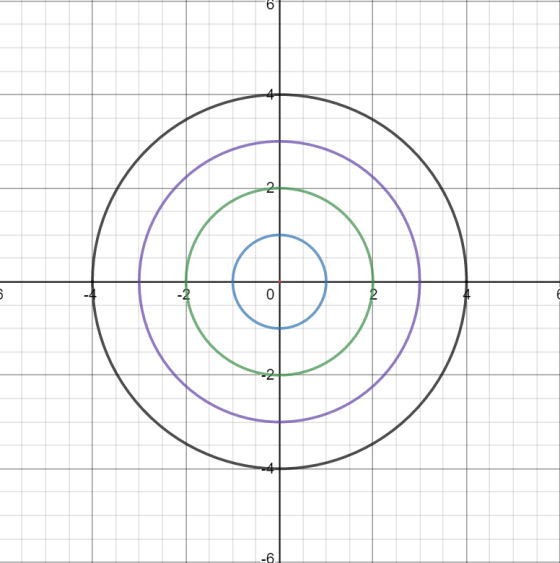
This for of equation represents circle centered at the origin. For different values of C we get the streamlines. I have added a graph showing the streamlines for C = 0, 1, 4, 9, 16.
3. Let f(z) = zc where c is a complex number. Assume that the domain of...
 3. Let f(z) = zc where c is a complex
number. Assume that the domain of f is the whole complex plane
except the negative real numbers. a) What is the derivative of f?
b) Let g(z) = cz. Find the derivative of g.
3. Let f(z) = zº where c is a complex number. Assume that the domain of f is the whole complex plane except the negative real numbers. a) What is the derivative of f? b) Let...
3. Let f(z) = zc where c is a complex
number. Assume that the domain of f is the whole complex plane
except the negative real numbers. a) What is the derivative of f?
b) Let g(z) = cz. Find the derivative of g.
3. Let f(z) = zº where c is a complex number. Assume that the domain of f is the whole complex plane except the negative real numbers. a) What is the derivative of f? b) Let...
complex analysis Let f(z) be continuous on S where for some real numbers 0< a <...
 complex analysis
Let f(z) be continuous on S where for some real numbers 0< a < b. Define max(Re(z)Im(z and suppose f(z) dz = 0 S, for all r E (a, b). Prove or disprove that f(z) is holomorphic on S.
complex analysis
Let f(z) be continuous on S where for some real numbers 0< a < b. Define max(Re(z)Im(z and suppose f(z) dz = 0 S, for all r E (a, b). Prove or disprove that f(z) is holomorphic on S.
complex analysis 6. Let z" f(z)=lim 1 z (a) What is the domain of definition of...
 complex analysis
6. Let z" f(z)=lim 1 z (a) What is the domain of definition of f, that is, for which compiex numbers z does the limit exist? (b) Give explicitly the values of f(2) for the various z in the domain of f.
6. Let z" f(z)=lim 1 z (a) What is the domain of definition of f, that is, for which compiex numbers z does the limit exist? (b) Give explicitly the values of f(2) for the various...
complex analysis
6. Let z" f(z)=lim 1 z (a) What is the domain of definition of f, that is, for which compiex numbers z does the limit exist? (b) Give explicitly the values of f(2) for the various z in the domain of f.
6. Let z" f(z)=lim 1 z (a) What is the domain of definition of f, that is, for which compiex numbers z does the limit exist? (b) Give explicitly the values of f(2) for the various...
2- a) The real part of a complex function f(z) given as, u(x, y) = 3x?y...
 2- a) The real part of a complex function f(z) given as, u(x, y) = 3x?y - y. Iff(2) is an analytic function, find v(x,y) and f(z) (15p) b) Find the whether f(z) is analytic or not where f(z) = cos(x) +ie'sinx. (15p)
Let z=6+6 \sqrt{3} i. (a) Graph z in the complex plane.
 Let z=6+6 \sqrt{3} i.(a) Graph z in the complex plane. (b) Write z in polar form.(c) Find the complex number z9. (Enter your answer in a+bi form.) z9=
Using Newton-Raphson method, find the complex root of the function f(z) = z 2 + z...
Using Newton-Raphson method, find the complex root of the function f(z) = z 2 + z + 1 with with an accuracy of 10–6. Let z0 = 1 − i. could you please solve analytical solution ?
Please answer without using previously posted answers. Thanks Let F(x, y) be a two-dimensional vector field. Spose further that there exists a scalar function, o, such that Then, F(x,y) is called a g...
 Please answer without using previously posted answers.
Thanks
Let F(x, y) be a two-dimensional vector field. Spose further that there exists a scalar function, o, such that Then, F(x,y) is called a gradient field, and φ s called a potential function. Ideal Fluid Flow Let F represent the two-dimensional velocity field of an inviscid fluid that is incompressible, ie. . F-0 (or divergence-free). F can be represented by (1), where ф is called the velocity potential-show that o is harmonic....
Please answer without using previously posted answers.
Thanks
Let F(x, y) be a two-dimensional vector field. Spose further that there exists a scalar function, o, such that Then, F(x,y) is called a gradient field, and φ s called a potential function. Ideal Fluid Flow Let F represent the two-dimensional velocity field of an inviscid fluid that is incompressible, ie. . F-0 (or divergence-free). F can be represented by (1), where ф is called the velocity potential-show that o is harmonic....
Let z = t(1 + i) be a complex number, where t is some real parameter....
 Let z = t(1 + i) be a complex number, where t is some real parameter. Using the polar form of a complex number, find Z6. teri/4 (V2t) erila (2t) 26. 6i/4 teori/4 (V2)%e6ni14 (12)etail4
real analysis 4. Let f(x) = tan x = suur on (, ). Note that f...
 real analysis
4. Let f(x) = tan x = suur on (, ). Note that f is continuous. (a) Sketch the graph of f. (b) Find f'(2). (c) Explain why f is strictly increasing. So f has an inverse function, f-'(x) = arctan x. (d) Sketch the graph of arctan r. (e) Find the derivative of arctan z. Show all your work.
real analysis
4. Let f(x) = tan x = suur on (, ). Note that f is continuous. (a) Sketch the graph of f. (b) Find f'(2). (c) Explain why f is strictly increasing. So f has an inverse function, f-'(x) = arctan x. (d) Sketch the graph of arctan r. (e) Find the derivative of arctan z. Show all your work.
Q7. The flow field is defined by the complex potential function, f(z)- Uz+mlnz) a) Define the stream and potential functions, b) Define the types of the potential flows superpositioned c) Using t...
 Q7. The flow field is defined by the complex potential function, f(z)- Uz+mlnz) a) Define the stream and potential functions, b) Define the types of the potential flows superpositioned c) Using the values, U-8 m/s and m-3 m'/s determine the pressure distribution and obtain the location op the stagnation point or points in the flow field.
Q7. The flow field is defined by the complex potential function, f(z)- Uz+mlnz) a) Define the stream and potential functions, b) Define the types...
Q7. The flow field is defined by the complex potential function, f(z)- Uz+mlnz) a) Define the stream and potential functions, b) Define the types of the potential flows superpositioned c) Using the values, U-8 m/s and m-3 m'/s determine the pressure distribution and obtain the location op the stagnation point or points in the flow field.
Q7. The flow field is defined by the complex potential function, f(z)- Uz+mlnz) a) Define the stream and potential functions, b) Define the types...
 3. Let f(z) = zc where c is a complex
number. Assume that the domain of f is the whole complex plane
except the negative real numbers. a) What is the derivative of f?
b) Let g(z) = cz. Find the derivative of g.
3. Let f(z) = zº where c is a complex number. Assume that the domain of f is the whole complex plane except the negative real numbers. a) What is the derivative of f? b) Let...
3. Let f(z) = zc where c is a complex
number. Assume that the domain of f is the whole complex plane
except the negative real numbers. a) What is the derivative of f?
b) Let g(z) = cz. Find the derivative of g.
3. Let f(z) = zº where c is a complex number. Assume that the domain of f is the whole complex plane except the negative real numbers. a) What is the derivative of f? b) Let...
 complex analysis
Let f(z) be continuous on S where for some real numbers 0< a < b. Define max(Re(z)Im(z and suppose f(z) dz = 0 S, for all r E (a, b). Prove or disprove that f(z) is holomorphic on S.
complex analysis
Let f(z) be continuous on S where for some real numbers 0< a < b. Define max(Re(z)Im(z and suppose f(z) dz = 0 S, for all r E (a, b). Prove or disprove that f(z) is holomorphic on S.
 complex analysis
6. Let z" f(z)=lim 1 z (a) What is the domain of definition of f, that is, for which compiex numbers z does the limit exist? (b) Give explicitly the values of f(2) for the various z in the domain of f.
6. Let z" f(z)=lim 1 z (a) What is the domain of definition of f, that is, for which compiex numbers z does the limit exist? (b) Give explicitly the values of f(2) for the various...
complex analysis
6. Let z" f(z)=lim 1 z (a) What is the domain of definition of f, that is, for which compiex numbers z does the limit exist? (b) Give explicitly the values of f(2) for the various z in the domain of f.
6. Let z" f(z)=lim 1 z (a) What is the domain of definition of f, that is, for which compiex numbers z does the limit exist? (b) Give explicitly the values of f(2) for the various...
 2- a) The real part of a complex function f(z) given as, u(x, y) = 3x?y - y. Iff(2) is an analytic function, find v(x,y) and f(z) (15p) b) Find the whether f(z) is analytic or not where f(z) = cos(x) +ie'sinx. (15p)
 Let z=6+6 \sqrt{3} i.(a) Graph z in the complex plane. (b) Write z in polar form.(c) Find the complex number z9. (Enter your answer in a+bi form.) z9=
 Please answer without using previously posted answers.
Thanks
Let F(x, y) be a two-dimensional vector field. Spose further that there exists a scalar function, o, such that Then, F(x,y) is called a gradient field, and φ s called a potential function. Ideal Fluid Flow Let F represent the two-dimensional velocity field of an inviscid fluid that is incompressible, ie. . F-0 (or divergence-free). F can be represented by (1), where ф is called the velocity potential-show that o is harmonic....
Please answer without using previously posted answers.
Thanks
Let F(x, y) be a two-dimensional vector field. Spose further that there exists a scalar function, o, such that Then, F(x,y) is called a gradient field, and φ s called a potential function. Ideal Fluid Flow Let F represent the two-dimensional velocity field of an inviscid fluid that is incompressible, ie. . F-0 (or divergence-free). F can be represented by (1), where ф is called the velocity potential-show that o is harmonic....
 Let z = t(1 + i) be a complex number, where t is some real parameter. Using the polar form of a complex number, find Z6. teri/4 (V2t) erila (2t) 26. 6i/4 teori/4 (V2)%e6ni14 (12)etail4
 real analysis
4. Let f(x) = tan x = suur on (, ). Note that f is continuous. (a) Sketch the graph of f. (b) Find f'(2). (c) Explain why f is strictly increasing. So f has an inverse function, f-'(x) = arctan x. (d) Sketch the graph of arctan r. (e) Find the derivative of arctan z. Show all your work.
real analysis
4. Let f(x) = tan x = suur on (, ). Note that f is continuous. (a) Sketch the graph of f. (b) Find f'(2). (c) Explain why f is strictly increasing. So f has an inverse function, f-'(x) = arctan x. (d) Sketch the graph of arctan r. (e) Find the derivative of arctan z. Show all your work.
 Q7. The flow field is defined by the complex potential function, f(z)- Uz+mlnz) a) Define the stream and potential functions, b) Define the types of the potential flows superpositioned c) Using the values, U-8 m/s and m-3 m'/s determine the pressure distribution and obtain the location op the stagnation point or points in the flow field.
Q7. The flow field is defined by the complex potential function, f(z)- Uz+mlnz) a) Define the stream and potential functions, b) Define the types...
Q7. The flow field is defined by the complex potential function, f(z)- Uz+mlnz) a) Define the stream and potential functions, b) Define the types of the potential flows superpositioned c) Using the values, U-8 m/s and m-3 m'/s determine the pressure distribution and obtain the location op the stagnation point or points in the flow field.
Q7. The flow field is defined by the complex potential function, f(z)- Uz+mlnz) a) Define the stream and potential functions, b) Define the types...
Most questions answered within 3 hours.
-
Where is the error in this code sequence?
String s1 = "Hello";
String s2 = "ello";...
asked 11 months ago -
Financial data for Joel de Paris, Inc., for last year
follow:
Joel de Paris, Inc.
Balance...
asked 11 months ago -
Consider this reaction:
Al2(SO4)3 (aq)+ BaCl3
(aq) Al2Cl6 (aq)- +
3BaSO4(s) . What is the...
asked 11 months ago -
Suppose that Savneet is considering increasing her
recent random sample from 20 car rentals to 40...
asked 11 months ago -
Trucks arrive at an unloading terminal at an average rate of 120
per hour.
Trucks arrive...
asked 11 months ago -
Why are methanol and ethanol completely soluble in water while
octanol is not very little soluble....
asked 11 months ago -
A facilities manager at a university reads in a research report
that the mean amount of...
asked 11 months ago -
When the CuSO4 is rehydrated by adding water to the anhydrous
compound, is this an endothermic...
asked 11 months ago -
A ray of sunlight is passing from diamond into crown glass; the
angle of incidence is...
asked 11 months ago -
A block of mass 0.249 kg is placed on top of a light, vertical
spring of...
asked 11 months ago -
how do the kidneys compensate in the presences of acidosis
a) trigger hyperventilate
b) reserve acid...
asked 11 months ago -
Question 501 pts
The rental rate of capital to the firm increases. Which of the
following...
asked 11 months ago