In the 2D squeezing flow, the plate at y=0 is stationary, and the plate at y=h...
In the 2D squeezing flow, the plate at y=0 is stationary, and the plate at y=h is given a velocity of u = (0, -V). Investigate the axi-symmetric squeezing flow.
Homework Answers
The system is as shown below:
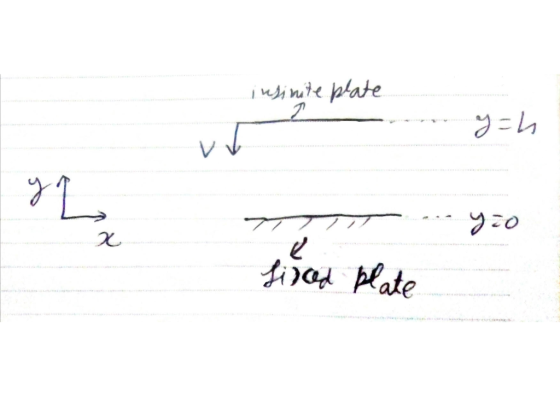
Consider a cylindrical control volume (CV) of radius r and length L, as shown below:
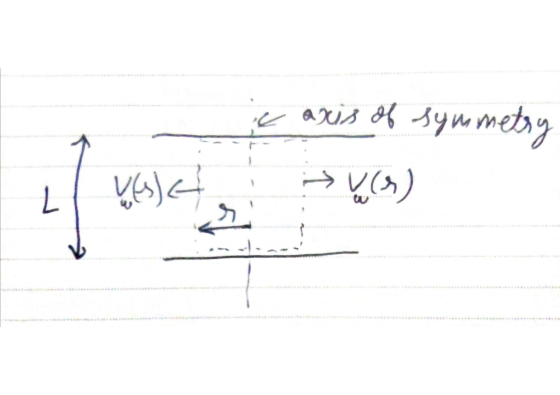
The walls of the CV are expanding with a radial velocity of Vw as shown. All the fluid particles at |x|=r will be having same radial velocity.
Since the fluid is incompressible, therefore volume of the CV must be constant.
Vol = volume of CV = 2*pi*r*L _________ eq. 1 (here pi = 22/7)
Therefore,
(since volume of CV is constant)
(since
)
also L = h - V*t,
__________________ eq. 2
Also,
(using
)
____________________ eq. 3
Therefore, the velocity and acceleration of the fluid particles vary with radius r from axis of symmetry and with time as well.
Add Answer to:
In the 2D squeezing flow, the plate at y=0 is stationary, and
the plate at y=h...
4. Consider fully developed Couette flow-flow between two infinite parallel plates separated by distance h, with...
 4. Consider fully developed Couette flow-flow between two infinite parallel plates separated by distance h, with the top plate moving and the bottom plate stationary. The flow is steady, incompressible, and two-dimensional in the xy- plane. Use the method of repeating variables to generate a dimensionless relationship for the x component of fluid velocity u as a function of fluid viscosity , top plate speed V, distance h, fluid density p, and distance y Show all your work. Hint: u...
4) Stream function Consider a steady, 2D, incompressible flow with velocity field u(,0, where U, h...
 4) Stream function Consider a steady, 2D, incompressible flow with velocity field u(,0, where U, h are constants. Determine the stream function p for this flow. For simplicity take ( 0)0
The x and y components of velocity for 2D flow are u = 3 m/s and...
The x and y components of velocity for 2D flow are u = 3 m/s and v = 9x2 m/s, where x is in meter. Determine the equation of the streamlines (y) and plot the graph of the streamline when y = 0 for the range of -10 <=x <= 10 and -10 <= y <= 10
3. Two parallel plates are 0.025 m apart (h): the lower plate is stationary and the upper plate m...
 Can you make matlab solve it?
3. Two parallel plates are 0.025 m apart (h): the lower plate is stationary and the upper plate moves at a velocity (V ) of 2 ms. The shear stress (t) is estimated by where u, the viscosity in Ns/m2, is a fiunction that depends on the temperature. Laboratory measurements give: тес! 5 | 20 | 30 | 50 | 55 0.08 0.015 0.009 0.006 0.0055 Estimate the shear stress at 38°C
3. Two...
Can you make matlab solve it?
3. Two parallel plates are 0.025 m apart (h): the lower plate is stationary and the upper plate moves at a velocity (V ) of 2 ms. The shear stress (t) is estimated by where u, the viscosity in Ns/m2, is a fiunction that depends on the temperature. Laboratory measurements give: тес! 5 | 20 | 30 | 50 | 55 0.08 0.015 0.009 0.006 0.0055 Estimate the shear stress at 38°C
3. Two...
For flow over a plate, the variation of velocity with vertical distance y from the plate...
For flow over a plate, the variation of velocity with vertical distance y from the plate is given as u(y)=ay^2-by^3 where a and b are constants. Obtain a relation for the wall shear stress in terms of a,b, and u.
A laminar flow of constant density and constant viscosity at steady state flows thought the two...
 A laminar flow of constant density and constant viscosity at steady state flows thought the two flat and parallel infinite plate. The upper plate is mowing while lower plate is stationary. The flow upper plate: moving is driven by the pressure gradient in the x direction. The velocity profile is desired to be derived for this system. Then - What are the correct answers? 20 lower plate: stationary ay c) PS, 0 200 b- Write the equation to find out...
Consider a Couette flow between two flat plates: One plate is stationary, while the other plate...
 Consider a Couette flow between two flat plates: One plate is stationary, while the other plate is moving with a velocity vo; the distance between the plates is h. Realize that the density and the viscosity of the fluid are roughly constant. You may also presume that the velocity is mostly unidirectional, solely varying in its perpendicular direction. In turn, formulate and solve the differential equation which governs the velocity profile!
5) The velocity field for a 2D U=(x-2y)t Ň - (2x+y)t flow Ý is: a) Is...
 5) The velocity field for a 2D U=(x-2y)t Ň - (2x+y)t flow Ý is: a) Is this How incompressible? irrotational? 6) Find the acceleration of a Fluid element in this c) Find 0 and 4 for this flow . flow
Extend the steady flow between a fixed lower plate and a moving upper plate, from the...
 Extend the steady flow between a fixed lower plate and a moving upper plate, from the image to the case of two immiscible liquids between the plates, as shown in the image. References eBook & Resources Section Break Problem 01.057 - Viscous Flow Between Parallel Plates (Velocity Analysis) Difficulty: Medium value: 5.00 points Problem 01.057.a - Viscous Flow Between Parallel Plates (Velocity Analysis) Find an analytic expression for the velocity U at the interface between the two liquid layers. Ou...
An incompressible fluid flows between two porous, parallel flat plates as shown in the Figure below....
 An incompressible fluid flows between two porous, parallel flat plates as shown in the Figure below. An identical fluid is injected at a constant speed V through the bottom plate and simultaneously extracted from the upper plate at the same velocity. There is no gravity force in x and y directions (g-g,-0). Assume the flow to be steady, fully-developed, 2D, and the pressure gradient in the x direction to be a constant P = constant). (a) Write the continuity equation...
 4. Consider fully developed Couette flow-flow between two infinite parallel plates separated by distance h, with the top plate moving and the bottom plate stationary. The flow is steady, incompressible, and two-dimensional in the xy- plane. Use the method of repeating variables to generate a dimensionless relationship for the x component of fluid velocity u as a function of fluid viscosity , top plate speed V, distance h, fluid density p, and distance y Show all your work. Hint: u...
 4) Stream function Consider a steady, 2D, incompressible flow with velocity field u(,0, where U, h are constants. Determine the stream function p for this flow. For simplicity take ( 0)0
 Can you make matlab solve it?
3. Two parallel plates are 0.025 m apart (h): the lower plate is stationary and the upper plate moves at a velocity (V ) of 2 ms. The shear stress (t) is estimated by where u, the viscosity in Ns/m2, is a fiunction that depends on the temperature. Laboratory measurements give: тес! 5 | 20 | 30 | 50 | 55 0.08 0.015 0.009 0.006 0.0055 Estimate the shear stress at 38°C
3. Two...
Can you make matlab solve it?
3. Two parallel plates are 0.025 m apart (h): the lower plate is stationary and the upper plate moves at a velocity (V ) of 2 ms. The shear stress (t) is estimated by where u, the viscosity in Ns/m2, is a fiunction that depends on the temperature. Laboratory measurements give: тес! 5 | 20 | 30 | 50 | 55 0.08 0.015 0.009 0.006 0.0055 Estimate the shear stress at 38°C
3. Two...
 A laminar flow of constant density and constant viscosity at steady state flows thought the two flat and parallel infinite plate. The upper plate is mowing while lower plate is stationary. The flow upper plate: moving is driven by the pressure gradient in the x direction. The velocity profile is desired to be derived for this system. Then - What are the correct answers? 20 lower plate: stationary ay c) PS, 0 200 b- Write the equation to find out...
 Consider a Couette flow between two flat plates: One plate is stationary, while the other plate is moving with a velocity vo; the distance between the plates is h. Realize that the density and the viscosity of the fluid are roughly constant. You may also presume that the velocity is mostly unidirectional, solely varying in its perpendicular direction. In turn, formulate and solve the differential equation which governs the velocity profile!
 5) The velocity field for a 2D U=(x-2y)t Ň - (2x+y)t flow Ý is: a) Is this How incompressible? irrotational? 6) Find the acceleration of a Fluid element in this c) Find 0 and 4 for this flow . flow
 Extend the steady flow between a fixed lower plate and a moving upper plate, from the image to the case of two immiscible liquids between the plates, as shown in the image. References eBook & Resources Section Break Problem 01.057 - Viscous Flow Between Parallel Plates (Velocity Analysis) Difficulty: Medium value: 5.00 points Problem 01.057.a - Viscous Flow Between Parallel Plates (Velocity Analysis) Find an analytic expression for the velocity U at the interface between the two liquid layers. Ou...
 An incompressible fluid flows between two porous, parallel flat plates as shown in the Figure below. An identical fluid is injected at a constant speed V through the bottom plate and simultaneously extracted from the upper plate at the same velocity. There is no gravity force in x and y directions (g-g,-0). Assume the flow to be steady, fully-developed, 2D, and the pressure gradient in the x direction to be a constant P = constant). (a) Write the continuity equation...
Most questions answered within 3 hours.
-
Where is the error in this code sequence?
String s1 = "Hello";
String s2 = "ello";...
asked 10 months ago -
Financial data for Joel de Paris, Inc., for last year
follow:
Joel de Paris, Inc.
Balance...
asked 10 months ago -
Consider this reaction:
Al2(SO4)3 (aq)+ BaCl3
(aq) Al2Cl6 (aq)- +
3BaSO4(s) . What is the...
asked 10 months ago -
Suppose that Savneet is considering increasing her
recent random sample from 20 car rentals to 40...
asked 10 months ago -
Trucks arrive at an unloading terminal at an average rate of 120
per hour.
Trucks arrive...
asked 10 months ago -
Why are methanol and ethanol completely soluble in water while
octanol is not very little soluble....
asked 10 months ago -
A facilities manager at a university reads in a research report
that the mean amount of...
asked 10 months ago -
When the CuSO4 is rehydrated by adding water to the anhydrous
compound, is this an endothermic...
asked 10 months ago -
A ray of sunlight is passing from diamond into crown glass; the
angle of incidence is...
asked 10 months ago -
A block of mass 0.249 kg is placed on top of a light, vertical
spring of...
asked 10 months ago -
how do the kidneys compensate in the presences of acidosis
a) trigger hyperventilate
b) reserve acid...
asked 10 months ago -
Question 501 pts
The rental rate of capital to the firm increases. Which of the
following...
asked 10 months ago