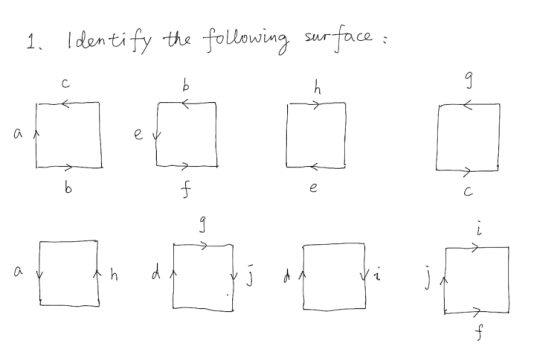
IT'S Geometry and Topology Problem.
Thanks!
Homework Answers
Solution:
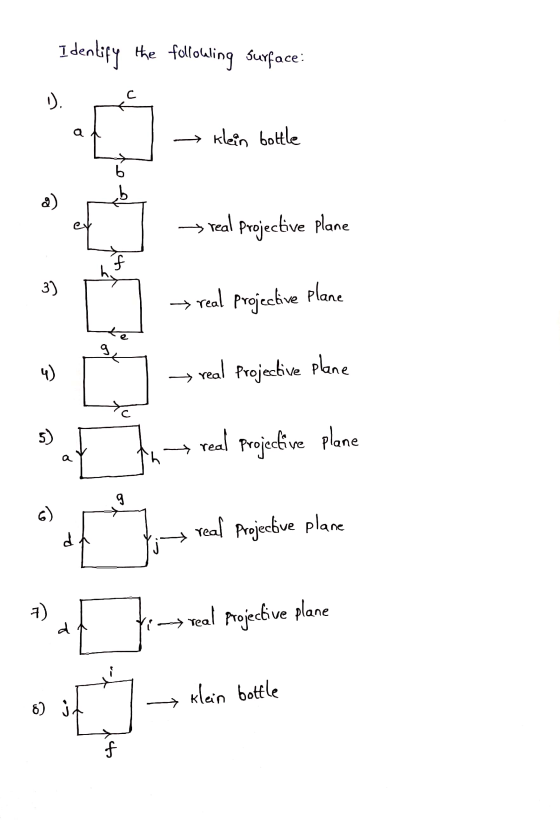
Add Answer to:
IT'S Geometry and Topology Problem.
Thanks!
1. Identify the following surface: nyos av th di
Topology Sort Which traversal do we use for Topology Sort of a di-graph? Given the following Di-G...
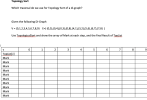 Topology Sort Which traversal do we use for Topology Sort of a di-graph? Given the following Di-Graph Use TopologicalSort and show the array of Mark at each step, and the final Result of Toplist 0 1 4 5 6 9 TopList v Mark Mark Mark Mark Mark Mark Mark Mark Mark Mark
Topology Sort Which traversal do we use for Topology Sort of a di-graph? Given the following Di-Graph Use TopologicalSort and show the array of Mark at each step,...
Topology Sort Which traversal do we use for Topology Sort of a di-graph? Given the following Di-Graph Use TopologicalSort and show the array of Mark at each step, and the final Result of Toplist 0 1 4 5 6 9 TopList v Mark Mark Mark Mark Mark Mark Mark Mark Mark Mark
Topology Sort Which traversal do we use for Topology Sort of a di-graph? Given the following Di-Graph Use TopologicalSort and show the array of Mark at each step,...
It's a binary division problem. Please help, thanks! Problem 6: Divide the following decimal numbers using...
 It's a binary division problem. Please help, thanks!
Problem 6: Divide the following decimal numbers using the subtract and restore method a) 150 by 10 b) 150 by 11
It's a binary division problem. Please help, thanks!
Problem 6: Divide the following decimal numbers using the subtract and restore method a) 150 by 10 b) 150 by 11
Identify a network topology that would best suit each of the following networked environments and explain why. 1.Apartm...
Identify a network topology that would best suit each of the following networked environments and explain why. 1.Apartment building 2.Collection of Apartment Buildings 3.City Convention Center
Problem 1. (50 points) Given the following network topology 54 270118 2/36 27 81 (1) Find...
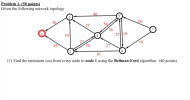 Problem 1. (50 points) Given the following network topology 54 270118 2/36 27 81 (1) Find the minimum cost from every node to node 1 using the Bellman-Ford algorithm. (40 points)
) Problem 1 (30pts) Verify that, for the following circuit, Th Z1 Th Figure 10.19 ▲...
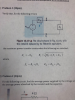 ) Problem 1 (30pts) Verify that, for the following circuit, Th Z1 Th Figure 10.19 ▲ The circuit shown in Fig. 10.18, with the network replaced by its Thévenin equivalent. the maximum power transfer occurs when the following are satisfied: х, --17h where ) Problem 2 (30pts) For the following circuit, find the average power supplied by the voltage so the average power absorbed by the resistor and the capacitor. 4Ω
3. For each of the following samples identify whether it's RNA or DNA AND whether it's...
 3. For each of the following samples identify whether it's RNA or DNA AND whether it's single-stranded of double stranded. Explain how you know. Guanine Cytosine Adenine Thymine Uracil 13% 14% 36% 37% 0% Sample 1 Sample 2 12% Sample 3 22% 36% 47% 5% 0% 47% 17% 0% 14%
Problem 3 (20 points) For the following circuit assume 1 = 0: Av= a) Determine the...
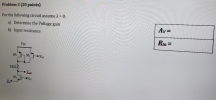 Problem 3 (20 points) For the following circuit assume 1 = 0: Av= a) Determine the Voltage gain b) Input resistance Rin = %3D VDD M2 M3 Vb2 3ΚΩΣ Vout M1 Vin Vb1
thanks! 1. Determine the following for (a) PF3 and (b) BrF4 Complete Lewis Dot Structure (all...
 thanks!
1. Determine the following for (a) PF3 and (b) BrF4 Complete Lewis Dot Structure (all bonding and non-bonding electrons) (a) :F: PEF (b) Number of electron groups around the central atom (a) (b) → Electron Group Geometry (the shape corresponding to the arrangement of th electron groups) (b) Number of bonding/non-bonding groups around the central atom (a) (b) → Molecular Geometry (Molecular Shape) (a) (b) Is the molecule polar? Explain your choice (use the arrangement of the dipoles, i...
thanks!
1. Determine the following for (a) PF3 and (b) BrF4 Complete Lewis Dot Structure (all bonding and non-bonding electrons) (a) :F: PEF (b) Number of electron groups around the central atom (a) (b) → Electron Group Geometry (the shape corresponding to the arrangement of th electron groups) (b) Number of bonding/non-bonding groups around the central atom (a) (b) → Molecular Geometry (Molecular Shape) (a) (b) Is the molecule polar? Explain your choice (use the arrangement of the dipoles, i...
thanks! 1. Determine the following for (a) PF3 and (b) BrF4 Complete Lewis Dot Structure (all...
 thanks!
1. Determine the following for (a) PF3 and (b) BrF4 Complete Lewis Dot Structure (all bonding and non-bonding electrons) (a) :F: PEF (b) Number of electron groups around the central atom (a) (b) → Electron Group Geometry (the shape corresponding to the arrangement of th electron groups) (b) Number of bonding/non-bonding groups around the central atom (a) (b) → Molecular Geometry (Molecular Shape) (a) (b) Is the molecule polar? Explain your choice (use the arrangement of the dipoles, i...
thanks!
1. Determine the following for (a) PF3 and (b) BrF4 Complete Lewis Dot Structure (all bonding and non-bonding electrons) (a) :F: PEF (b) Number of electron groups around the central atom (a) (b) → Electron Group Geometry (the shape corresponding to the arrangement of th electron groups) (b) Number of bonding/non-bonding groups around the central atom (a) (b) → Molecular Geometry (Molecular Shape) (a) (b) Is the molecule polar? Explain your choice (use the arrangement of the dipoles, i...
Please answer without using the graduent function (triangle). Thanks! :) Problem 1: Ehrenfest's Theorem [6 marks]...
 Please answer without using the graduent function (triangle).
Thanks! :)
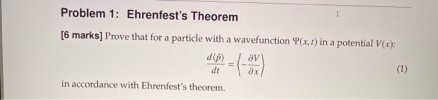
Problem 1: Ehrenfest's Theorem [6 marks] Prove that for a particle with a wavefunction P(x, t) in a potential V(x): dlp) av dt Toxl (1) in accordance with Ehrenfest's theorem.
Please answer without using the graduent function (triangle).
Thanks! :)
Problem 1: Ehrenfest's Theorem [6 marks] Prove that for a particle with a wavefunction P(x, t) in a potential V(x): dlp) av dt Toxl (1) in accordance with Ehrenfest's theorem.
 Topology Sort Which traversal do we use for Topology Sort of a di-graph? Given the following Di-Graph Use TopologicalSort and show the array of Mark at each step, and the final Result of Toplist 0 1 4 5 6 9 TopList v Mark Mark Mark Mark Mark Mark Mark Mark Mark Mark
Topology Sort Which traversal do we use for Topology Sort of a di-graph? Given the following Di-Graph Use TopologicalSort and show the array of Mark at each step,...
Topology Sort Which traversal do we use for Topology Sort of a di-graph? Given the following Di-Graph Use TopologicalSort and show the array of Mark at each step, and the final Result of Toplist 0 1 4 5 6 9 TopList v Mark Mark Mark Mark Mark Mark Mark Mark Mark Mark
Topology Sort Which traversal do we use for Topology Sort of a di-graph? Given the following Di-Graph Use TopologicalSort and show the array of Mark at each step,...
 It's a binary division problem. Please help, thanks!
Problem 6: Divide the following decimal numbers using the subtract and restore method a) 150 by 10 b) 150 by 11
It's a binary division problem. Please help, thanks!
Problem 6: Divide the following decimal numbers using the subtract and restore method a) 150 by 10 b) 150 by 11
 Problem 1. (50 points) Given the following network topology 54 270118 2/36 27 81 (1) Find the minimum cost from every node to node 1 using the Bellman-Ford algorithm. (40 points)
 ) Problem 1 (30pts) Verify that, for the following circuit, Th Z1 Th Figure 10.19 ▲ The circuit shown in Fig. 10.18, with the network replaced by its Thévenin equivalent. the maximum power transfer occurs when the following are satisfied: х, --17h where ) Problem 2 (30pts) For the following circuit, find the average power supplied by the voltage so the average power absorbed by the resistor and the capacitor. 4Ω
 3. For each of the following samples identify whether it's RNA or DNA AND whether it's single-stranded of double stranded. Explain how you know. Guanine Cytosine Adenine Thymine Uracil 13% 14% 36% 37% 0% Sample 1 Sample 2 12% Sample 3 22% 36% 47% 5% 0% 47% 17% 0% 14%
 Problem 3 (20 points) For the following circuit assume 1 = 0: Av= a) Determine the Voltage gain b) Input resistance Rin = %3D VDD M2 M3 Vb2 3ΚΩΣ Vout M1 Vin Vb1
 thanks!
1. Determine the following for (a) PF3 and (b) BrF4 Complete Lewis Dot Structure (all bonding and non-bonding electrons) (a) :F: PEF (b) Number of electron groups around the central atom (a) (b) → Electron Group Geometry (the shape corresponding to the arrangement of th electron groups) (b) Number of bonding/non-bonding groups around the central atom (a) (b) → Molecular Geometry (Molecular Shape) (a) (b) Is the molecule polar? Explain your choice (use the arrangement of the dipoles, i...
thanks!
1. Determine the following for (a) PF3 and (b) BrF4 Complete Lewis Dot Structure (all bonding and non-bonding electrons) (a) :F: PEF (b) Number of electron groups around the central atom (a) (b) → Electron Group Geometry (the shape corresponding to the arrangement of th electron groups) (b) Number of bonding/non-bonding groups around the central atom (a) (b) → Molecular Geometry (Molecular Shape) (a) (b) Is the molecule polar? Explain your choice (use the arrangement of the dipoles, i...
 thanks!
1. Determine the following for (a) PF3 and (b) BrF4 Complete Lewis Dot Structure (all bonding and non-bonding electrons) (a) :F: PEF (b) Number of electron groups around the central atom (a) (b) → Electron Group Geometry (the shape corresponding to the arrangement of th electron groups) (b) Number of bonding/non-bonding groups around the central atom (a) (b) → Molecular Geometry (Molecular Shape) (a) (b) Is the molecule polar? Explain your choice (use the arrangement of the dipoles, i...
thanks!
1. Determine the following for (a) PF3 and (b) BrF4 Complete Lewis Dot Structure (all bonding and non-bonding electrons) (a) :F: PEF (b) Number of electron groups around the central atom (a) (b) → Electron Group Geometry (the shape corresponding to the arrangement of th electron groups) (b) Number of bonding/non-bonding groups around the central atom (a) (b) → Molecular Geometry (Molecular Shape) (a) (b) Is the molecule polar? Explain your choice (use the arrangement of the dipoles, i...
 Please answer without using the graduent function (triangle).
Thanks! :)
Problem 1: Ehrenfest's Theorem [6 marks] Prove that for a particle with a wavefunction P(x, t) in a potential V(x): dlp) av dt Toxl (1) in accordance with Ehrenfest's theorem.
Please answer without using the graduent function (triangle).
Thanks! :)
Problem 1: Ehrenfest's Theorem [6 marks] Prove that for a particle with a wavefunction P(x, t) in a potential V(x): dlp) av dt Toxl (1) in accordance with Ehrenfest's theorem.
Most questions answered within 3 hours.
-
Where is the error in this code sequence?
String s1 = "Hello";
String s2 = "ello";...
asked 10 months ago -
Financial data for Joel de Paris, Inc., for last year
follow:
Joel de Paris, Inc.
Balance...
asked 10 months ago -
Consider this reaction:
Al2(SO4)3 (aq)+ BaCl3
(aq) Al2Cl6 (aq)- +
3BaSO4(s) . What is the...
asked 10 months ago -
Suppose that Savneet is considering increasing her
recent random sample from 20 car rentals to 40...
asked 10 months ago -
Trucks arrive at an unloading terminal at an average rate of 120
per hour.
Trucks arrive...
asked 10 months ago -
Why are methanol and ethanol completely soluble in water while
octanol is not very little soluble....
asked 10 months ago -
A facilities manager at a university reads in a research report
that the mean amount of...
asked 10 months ago -
When the CuSO4 is rehydrated by adding water to the anhydrous
compound, is this an endothermic...
asked 10 months ago -
A ray of sunlight is passing from diamond into crown glass; the
angle of incidence is...
asked 10 months ago -
A block of mass 0.249 kg is placed on top of a light, vertical
spring of...
asked 10 months ago -
how do the kidneys compensate in the presences of acidosis
a) trigger hyperventilate
b) reserve acid...
asked 10 months ago -
Question 501 pts
The rental rate of capital to the firm increases. Which of the
following...
asked 10 months ago