![9. Linked Question Groot [1]: What is the order of the reaction with respect to ClO2 Experiment Number (CIO2) (M) 0.060 0.0](http://img.homeworklib.com/questions/a8639d90-d14b-11ea-8346-5d4b380c947b.png?x-oss-process=image/resize,w_560)
Homework Answers
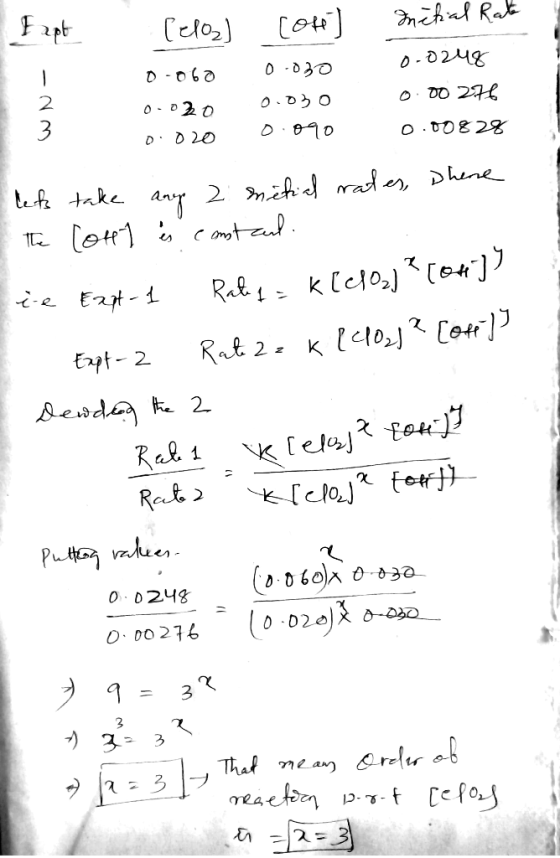
To find rate, the formula is Rate = k [ClO2]x * [OH-]y
where k = Rate constant
![② sincetardy to calculate order of [or] take any two cupt. where [elo,) in contant. ése Expt 2 Expt 3 Rate 2 Rate 3 kilos lot](http://img.homeworklib.com/questions/aa7a6700-d14b-11ea-8347-59fc7147ccc1.png?x-oss-process=image/resize,w_560)
![noo putting the value of x and by is en Expt. 1, we get t o El Rate= K[o]? [Only 70-02484 -K (0.06033 (0.030 m)? K= 0.0248 M/](http://img.homeworklib.com/questions/ab11c040-d14b-11ea-ac7d-73d094e424b6.png?x-oss-process=image/resize,w_560)
Add Answer to:
9. Linked Question "Groot" [1]: What is the order of the reaction with respect to ClO2...
Question Completion Status: Consider this chemical reaction at 25 °C: ClO2(aq) + 2OH(aq) + C1O3(aq) +...
 Question Completion Status: Consider this chemical reaction at 25 °C: ClO2(aq) + 2OH(aq) + C1O3(aq) + CO2(aq) The following experimental data were collected (M=mol/L): Experiment Initial [CIO2] (M) Initial [OH^](M) 0.060 0.030 2 0.020 0.030 3 0.020 0.090 Initial rate (M/s) 0.0248 0.00276 0.00828 Determine the rate law. Suggested time: 6 min rate = k[CIO2][OH-]2 none of these rate = k[CIO2](OH) 1 rate = K[C1021?[OH-]2 rate - k[CI0212[OH-] rate = k[Clo21°OH)
Useful Information: Please show your work and write in complete sentences. R= 8.314 J/mol K 1/[A].=...
 Useful Information: Please show your work and write in complete sentences. R= 8.314 J/mol K 1/[A].= kt +1/[A]. In k=-E/RT+ In A In [A] =-kt + In[A]. In kı/k2 = E/R (1/T2 - 1/11) 1. The following data were collected for the reaction: 2 C102(aq) + 2 OH (g) → C103 (aq) + ClO2 (aq) + H2O(1) Experiment [C102], M [OH-], M Initial Rate, M/s 1 0.060 0.030 0.0248 2 0 .020 0.030 0.00276 0.020 0 .090 0.00828 a. Determine...
QUESTION 9 Use the following information for the reaction: 2 ClO 2(aq) + 2 OH -...
QUESTION 9 Use the following information for the reaction: 2 ClO 2(aq) + 2 OH - (aq) → ClO 3-(aq) + ClO 2-(aq) + H 2O(l) Experiment [ClO2] (mol/L) [OH- ] (mol/L) Initial Rate (mol/L-min) i 0.020 0.030 0.00276 ii 0.060 0.030 0.0248 iii 0.020 0.090 0.00828 By what nearest whole number factor does the initial rate change from experiment i to experiment ii? In the analysis of this data would it be useful to compare data for experiment ii...
2 CIO2 (aq) + 2 OH- (aq) - CIO3- (aq) + CO2- (aq) + H20 (1)...
 2 CIO2 (aq) + 2 OH- (aq) - CIO3- (aq) + CO2- (aq) + H20 (1) Experiment Number Initial Rate (CIO2(M) [OH-] (M) (M/s) 0.060 0.030 0.0248 0.020 0.030 0.00276 0.020 0 .090 0.00828 3 1) What is the magnitude of the rate constant for the reaction? A) 1.15 x 10⁴ B) 115 C) 4.6 D) 713 E) 230 2) Which reaction produces a decrease in the entropy of the system? A) 2C(s) + O2 (g) - 200 (8) B)...
please please answer both questions . Thank you !!! Question 9 (1 point) Benzene and toluene...
 please please answer both questions . Thank you !!!
Question 9 (1 point) Benzene and toluene form an ideal solution. At 298 K, what is the mole fraction of benzene in the liquid that is in equilibrium with a vapor that has equal partial pressures of benzene and toluene? At 298 K, the vapor pressures of pure benzene and pure toluene are 95 and 28 tor respectively 0.50 0.77 0.23 0.30 none of these Question 10(1 point) 340.0 g of...
please please answer both questions . Thank you !!!
Question 9 (1 point) Benzene and toluene form an ideal solution. At 298 K, what is the mole fraction of benzene in the liquid that is in equilibrium with a vapor that has equal partial pressures of benzene and toluene? At 298 K, the vapor pressures of pure benzene and pure toluene are 95 and 28 tor respectively 0.50 0.77 0.23 0.30 none of these Question 10(1 point) 340.0 g of...
QUESTION 6 From the following data, the reaction order for Ais___and the reaction order for Bis...
 QUESTION 6 From the following data, the reaction order for Ais___and the reaction order for Bis A Second order for A: first order for B B. zero order for Azero order for B C. zero order for Afirst order for B D. first order for As first order for B E. None of the answers are correct. QUESTION 7 You are trying to determine the reaction rate for a reaction with several intermediate steps. The rate for the overall reaction...
The reaction AB(aq)→A(g)+B(g) is second order in AB and has a rate constant of 0.0157 M−1⋅s−1...
The reaction AB(aq)→A(g)+B(g) is second order in AB and has a rate constant of 0.0157 M−1⋅s−1 at 25.0 ∘C. A reaction vessel initially contains 250.0 mL of 0.130 M AB which is allowed to react to form the gaseous product. The product is collected over water at 25.0 ∘C. How much time is required to produce 226.0 mL of the products at a barometric pressure of 718.3 mmHg . (The vapor pressure of water at this temperature is 23.8 mmHg.)
1. Which of the following conditions defines a non-spontaneous oxidation-reduction reaction? E° + ΔG° - &
1. Which of the following conditions defines a non-spontaneous oxidation-reduction reaction? E° + ΔG° - Keq <1 E° - ΔG° - Keq <1 E° + ΔG°+ Keq >1 E° + ΔG°- Keq >1 E° - ΔG° + Keq <1 2. What information can be obtained from the Figure below? The equivalence point occurs at pH = 7.0 but the pKa is not known from the graph. Both the pOH and the...
GIVEN THE FOLLOWING DATA FOR THIS REACTION: NH4+(aq) + NO2-(aq) ---> N2(g) + 2H2O(l) EXPT NH4+...
GIVEN THE FOLLOWING DATA FOR THIS REACTION: NH4+(aq) + NO2-(aq) ---> N2(g) + 2H2O(l) EXPT NH4+ NO2- RATE 1 0.010 M 0.020 M 0.020 M/s 2 0.015 M 0.020 M 0.030 M/s 3 0.010 M 0.010 M 0.005 M/s a. Calculate the order of reaction with respect to NH4+ b. Calculate the order of reaction with respect to NO2- c. Calculate the rate constant k d. Determine the overall order of reaction e. Determine the rate law
3. A reaction has two reactants A and B. What is the order with respect to...
 3. A reaction has two reactants A and B. What is the order with respect to each reactant and the overall order of the reaction described by each of the following rate expressions? a) rate = ki[A] b) rate = k2[A][B] A=3 A=1 B=0 B=1 c) rate = k3[A][B] d) rate = ka[B] A=0 B=a B=1 What are the units of the rate constants in Question 3 if the rate is expressed in mol/L*min? a) b) 4. b)
 Question Completion Status: Consider this chemical reaction at 25 °C: ClO2(aq) + 2OH(aq) + C1O3(aq) + CO2(aq) The following experimental data were collected (M=mol/L): Experiment Initial [CIO2] (M) Initial [OH^](M) 0.060 0.030 2 0.020 0.030 3 0.020 0.090 Initial rate (M/s) 0.0248 0.00276 0.00828 Determine the rate law. Suggested time: 6 min rate = k[CIO2][OH-]2 none of these rate = k[CIO2](OH) 1 rate = K[C1021?[OH-]2 rate - k[CI0212[OH-] rate = k[Clo21°OH)
 Useful Information: Please show your work and write in complete sentences. R= 8.314 J/mol K 1/[A].= kt +1/[A]. In k=-E/RT+ In A In [A] =-kt + In[A]. In kı/k2 = E/R (1/T2 - 1/11) 1. The following data were collected for the reaction: 2 C102(aq) + 2 OH (g) → C103 (aq) + ClO2 (aq) + H2O(1) Experiment [C102], M [OH-], M Initial Rate, M/s 1 0.060 0.030 0.0248 2 0 .020 0.030 0.00276 0.020 0 .090 0.00828 a. Determine...
 2 CIO2 (aq) + 2 OH- (aq) - CIO3- (aq) + CO2- (aq) + H20 (1) Experiment Number Initial Rate (CIO2(M) [OH-] (M) (M/s) 0.060 0.030 0.0248 0.020 0.030 0.00276 0.020 0 .090 0.00828 3 1) What is the magnitude of the rate constant for the reaction? A) 1.15 x 10⁴ B) 115 C) 4.6 D) 713 E) 230 2) Which reaction produces a decrease in the entropy of the system? A) 2C(s) + O2 (g) - 200 (8) B)...
 please please answer both questions . Thank you !!!
Question 9 (1 point) Benzene and toluene form an ideal solution. At 298 K, what is the mole fraction of benzene in the liquid that is in equilibrium with a vapor that has equal partial pressures of benzene and toluene? At 298 K, the vapor pressures of pure benzene and pure toluene are 95 and 28 tor respectively 0.50 0.77 0.23 0.30 none of these Question 10(1 point) 340.0 g of...
please please answer both questions . Thank you !!!
Question 9 (1 point) Benzene and toluene form an ideal solution. At 298 K, what is the mole fraction of benzene in the liquid that is in equilibrium with a vapor that has equal partial pressures of benzene and toluene? At 298 K, the vapor pressures of pure benzene and pure toluene are 95 and 28 tor respectively 0.50 0.77 0.23 0.30 none of these Question 10(1 point) 340.0 g of...
 QUESTION 6 From the following data, the reaction order for Ais___and the reaction order for Bis A Second order for A: first order for B B. zero order for Azero order for B C. zero order for Afirst order for B D. first order for As first order for B E. None of the answers are correct. QUESTION 7 You are trying to determine the reaction rate for a reaction with several intermediate steps. The rate for the overall reaction...
 3. A reaction has two reactants A and B. What is the order with respect to each reactant and the overall order of the reaction described by each of the following rate expressions? a) rate = ki[A] b) rate = k2[A][B] A=3 A=1 B=0 B=1 c) rate = k3[A][B] d) rate = ka[B] A=0 B=a B=1 What are the units of the rate constants in Question 3 if the rate is expressed in mol/L*min? a) b) 4. b)
Most questions answered within 3 hours.
-
Where is the error in this code sequence?
String s1 = "Hello";
String s2 = "ello";...
asked 10 months ago -
Financial data for Joel de Paris, Inc., for last year
follow:
Joel de Paris, Inc.
Balance...
asked 10 months ago -
Consider this reaction:
Al2(SO4)3 (aq)+ BaCl3
(aq) Al2Cl6 (aq)- +
3BaSO4(s) . What is the...
asked 10 months ago -
Suppose that Savneet is considering increasing her
recent random sample from 20 car rentals to 40...
asked 10 months ago -
Trucks arrive at an unloading terminal at an average rate of 120
per hour.
Trucks arrive...
asked 10 months ago -
Why are methanol and ethanol completely soluble in water while
octanol is not very little soluble....
asked 10 months ago -
A facilities manager at a university reads in a research report
that the mean amount of...
asked 10 months ago -
When the CuSO4 is rehydrated by adding water to the anhydrous
compound, is this an endothermic...
asked 10 months ago -
A ray of sunlight is passing from diamond into crown glass; the
angle of incidence is...
asked 10 months ago -
A block of mass 0.249 kg is placed on top of a light, vertical
spring of...
asked 10 months ago -
how do the kidneys compensate in the presences of acidosis
a) trigger hyperventilate
b) reserve acid...
asked 10 months ago -
Question 501 pts
The rental rate of capital to the firm increases. Which of the
following...
asked 10 months ago