
Homework Answers
Add Answer to:
Please explain if this is right? I think I am missing some
things! Thanks
2. An...
2. An unknown containing one or more of the ions studied in this experiment has the...
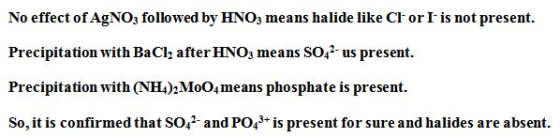
 2. An unknown containing one or more of the ions studied in this experiment has the following properties: A. No effet is o hsrved on adition of O M HNO, B. No effect is observed on addition of 0.1 M AgNO, to the solution from Part A D. A yellow precipitate is observed on addition of (NH ),MoO, to the solution from Part A On the basis of this information, which ions are present, which are absent, and which are...
Advance Study Assignment: Spot Tests for Some Common Anions
An unknown containing one or more of the ions studied in this experiment has the following properties:a. No effect on addition of 6 M HNO3.b. No effect on addition of 0.1 M AgNO3 to solution in Part A.c. White precipitate on addition of 1 M BaCl2 to solution in Part A.d. Yellow precipitate on addion of (NH4)2MoO4, to solution in Part A.On the basis of this information which ions are present, which are absent,and which are in doubt?
3. A solution that may contain any of the group III cations. Treatment of the solution with CIO i...
 3. A solution that may contain any of the group III cations. Treatment of the solution with CIO in alkaline medium yields a yellow solution and a colored precipitate. The acidified solution is unaffected by treatment with NH,OH. The colored precipitate dissolves in nitric acid; addition of excess NH,OH to this acidic solution produces only a blue solution. Which group III ions are present? Which are absent? Which are in doubt? How would you remove all doubt?
3. A solution...
3. A solution that may contain any of the group III cations. Treatment of the solution with CIO in alkaline medium yields a yellow solution and a colored precipitate. The acidified solution is unaffected by treatment with NH,OH. The colored precipitate dissolves in nitric acid; addition of excess NH,OH to this acidic solution produces only a blue solution. Which group III ions are present? Which are absent? Which are in doubt? How would you remove all doubt?
3. A solution...
Each of the observations listed was made on a different solution. Given the observation, state which...
 Each of the observations listed was made on a different solution. Given the observation, state which ion studied in this experiment is present. If the test is not definitive, indicate that with a question mark. a. Addition of 6 M NaOH and Al to the solution produces a vapor that turns red litmus blue. Ion present: b. Addition of 6 M HCI produces a vapor with an acrid odor. Ion present: c. Addition of 6 M HNO_3 produces an effervescence....
3. A solution that may contain any of the group III cations. Treatment of the solution...
 3. A solution that may contain any of the group III cations. Treatment of the solution with CIO in alkaline medium yields a yellow solution and a colored precipitate. The acidified solution is unaffected by treatment with NH,OH. The colored precipitate dissolves in nitric acid; addition of excess NH,OH to this acidic solution produces only a blue solution. Which group III ions are present? Which are absent? Which are in doubt? How would you remove all doubt? 149
2. A solution that may contain Sn.Bi. Cu? and Cdions is treated with thioacetamide in an...
 2. A solution that may contain Sn.Bi. Cu? and Cdions is treated with thioacetamide in an acidic medium. The black precipitate that forms is partly soluble in a strongly alkaline solution. The precipitate that remains is soluble in 6M HNO, and gives a blue solution when treated with excess NH Based on this information, which ions are present, which are absent, and which are still in doubt? Present Absent Snut Cu 2+ Bi 34 3. Explain how controlling the solution...
2. A solution that may contain Sn.Bi. Cu and Cd²+ ions is treated with thioacetamide in...
 2. A solution that may contain Sn.Bi. Cu and Cd²+ ions is treated with thioacetamide in an acidic medium. The black precipitate that forms is partly soluble in a strongly alkaline solution. The precipitate that remains is soluble in 6M HNO, and gives a blue solution when treated with excess NH. Based on this information, which ions are present, which are absent, and which are still in doubt? 3. Explain how controlling the solution pH allows separation of Group II...
Lab Section: 1 Prelab: Inorganic Group I Ions 1. On the report sheet, complete the flow...
 Lab Section: 1 Prelab: Inorganic Group I Ions 1. On the report sheet, complete the flow diagram for the separation and identification of the ions in Group I 2. Write balanced net ionic equations for the following reactions: The precipitation of the chloride of Pb a. in Step 1. The formation of a yellow precipitate in Step 4. b. The formation of a complex ion in Step 5. c. d. The reaction that forms a white precipitate in Step 5....
Sect. Date Name Prelaboratory Assignment: Qualitative Analysis Group III Cations 1. Prepare a complete flow chart...
 Sect. Date Name Prelaboratory Assignment: Qualitative Analysis Group III Cations 1. Prepare a complete flow chart for the procedure and put it on your data sheet. 2. Write balanced net ionic equations describing each of the following reactions: Dissolution of Ni(OH), in nitric acid. Oxidation of Cr'to Cr by CIO in alkaline solution (CIO is converted to CI') The confirming test for Fe 3. A solution that may contain any of the group II cations. Treatment of the solution with...
DATA TABLE STEP 1 AgNO3 1,C,,2 STEP 3 Ba(NO3)2 SO - Decant white BaSO4 ppt (CONFIRMS...
 DATA TABLE STEP 1 AgNO3 1,C,,2 STEP 3 Ba(NO3)2 SO - Decant white BaSO4 ppt (CONFIRMS SO2-) yellow Agl. AgCl ppt NH,OH yellow Agl. AgCl ppt RECYCLE Chemical Waste HNO blue litmus Decant white AgC ppt (CONFIRMS CT) yellow Agl.ppt (CONFIRMST) red spot 6. Refer to the Data Table to determine which anions (I-, Cl-, SO42-) are present and absent in an unknown solution given the following observations. • The unknown solution in test tube #1 plus AgNO3 gives a...
 2. An unknown containing one or more of the ions studied in this experiment has the following properties: A. No effet is o hsrved on adition of O M HNO, B. No effect is observed on addition of 0.1 M AgNO, to the solution from Part A D. A yellow precipitate is observed on addition of (NH ),MoO, to the solution from Part A On the basis of this information, which ions are present, which are absent, and which are...
 3. A solution that may contain any of the group III cations. Treatment of the solution with CIO in alkaline medium yields a yellow solution and a colored precipitate. The acidified solution is unaffected by treatment with NH,OH. The colored precipitate dissolves in nitric acid; addition of excess NH,OH to this acidic solution produces only a blue solution. Which group III ions are present? Which are absent? Which are in doubt? How would you remove all doubt?
3. A solution...
3. A solution that may contain any of the group III cations. Treatment of the solution with CIO in alkaline medium yields a yellow solution and a colored precipitate. The acidified solution is unaffected by treatment with NH,OH. The colored precipitate dissolves in nitric acid; addition of excess NH,OH to this acidic solution produces only a blue solution. Which group III ions are present? Which are absent? Which are in doubt? How would you remove all doubt?
3. A solution...
 Each of the observations listed was made on a different solution. Given the observation, state which ion studied in this experiment is present. If the test is not definitive, indicate that with a question mark. a. Addition of 6 M NaOH and Al to the solution produces a vapor that turns red litmus blue. Ion present: b. Addition of 6 M HCI produces a vapor with an acrid odor. Ion present: c. Addition of 6 M HNO_3 produces an effervescence....
 3. A solution that may contain any of the group III cations. Treatment of the solution with CIO in alkaline medium yields a yellow solution and a colored precipitate. The acidified solution is unaffected by treatment with NH,OH. The colored precipitate dissolves in nitric acid; addition of excess NH,OH to this acidic solution produces only a blue solution. Which group III ions are present? Which are absent? Which are in doubt? How would you remove all doubt? 149
 2. A solution that may contain Sn.Bi. Cu? and Cdions is treated with thioacetamide in an acidic medium. The black precipitate that forms is partly soluble in a strongly alkaline solution. The precipitate that remains is soluble in 6M HNO, and gives a blue solution when treated with excess NH Based on this information, which ions are present, which are absent, and which are still in doubt? Present Absent Snut Cu 2+ Bi 34 3. Explain how controlling the solution...
 2. A solution that may contain Sn.Bi. Cu and Cd²+ ions is treated with thioacetamide in an acidic medium. The black precipitate that forms is partly soluble in a strongly alkaline solution. The precipitate that remains is soluble in 6M HNO, and gives a blue solution when treated with excess NH. Based on this information, which ions are present, which are absent, and which are still in doubt? 3. Explain how controlling the solution pH allows separation of Group II...
 Lab Section: 1 Prelab: Inorganic Group I Ions 1. On the report sheet, complete the flow diagram for the separation and identification of the ions in Group I 2. Write balanced net ionic equations for the following reactions: The precipitation of the chloride of Pb a. in Step 1. The formation of a yellow precipitate in Step 4. b. The formation of a complex ion in Step 5. c. d. The reaction that forms a white precipitate in Step 5....
 Sect. Date Name Prelaboratory Assignment: Qualitative Analysis Group III Cations 1. Prepare a complete flow chart for the procedure and put it on your data sheet. 2. Write balanced net ionic equations describing each of the following reactions: Dissolution of Ni(OH), in nitric acid. Oxidation of Cr'to Cr by CIO in alkaline solution (CIO is converted to CI') The confirming test for Fe 3. A solution that may contain any of the group II cations. Treatment of the solution with...
 DATA TABLE STEP 1 AgNO3 1,C,,2 STEP 3 Ba(NO3)2 SO - Decant white BaSO4 ppt (CONFIRMS SO2-) yellow Agl. AgCl ppt NH,OH yellow Agl. AgCl ppt RECYCLE Chemical Waste HNO blue litmus Decant white AgC ppt (CONFIRMS CT) yellow Agl.ppt (CONFIRMST) red spot 6. Refer to the Data Table to determine which anions (I-, Cl-, SO42-) are present and absent in an unknown solution given the following observations. • The unknown solution in test tube #1 plus AgNO3 gives a...
Most questions answered within 3 hours.
-
Where is the error in this code sequence?
String s1 = "Hello";
String s2 = "ello";...
asked 10 months ago -
Financial data for Joel de Paris, Inc., for last year
follow:
Joel de Paris, Inc.
Balance...
asked 10 months ago -
Consider this reaction:
Al2(SO4)3 (aq)+ BaCl3
(aq) Al2Cl6 (aq)- +
3BaSO4(s) . What is the...
asked 10 months ago -
Suppose that Savneet is considering increasing her
recent random sample from 20 car rentals to 40...
asked 10 months ago -
Trucks arrive at an unloading terminal at an average rate of 120
per hour.
Trucks arrive...
asked 10 months ago -
Why are methanol and ethanol completely soluble in water while
octanol is not very little soluble....
asked 10 months ago -
A facilities manager at a university reads in a research report
that the mean amount of...
asked 10 months ago -
When the CuSO4 is rehydrated by adding water to the anhydrous
compound, is this an endothermic...
asked 10 months ago -
A ray of sunlight is passing from diamond into crown glass; the
angle of incidence is...
asked 10 months ago -
A block of mass 0.249 kg is placed on top of a light, vertical
spring of...
asked 10 months ago -
how do the kidneys compensate in the presences of acidosis
a) trigger hyperventilate
b) reserve acid...
asked 10 months ago -
Question 501 pts
The rental rate of capital to the firm increases. Which of the
following...
asked 10 months ago