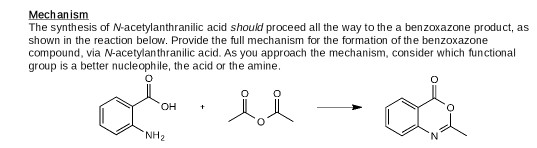
Please use curved arrow notation
Homework Answers
Request Answer!
We need at least 10 more requests to produce the answer.
0 / 10 have requested this problem solution
The more requests, the faster the answer.
Add Answer to:
Please use curved arrow notation
Mechanism The synthesis of N-acetylanthranilic acid should proceed all the way...
4 4) Write the reaction product and use the curved arrow notation to draw a mechanism...
 4
4) Write the reaction product and use the curved arrow notation to draw a mechanism that accounts for the formation of product upon oxymercuration/ reduction of cis-4-hexenoic acid in aqueous THF. (8 points) a) Write the reaction. 1) Hg(OAC), aq, THE 2) NaBH, aq. THE HO cis-4-hextenoic acid b) Write a mechanism.
4
4) Write the reaction product and use the curved arrow notation to draw a mechanism that accounts for the formation of product upon oxymercuration/ reduction of cis-4-hexenoic acid in aqueous THF. (8 points) a) Write the reaction. 1) Hg(OAC), aq, THE 2) NaBH, aq. THE HO cis-4-hextenoic acid b) Write a mechanism.
• Use the curved-arrow notation to draw the mechanism for the formation of 2-methyl-2-hexanol from n-butylmagnesium...
• Use the curved-arrow notation to draw the mechanism for the formation of 2-methyl-2-hexanol from n-butylmagnesium bromide. • Discuss, using the mechanism, why it is important to use anhydrous diethyl ether in this reaction. • Describe how you would purify the final product by distillation. What obstacles would you run into?
Using the curved arrow notation write the stepwise mechanism of the following tautomerizations un...
 Using the curved arrow notation write the stepwise mechanism of the following tautomerizations under either acidic or basic conditions. Make sure to indicate which tautomer form is most stable. a. (E)-4-hydroxy-5-methylhex-3-en-2-one b. octahydro-1Hisoindol-1-one c. 9H-purin-6-amine d. (Z)-N-ethylisobutyrimidic acid 52.
Using the curved arrow notation write the stepwise mechanism of the following tautomerizations under either acidic or basic conditions. Make sure to indicate which tautomer form is most stable. a. (E)-4-hydroxy-5-methylhex-3-en-2-one b. octahydro-1Hisoindol-1-one c. 9H-purin-6-amine d. (Z)-N-ethylisobutyrimidic acid 52.
Using the curved arrow notation write the stepwise mechanism of the following tautomerizations under either acidic or basic conditions. Make sure to indicate which tautomer form is most stable. a. (E)-4-hydroxy-5-methylhex-3-en-2-one b. octahydro-1Hisoindol-1-one c. 9H-purin-6-amine d. (Z)-N-ethylisobutyrimidic acid 52.
Using the curved arrow notation, write a stepwise mechanism to rationalize the formation of each product...
 Using the curved arrow notation, write a stepwise mechanism to rationalize the formation of each product in the following reaction (you may need the back of this sheet).
35. (4) Provide a mechanism for the following transformation. You must use curved arrows to represent...
 35. (4) Provide a mechanism for the following transformation. You must use curved arrows to represent electron movement and show all formal +/- charges to get full credit. a -N(CH3)3 heat CH3 CH2 OH 36. (6) Provide a synthesis for the following amine using a Gabriel synthesis. NH2 37. (4) Draw the 4 possible organic products for each reaction. 3.8 CH NHA 38. (4) Draw a structure for the expected product of the following reactions. NH2 + HEN H CI...
Part III - Mechanism (14 marks] A. Use the curved arrow notation to draw the step-wise...
 Part III - Mechanism (14 marks] A. Use the curved arrow notation to draw the step-wise reaction mechanisms that account for the formation of the products shown in the transformation below. All reactants are shown. (8 MARKS] MeOH осна + -TsOH
23. Complete the single step acid-base reactions below by using curved arrow notation to show the...
 23. Complete the single step acid-base reactions below by using curved arrow notation to show the movement of electrons and drawing the expected product/s from each reaction. Label each species with all term/s that apply: Bronsted acid/base, conjugate acid/base, Lewis acid/base and/or electrophile/nucleophile. HS a. 礼。
Show the curved arrow mechanism for the reaction...
 1.2.3.4.5.6.7.8.Show the curved arrow mechanism for the reaction between ethoxide and methanol to give ethanol and the methoxide ion. 1st attempt Jual See Periodic Table See Hint OH-Ö: Add the missing curved arrow notation.The carbon-metal bond in organometallic Grignard reagents exhibits significant covalent character. However, we can treat these compounds as electron-rich carbanions because of the large difference in electronegativity between carbon and magnesium. These reagents are great to form carbon-carbon bonds but must be kept in an anhydrous environment...
CICI 35. (4) Provide a mechanism for the following transformation. You must use curved arrows to...
 CICI 35. (4) Provide a mechanism for the following transformation. You must use curved arrows to represent electron movement and show all formal +/- charges to get full credit. a Nichols heat CHE CH2 OH 36.6) Provide a synthesis for the following amine using a Gabriel synthesis. NH2 37.(4) Draw the 4 possible organic products for each reaction. CHÚNH 38. (4) Draw a structure for the expected product of the following reactions. NH + HEN OH OH
4) Write the product, and draw a complete curved arrow mechanism for the reaction below. Include...
 4) Write the product, and draw a complete curved arrow mechanism for the reaction below. Include the formation of all intermediates (10 points total) Product Mechanism 5) Name the following molecules (8 points total) a) NH b) 6) An amine A reacts with acetone in the presence of a trace of acid to give product B The 'H-NMR spectra of A and B are shown on page 5 as spectra A and B, respectively. ldentify A (amine)) and product B...
 4
4) Write the reaction product and use the curved arrow notation to draw a mechanism that accounts for the formation of product upon oxymercuration/ reduction of cis-4-hexenoic acid in aqueous THF. (8 points) a) Write the reaction. 1) Hg(OAC), aq, THE 2) NaBH, aq. THE HO cis-4-hextenoic acid b) Write a mechanism.
4
4) Write the reaction product and use the curved arrow notation to draw a mechanism that accounts for the formation of product upon oxymercuration/ reduction of cis-4-hexenoic acid in aqueous THF. (8 points) a) Write the reaction. 1) Hg(OAC), aq, THE 2) NaBH, aq. THE HO cis-4-hextenoic acid b) Write a mechanism.
 Using the curved arrow notation write the stepwise mechanism of the following tautomerizations under either acidic or basic conditions. Make sure to indicate which tautomer form is most stable. a. (E)-4-hydroxy-5-methylhex-3-en-2-one b. octahydro-1Hisoindol-1-one c. 9H-purin-6-amine d. (Z)-N-ethylisobutyrimidic acid 52.
Using the curved arrow notation write the stepwise mechanism of the following tautomerizations under either acidic or basic conditions. Make sure to indicate which tautomer form is most stable. a. (E)-4-hydroxy-5-methylhex-3-en-2-one b. octahydro-1Hisoindol-1-one c. 9H-purin-6-amine d. (Z)-N-ethylisobutyrimidic acid 52.
Using the curved arrow notation write the stepwise mechanism of the following tautomerizations under either acidic or basic conditions. Make sure to indicate which tautomer form is most stable. a. (E)-4-hydroxy-5-methylhex-3-en-2-one b. octahydro-1Hisoindol-1-one c. 9H-purin-6-amine d. (Z)-N-ethylisobutyrimidic acid 52.
 Using the curved arrow notation, write a stepwise mechanism to rationalize the formation of each product in the following reaction (you may need the back of this sheet).
 35. (4) Provide a mechanism for the following transformation. You must use curved arrows to represent electron movement and show all formal +/- charges to get full credit. a -N(CH3)3 heat CH3 CH2 OH 36. (6) Provide a synthesis for the following amine using a Gabriel synthesis. NH2 37. (4) Draw the 4 possible organic products for each reaction. 3.8 CH NHA 38. (4) Draw a structure for the expected product of the following reactions. NH2 + HEN H CI...
 Part III - Mechanism (14 marks] A. Use the curved arrow notation to draw the step-wise reaction mechanisms that account for the formation of the products shown in the transformation below. All reactants are shown. (8 MARKS] MeOH осна + -TsOH
 23. Complete the single step acid-base reactions below by using curved arrow notation to show the movement of electrons and drawing the expected product/s from each reaction. Label each species with all term/s that apply: Bronsted acid/base, conjugate acid/base, Lewis acid/base and/or electrophile/nucleophile. HS a. 礼。
 1.2.3.4.5.6.7.8.Show the curved arrow mechanism for the reaction between ethoxide and methanol to give ethanol and the methoxide ion. 1st attempt Jual See Periodic Table See Hint OH-Ö: Add the missing curved arrow notation.The carbon-metal bond in organometallic Grignard reagents exhibits significant covalent character. However, we can treat these compounds as electron-rich carbanions because of the large difference in electronegativity between carbon and magnesium. These reagents are great to form carbon-carbon bonds but must be kept in an anhydrous environment...
 CICI 35. (4) Provide a mechanism for the following transformation. You must use curved arrows to represent electron movement and show all formal +/- charges to get full credit. a Nichols heat CHE CH2 OH 36.6) Provide a synthesis for the following amine using a Gabriel synthesis. NH2 37.(4) Draw the 4 possible organic products for each reaction. CHÚNH 38. (4) Draw a structure for the expected product of the following reactions. NH + HEN OH OH
 4) Write the product, and draw a complete curved arrow mechanism for the reaction below. Include the formation of all intermediates (10 points total) Product Mechanism 5) Name the following molecules (8 points total) a) NH b) 6) An amine A reacts with acetone in the presence of a trace of acid to give product B The 'H-NMR spectra of A and B are shown on page 5 as spectra A and B, respectively. ldentify A (amine)) and product B...
Most questions answered within 3 hours.
-
Where is the error in this code sequence?
String s1 = "Hello";
String s2 = "ello";...
asked 11 months ago -
Financial data for Joel de Paris, Inc., for last year
follow:
Joel de Paris, Inc.
Balance...
asked 11 months ago -
Consider this reaction:
Al2(SO4)3 (aq)+ BaCl3
(aq) Al2Cl6 (aq)- +
3BaSO4(s) . What is the...
asked 11 months ago -
Suppose that Savneet is considering increasing her
recent random sample from 20 car rentals to 40...
asked 11 months ago -
Trucks arrive at an unloading terminal at an average rate of 120
per hour.
Trucks arrive...
asked 11 months ago -
Why are methanol and ethanol completely soluble in water while
octanol is not very little soluble....
asked 11 months ago -
A facilities manager at a university reads in a research report
that the mean amount of...
asked 11 months ago -
When the CuSO4 is rehydrated by adding water to the anhydrous
compound, is this an endothermic...
asked 11 months ago -
A ray of sunlight is passing from diamond into crown glass; the
angle of incidence is...
asked 11 months ago -
A block of mass 0.249 kg is placed on top of a light, vertical
spring of...
asked 11 months ago -
how do the kidneys compensate in the presences of acidosis
a) trigger hyperventilate
b) reserve acid...
asked 11 months ago -
Question 501 pts
The rental rate of capital to the firm increases. Which of the
following...
asked 11 months ago