
Homework Answers
Here is the solution of your question. If you have any doubt or need any clarification please comment in comment box and will definitely resolve your query. If you find useful please upvote it. Thanks in advance.
Add Answer to:
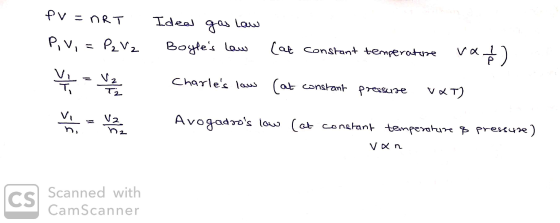
Identify each gas law. PV = nRT PV = P,V2 Answer Bank Boyle's law ideal gas...
Question 9 of 11 > Rearrange the combined gas law to isolate V. PV - P.V2...
 Question 9 of 11 > Rearrange the combined gas law to isolate V. PV - P.V2 Answer Bank about us career privacy policy terms of use contact us help
Ideal Gas Law Identify all variables in the ideal gas law: PV nRT; give their names...
 Ideal Gas Law
Identify all variables in the ideal gas law: PV nRT; give their names and units.
Ideal Gas Law
Identify all variables in the ideal gas law: PV nRT; give their names and units.
Please answer whole page. Gas Laws Formulas Ideal Gas Law PV = nRT Combined Gas Law...
 Please answer whole page.
Gas Laws Formulas Ideal Gas Law PV = nRT Combined Gas Law (P1) (V1) Ti (P2)(V2) Tz = Dalton's Law of Partial Pressures P = P, +P, +P, + ...etc. K= °C + 273 1. A large balloon has a volume of 2.5 L at a temperature of 0 °C. What is the new volume of the balloon at constant pressure when the temperature rises to a) 120 °C ? b) 375 °C ? 2. A...
Please answer whole page.
Gas Laws Formulas Ideal Gas Law PV = nRT Combined Gas Law (P1) (V1) Ti (P2)(V2) Tz = Dalton's Law of Partial Pressures P = P, +P, +P, + ...etc. K= °C + 273 1. A large balloon has a volume of 2.5 L at a temperature of 0 °C. What is the new volume of the balloon at constant pressure when the temperature rises to a) 120 °C ? b) 375 °C ? 2. A...
One way to write the ideal gas law is PV = nRT where P is the...
One way to write the ideal gas law is PV = nRT where P is the pressure, V is the volume, n is the number of moles, R is the universal gas law constant and T is the temperature. Solve the ideal gas law for T.
Please answer the whole page. Ideal Gas Law PV = nRT Gas Laws Formulas Combined Gas Law (P1)(V1) Ti (P2)(V2) Tz = Dalto...
 Please answer the whole page.
Ideal Gas Law PV = nRT Gas Laws Formulas Combined Gas Law (P1)(V1) Ti (P2)(V2) Tz = Dalton's Law of Partial Pressures P = P, +P+P, + ...etc. K="C + 273 3. A 5.0 L sample of gas has a pressure of 1200 torr. What is the new pressure if the temperature is changed from 220 K to 440 K and the volume increased to 20.0 L ? 4. A 10.0 mL sample of gas...
Please answer the whole page.
Ideal Gas Law PV = nRT Gas Laws Formulas Combined Gas Law (P1)(V1) Ti (P2)(V2) Tz = Dalton's Law of Partial Pressures P = P, +P+P, + ...etc. K="C + 273 3. A 5.0 L sample of gas has a pressure of 1200 torr. What is the new pressure if the temperature is changed from 220 K to 440 K and the volume increased to 20.0 L ? 4. A 10.0 mL sample of gas...
Consider equimolar samples of the same ideal gas at the same volume, but different temperatures. Sample...
 Consider equimolar samples of the same ideal gas at the same volume, but different temperatures. Sample C is at a higher temperature than sample D. Compare the pressures. OC>D OC=D OC <D contact us about us careers | privacy policy terms of use е Attempt 3 Compare the rms speeds. OC>D OC=D OC<D Incorrect Compare the average kinetic energies. contact us help careers about us Privacy policy terms of use e Attempt 3 Consider equimolar samples of the same ideal...
Problem 1: Ideal Gas Law Problem 1. The ideal gas law states PV nRT where P,...
 Problem 1: Ideal Gas Law
Problem 1. The ideal gas law states PV nRT where P, V, and T are the pressure, volume and absolute temperature; n is the number of moles of gas; and R is the the ideal gas constant. Consider a 1-gallon canister of gas at a pressure of 1 atm. Answer the following questions: 1. How much energy would be needed to increase the pressure of the closed canister to 50 psi without changing its volume?...
Problem 1: Ideal Gas Law
Problem 1. The ideal gas law states PV nRT where P, V, and T are the pressure, volume and absolute temperature; n is the number of moles of gas; and R is the the ideal gas constant. Consider a 1-gallon canister of gas at a pressure of 1 atm. Answer the following questions: 1. How much energy would be needed to increase the pressure of the closed canister to 50 psi without changing its volume?...
Given the Ideal Gas Law as PV=nRT, can someone derive the Ideal Gas Law into the...
Given the Ideal Gas Law as PV=nRT, can someone derive the Ideal Gas Law into the form P=rho(R)(T)? This is assuming R=8.314 J mol -1 K -1, na is Avogadro’s number where Avogadro’s number represents the number of point masses N, and that k*na=R.
If 82.5 mol of an ideal gas occupies 59.5 L at 381 K, what is the...
 If 82.5 mol of an ideal gas occupies 59.5 L at 381 K, what is the pressure of the gas? pressure: atm about us careers privacy policy terms of use contact us help
A sealed container holding 0.0255 L of an ideal gas at 0.987 atm and 69 °C...
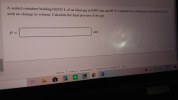 A sealed container holding 0.0255 L of an ideal gas at 0.987 atm and 69 °C is placed into a refrigerator and cooled to 43 °C with no change in volume. Calculate the final pressure of the gas. P= atm I help contact us careers about us | privacy policy terms of use e D TI
 Question 9 of 11 > Rearrange the combined gas law to isolate V. PV - P.V2 Answer Bank about us career privacy policy terms of use contact us help
 Ideal Gas Law
Identify all variables in the ideal gas law: PV nRT; give their names and units.
Ideal Gas Law
Identify all variables in the ideal gas law: PV nRT; give their names and units.
 Please answer whole page.
Gas Laws Formulas Ideal Gas Law PV = nRT Combined Gas Law (P1) (V1) Ti (P2)(V2) Tz = Dalton's Law of Partial Pressures P = P, +P, +P, + ...etc. K= °C + 273 1. A large balloon has a volume of 2.5 L at a temperature of 0 °C. What is the new volume of the balloon at constant pressure when the temperature rises to a) 120 °C ? b) 375 °C ? 2. A...
Please answer whole page.
Gas Laws Formulas Ideal Gas Law PV = nRT Combined Gas Law (P1) (V1) Ti (P2)(V2) Tz = Dalton's Law of Partial Pressures P = P, +P, +P, + ...etc. K= °C + 273 1. A large balloon has a volume of 2.5 L at a temperature of 0 °C. What is the new volume of the balloon at constant pressure when the temperature rises to a) 120 °C ? b) 375 °C ? 2. A...
 Please answer the whole page.
Ideal Gas Law PV = nRT Gas Laws Formulas Combined Gas Law (P1)(V1) Ti (P2)(V2) Tz = Dalton's Law of Partial Pressures P = P, +P+P, + ...etc. K="C + 273 3. A 5.0 L sample of gas has a pressure of 1200 torr. What is the new pressure if the temperature is changed from 220 K to 440 K and the volume increased to 20.0 L ? 4. A 10.0 mL sample of gas...
Please answer the whole page.
Ideal Gas Law PV = nRT Gas Laws Formulas Combined Gas Law (P1)(V1) Ti (P2)(V2) Tz = Dalton's Law of Partial Pressures P = P, +P+P, + ...etc. K="C + 273 3. A 5.0 L sample of gas has a pressure of 1200 torr. What is the new pressure if the temperature is changed from 220 K to 440 K and the volume increased to 20.0 L ? 4. A 10.0 mL sample of gas...
 Consider equimolar samples of the same ideal gas at the same volume, but different temperatures. Sample C is at a higher temperature than sample D. Compare the pressures. OC>D OC=D OC <D contact us about us careers | privacy policy terms of use е Attempt 3 Compare the rms speeds. OC>D OC=D OC<D Incorrect Compare the average kinetic energies. contact us help careers about us Privacy policy terms of use e Attempt 3 Consider equimolar samples of the same ideal...
 Problem 1: Ideal Gas Law
Problem 1. The ideal gas law states PV nRT where P, V, and T are the pressure, volume and absolute temperature; n is the number of moles of gas; and R is the the ideal gas constant. Consider a 1-gallon canister of gas at a pressure of 1 atm. Answer the following questions: 1. How much energy would be needed to increase the pressure of the closed canister to 50 psi without changing its volume?...
Problem 1: Ideal Gas Law
Problem 1. The ideal gas law states PV nRT where P, V, and T are the pressure, volume and absolute temperature; n is the number of moles of gas; and R is the the ideal gas constant. Consider a 1-gallon canister of gas at a pressure of 1 atm. Answer the following questions: 1. How much energy would be needed to increase the pressure of the closed canister to 50 psi without changing its volume?...
 If 82.5 mol of an ideal gas occupies 59.5 L at 381 K, what is the pressure of the gas? pressure: atm about us careers privacy policy terms of use contact us help
 A sealed container holding 0.0255 L of an ideal gas at 0.987 atm and 69 °C is placed into a refrigerator and cooled to 43 °C with no change in volume. Calculate the final pressure of the gas. P= atm I help contact us careers about us | privacy policy terms of use e D TI
Most questions answered within 3 hours.
-
Where is the error in this code sequence?
String s1 = "Hello";
String s2 = "ello";...
asked 10 months ago -
Financial data for Joel de Paris, Inc., for last year
follow:
Joel de Paris, Inc.
Balance...
asked 10 months ago -
Consider this reaction:
Al2(SO4)3 (aq)+ BaCl3
(aq) Al2Cl6 (aq)- +
3BaSO4(s) . What is the...
asked 10 months ago -
Suppose that Savneet is considering increasing her
recent random sample from 20 car rentals to 40...
asked 10 months ago -
Trucks arrive at an unloading terminal at an average rate of 120
per hour.
Trucks arrive...
asked 10 months ago -
Why are methanol and ethanol completely soluble in water while
octanol is not very little soluble....
asked 10 months ago -
A facilities manager at a university reads in a research report
that the mean amount of...
asked 10 months ago -
When the CuSO4 is rehydrated by adding water to the anhydrous
compound, is this an endothermic...
asked 10 months ago -
A ray of sunlight is passing from diamond into crown glass; the
angle of incidence is...
asked 10 months ago -
A block of mass 0.249 kg is placed on top of a light, vertical
spring of...
asked 10 months ago -
how do the kidneys compensate in the presences of acidosis
a) trigger hyperventilate
b) reserve acid...
asked 10 months ago -
Question 501 pts
The rental rate of capital to the firm increases. Which of the
following...
asked 10 months ago