Please explain what you do and why.
Homework Answers
Answer Question a: Potential of cell
First step: Identify the semi-reactions of oxidation and reduction and the balanced complete equation of cell
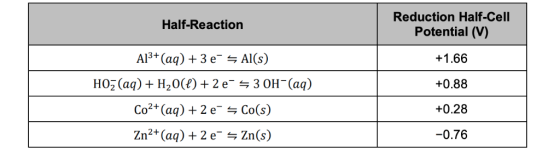
- Write the semi-reactions of reduction for Al3+ (from Al(NO3)3) to Al and for Co2+ (from Co(NO3)2) to Co. And compare their standard potentials of reduction
- Al3+ has the higher Eºred, then it will be reduced and the the Co will be oxidized. Let's rewrite the semi-reactions into one of reduction and the other of oxidation.
For the Co, to write the semi-reaction of oxidation you just write the inverse reaction, and change the sign of Eºred to obtain the Eºoxid value.
- Now, it is necessary balance the chemical equation:
Second step: Determinate the Eº of the galvanic cell
- The standard potential of cell is defined as:
*This is in standard conditions: 298 K and solutions 1M
Third step: Determinate the E of the galvanic cell if you use 250 mL of Al(NO3)3 0.15 M and 250 mL of Co(NO3)2 0.85 M
- At this conditions, we must use the Nersnt equation to determinate the potential of cell
where
- R = gas constant = 8.314 J/mol.K
- T = absolute temperature = 298 K
- n = moles of transfered electrons = 6 (see the balance of semi-reactions)
- F = faraday constant = 96485 J/V.mol
- Q = reaction quotient (only consider gas and aqueous species)
- Then, we need to find the
[Co2+] and [Al3+] in the cell:
- The Co2+ comes from 250 mL of Co(NO3)2 0.85 M
1 mol of Co(NO3)2 produces 1 mol of Co2+, then, [Co(NO3)2] = [Co2+] = 0.85 M
- The Al3+ comes from 250 mL of Al(NO3)3 0.15 M
1 mol of Al(NO3)3 produces 1 mol of Al3+, then, [Al(NO3)3] = [Al3+] = 0.15 M
- Now, we can calculate the potential of cell:
Answer Question b: mass gained/lost by cobalt electrode
First step: Calculate the equilibrium constant of the reaction:
- At equilibrium the standard Gibbs free energy is zero, and the free energy is defined as:
then
Second step: Determinate the reaction direction
- From question a, we have calculate the reaction quotient for the cell with 250 mL of Al(NO3)3 0.15 M and 250 mL of Co(NO3)2 0.85 M
- In this case, Q << K (27.294 << 1.09x10140). This means, that reaction must go to right to reach the equilibrium.
- According to the reaction, if reaction goes to right, the Co electrode will be consumed ang it will loss mass
Third step: Determinate the amount of Co2+ produced
- All mass lost by Co electrode will be transformed in Co2+. Then, we need determinate the [Co2+] at equilibrium and compare with the initial [Co2+]. to do this, we made a ICE table:
| 2 Al3+ | + | 3 Co | --> | 2 Al | + | 3 Co2+ | |
| Initial | 0.15 | -- | -- | 0.85 | |||
| Change | -2x | -- | -- | +3x | |||
| Equilibrium | 0.15-2x | -- | -- | 0.85+3x |
- The equilibrium constant for this reaction is:
- Like thw equilibrium constant is very large, we can made an approximation. A very large K indicates that almost reactants will be convert to products, then,
- Now, we can calculate the amount of Co2+ produced, it will be equal to the change in [Co2+] = 3x
the moles produced of Co2+ are (the cell has 250 mL = 0.25 L):
Fourth step: mass of Co lost
- All moles of Co2+ produced comes from Co electrode:
- According to reaction, 1 mol of Co produces 1 mol of Co2+. Then if 0.0563 mol of Co2+ were produced, this means that 0.0563 mol of Co were consumed
- Therefore, the mass lost by Co electrode is
Answer Question c: current generated
- Data
- 2 hours to reach equilibrium
- 3.315 g of Co lost (0.0563 mol of Co)
- We can use the Faraday's laws to determinate the amount of current generated:
where
- m = mass lost by Co electrode = 3.315 g
- MW = molar mass of Co = 58.933 g/mol
- n = moles of Co = 0.0563 mol
- I = current generated (Amp)
- t = time to reach the equilibrium (seg) = 2 h = 7200 seg (2 h x 3600 seg/h)
- F = Faradys constant = 96485 C/mol
- z = valence number of Co2+ = 2
then, the current generated is
RESUME
- Question a : Potential of cell = +1.37 V
- Question b : the mass lost by Co electrode after the cell reaches the equilibrium is 3.315 g
- Question c: the cell will generate 1.509 amp
Add Answer to:
Please explain what you do and why.
A galvanic cell is setup with the following two...
A galvanic cell is set up with the following two half-cells: • A 250.0 mL solution...
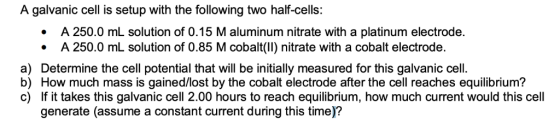
A galvanic cell is set up with the following two half-cells: • A 250.0 mL solution of 0.15 M aluminium nitrate with a platinum electrode. • A 250.0 mL solution of 0.85 M cobalt(II) nitrate with a cobalt electrode. a) Determine the cell potential that will be initially measured for this galvanic cell. b) How much mass is gained/lost by the cobalt electrode after the cell reaches equilibrium? c) If it takes this galvanic cell 2.00 hours to reach equilibrium,...
Draw the voltaic cell that will give the most positive cell potential choosing from the following...
Draw the voltaic cell that will give the most positive cell potential choosing from the following half reactions: Eo (vs. SHE) Zn2+ (aq) + 2e- Zn (s), Eo= -0.76 Al3+ (aq) + 3e- Al (s), Eo= -1.66 Cr3+ (aq) + 3e- Cr (s), Eo= -0.74 Co2+ (aq) + 2e- Co (s), Eo= -0.28
Part A through H 1. [60 pts) A galvanic cell is a type of battery where...
 Part A through H
1. [60 pts) A galvanic cell is a type of battery where the electrodes are immersed in different electrolyte solutions, which are connected by an ion-conducting bridge. Consider a galvanic cell with Al and Cu electrodes. The Al electrode is immersed in a solution containing a standard concentration of Al3+ ions and the Cu electrode is immersed in a solution containing a standard concentration of Cu* ions. External Circuit The standard reduction potentials for the half...
Part A through H
1. [60 pts) A galvanic cell is a type of battery where the electrodes are immersed in different electrolyte solutions, which are connected by an ion-conducting bridge. Consider a galvanic cell with Al and Cu electrodes. The Al electrode is immersed in a solution containing a standard concentration of Al3+ ions and the Cu electrode is immersed in a solution containing a standard concentration of Cu* ions. External Circuit The standard reduction potentials for the half...
What is the standard emf of a galvanic cell made of a Co electrode in a 1.0 M Co(NO32 solution and a Al electrode in a 1.0 M AI(NO3)3 solution at 25°C?
 What is the standard emf of a galvanic cell made of a Co electrode in a 1.0 M Co(NO32 solution and a Al electrode in a 1.0 M AI(NO3)3 solution at 25°C? 0 cell Standard Reduction Potentials at 25°C Half-Reaction E(V +2.87 +2.07 +1.82 O,(g) 2H (aq)2e0(g)+HO Co3+(aq) + e-_? Co2+(aq) H,02(aq) + 2H"(aq) + 2e-_ 2H20 Cu2+(aq) + 2e-? Cu(s) AgCIs) + Ag(s) + CI(a) S02-(aq) + 4H'(aq) + 2e S02(g) + 2H20 Cu2+(aq) + e-_ Cu+(aq) Sn (aq)...
When determining the relative reduction potentials of several electrode systems, why does it not matter what...
When determining the relative reduction potentials of several electrode systems, why does it not matter what is chosen as a reference electrode? What action(s) is/are required to compare electrode potentials measured relative to different references? A galvanic cell is created according to the following cell notation: Al(s) | Al3+(1.0M) || Cu2+(1.0M) | Cu(s) Reduction Half Reaction E ̊ (volts) Al3+(aq) + 3e- -> Al(s) -1.66 Cu2+(aq) + 2e- -> Cu(s) 0.34 What is the overall cell potential? What would be...
Calculate the theoretical cell potential (E°) of a galvanic cell under standard conditions made up of...
 Calculate the theoretical cell potential (E°) of a galvanic cell
under standard conditions made up of copper and magnesium (see Part
II and Table 1 for more information).
PARTIL Creating and Testing Voltaic Cells Introduction and Background for the Voltaic Cells A galvanic cell (sometimes more appropriately called a voltaic cell) consists of two half-cells joined by a salt bridge that allow ions to pass between the two sides in order to maintain electroneutrality. Each half-cell contains the Components of...
Calculate the theoretical cell potential (E°) of a galvanic cell
under standard conditions made up of copper and magnesium (see Part
II and Table 1 for more information).
PARTIL Creating and Testing Voltaic Cells Introduction and Background for the Voltaic Cells A galvanic cell (sometimes more appropriately called a voltaic cell) consists of two half-cells joined by a salt bridge that allow ions to pass between the two sides in order to maintain electroneutrality. Each half-cell contains the Components of...
4. One half cell in a Galvanic cell is constructed from a silver wire dipped into...
 4. One half cell in a Galvanic cell is constructed from a silver wire dipped into a silver nitrate solution with unknown concentration. The other half consists of zinc electrode in a 1.0 M zinc nitrate solution. The cell potential = 1.48 V. Calculate Eºcell and then use that value to calculate the concentration of the silver nitrate solution. 5. 250.0 Amp of electricity is run through a brine (NaCl) solution for 1.50 hours. a. How many grams of sodium...
6. Suppose you initially have a standard galvanic cell based on the following half- reactions: Cu...
 Detailed answer please.
6. Suppose you initially have a standard galvanic cell based on the following half- reactions: Cu" (aq) 2eCu (s) Ag' (aq)e Ag (s) The metal electrodes in this cell are Ag (s) and Cu (s). Does the cell potential increase, decrease, or remain the same when the following changes occur? Provide a reasonable explanation to support your answers a) Solid CuSO4 is added to the copper half-cell compartment (CuSO4 b) NHs (aq) is added to the copper...
Detailed answer please.
6. Suppose you initially have a standard galvanic cell based on the following half- reactions: Cu" (aq) 2eCu (s) Ag' (aq)e Ag (s) The metal electrodes in this cell are Ag (s) and Cu (s). Does the cell potential increase, decrease, or remain the same when the following changes occur? Provide a reasonable explanation to support your answers a) Solid CuSO4 is added to the copper half-cell compartment (CuSO4 b) NHs (aq) is added to the copper...
Information for Questions 8 -9: A concentration cell is set up with two different Zn (s)...
 Information for Questions 8 -9: A concentration cell is set up with two different Zn (s) / Zn2+ (aq) half-cells that contain different concentrations of Zn2+ (aq). The two half-cell solutions are connected with a salt bridge, and the zinc electrodes are connected with a wire and voltmeter. Consider the following standard reduction potential at 25°C: Zn2+ (aq) -0.76 V 2e--> Zn (s) E。= + Use the information here about this concentration cell for Questions 8 and 9. 8. What...
Tse the References to access important valnes if meeded for this westion. A galvanic cell Fe(s) F...
 Tse the References to access important valnes if meeded for this westion. A galvanic cell Fe(s) Fe (aNaNi(s) is constructed using a completely immersed Fe electrode that weighs 37.1 g and a Ni electrode ismersed in 473 mL of 1.00 MN(aq) solution A steady current of 0.0769 A is drawn fom the cell as the electrons move fro the Fe electrode to the Ni electrode. a) Which reactant is the limiting reactant in this eell? Enter symbel (b) How long...
 Part A through H
1. [60 pts) A galvanic cell is a type of battery where the electrodes are immersed in different electrolyte solutions, which are connected by an ion-conducting bridge. Consider a galvanic cell with Al and Cu electrodes. The Al electrode is immersed in a solution containing a standard concentration of Al3+ ions and the Cu electrode is immersed in a solution containing a standard concentration of Cu* ions. External Circuit The standard reduction potentials for the half...
Part A through H
1. [60 pts) A galvanic cell is a type of battery where the electrodes are immersed in different electrolyte solutions, which are connected by an ion-conducting bridge. Consider a galvanic cell with Al and Cu electrodes. The Al electrode is immersed in a solution containing a standard concentration of Al3+ ions and the Cu electrode is immersed in a solution containing a standard concentration of Cu* ions. External Circuit The standard reduction potentials for the half...
 What is the standard emf of a galvanic cell made of a Co electrode in a 1.0 M Co(NO32 solution and a Al electrode in a 1.0 M AI(NO3)3 solution at 25°C? 0 cell Standard Reduction Potentials at 25°C Half-Reaction E(V +2.87 +2.07 +1.82 O,(g) 2H (aq)2e0(g)+HO Co3+(aq) + e-_? Co2+(aq) H,02(aq) + 2H"(aq) + 2e-_ 2H20 Cu2+(aq) + 2e-? Cu(s) AgCIs) + Ag(s) + CI(a) S02-(aq) + 4H'(aq) + 2e S02(g) + 2H20 Cu2+(aq) + e-_ Cu+(aq) Sn (aq)...
 Calculate the theoretical cell potential (E°) of a galvanic cell
under standard conditions made up of copper and magnesium (see Part
II and Table 1 for more information).
PARTIL Creating and Testing Voltaic Cells Introduction and Background for the Voltaic Cells A galvanic cell (sometimes more appropriately called a voltaic cell) consists of two half-cells joined by a salt bridge that allow ions to pass between the two sides in order to maintain electroneutrality. Each half-cell contains the Components of...
Calculate the theoretical cell potential (E°) of a galvanic cell
under standard conditions made up of copper and magnesium (see Part
II and Table 1 for more information).
PARTIL Creating and Testing Voltaic Cells Introduction and Background for the Voltaic Cells A galvanic cell (sometimes more appropriately called a voltaic cell) consists of two half-cells joined by a salt bridge that allow ions to pass between the two sides in order to maintain electroneutrality. Each half-cell contains the Components of...
 4. One half cell in a Galvanic cell is constructed from a silver wire dipped into a silver nitrate solution with unknown concentration. The other half consists of zinc electrode in a 1.0 M zinc nitrate solution. The cell potential = 1.48 V. Calculate Eºcell and then use that value to calculate the concentration of the silver nitrate solution. 5. 250.0 Amp of electricity is run through a brine (NaCl) solution for 1.50 hours. a. How many grams of sodium...
 Detailed answer please.
6. Suppose you initially have a standard galvanic cell based on the following half- reactions: Cu" (aq) 2eCu (s) Ag' (aq)e Ag (s) The metal electrodes in this cell are Ag (s) and Cu (s). Does the cell potential increase, decrease, or remain the same when the following changes occur? Provide a reasonable explanation to support your answers a) Solid CuSO4 is added to the copper half-cell compartment (CuSO4 b) NHs (aq) is added to the copper...
Detailed answer please.
6. Suppose you initially have a standard galvanic cell based on the following half- reactions: Cu" (aq) 2eCu (s) Ag' (aq)e Ag (s) The metal electrodes in this cell are Ag (s) and Cu (s). Does the cell potential increase, decrease, or remain the same when the following changes occur? Provide a reasonable explanation to support your answers a) Solid CuSO4 is added to the copper half-cell compartment (CuSO4 b) NHs (aq) is added to the copper...
 Information for Questions 8 -9: A concentration cell is set up with two different Zn (s) / Zn2+ (aq) half-cells that contain different concentrations of Zn2+ (aq). The two half-cell solutions are connected with a salt bridge, and the zinc electrodes are connected with a wire and voltmeter. Consider the following standard reduction potential at 25°C: Zn2+ (aq) -0.76 V 2e--> Zn (s) E。= + Use the information here about this concentration cell for Questions 8 and 9. 8. What...
 Tse the References to access important valnes if meeded for this westion. A galvanic cell Fe(s) Fe (aNaNi(s) is constructed using a completely immersed Fe electrode that weighs 37.1 g and a Ni electrode ismersed in 473 mL of 1.00 MN(aq) solution A steady current of 0.0769 A is drawn fom the cell as the electrons move fro the Fe electrode to the Ni electrode. a) Which reactant is the limiting reactant in this eell? Enter symbel (b) How long...
Most questions answered within 3 hours.
-
Where is the error in this code sequence?
String s1 = "Hello";
String s2 = "ello";...
asked 10 months ago -
Financial data for Joel de Paris, Inc., for last year
follow:
Joel de Paris, Inc.
Balance...
asked 10 months ago -
Consider this reaction:
Al2(SO4)3 (aq)+ BaCl3
(aq) Al2Cl6 (aq)- +
3BaSO4(s) . What is the...
asked 10 months ago -
Suppose that Savneet is considering increasing her
recent random sample from 20 car rentals to 40...
asked 10 months ago -
Trucks arrive at an unloading terminal at an average rate of 120
per hour.
Trucks arrive...
asked 10 months ago -
Why are methanol and ethanol completely soluble in water while
octanol is not very little soluble....
asked 10 months ago -
A facilities manager at a university reads in a research report
that the mean amount of...
asked 10 months ago -
When the CuSO4 is rehydrated by adding water to the anhydrous
compound, is this an endothermic...
asked 10 months ago -
A ray of sunlight is passing from diamond into crown glass; the
angle of incidence is...
asked 10 months ago -
A block of mass 0.249 kg is placed on top of a light, vertical
spring of...
asked 10 months ago -
how do the kidneys compensate in the presences of acidosis
a) trigger hyperventilate
b) reserve acid...
asked 10 months ago -
Question 501 pts
The rental rate of capital to the firm increases. Which of the
following...
asked 10 months ago