
Homework Answers
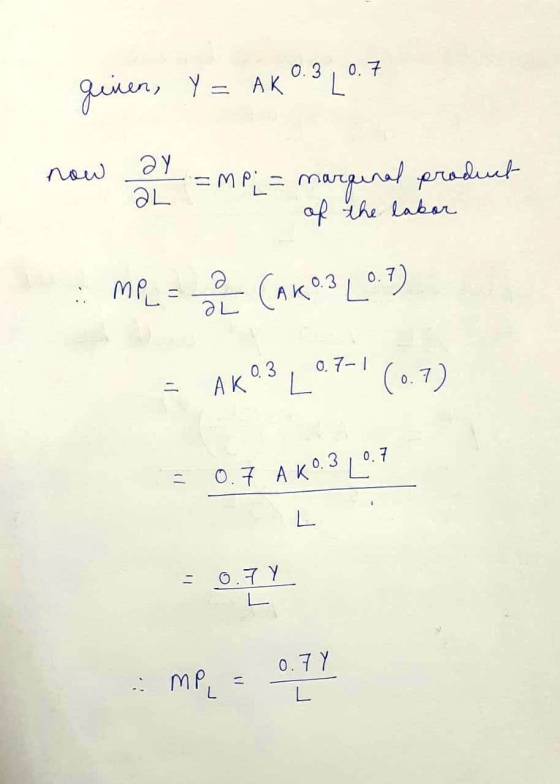
a. we know labours are paid according to their marginal product(we'll assume price of the product is 1 now)
hence wage=1xMPL=MPL
 NOW LET'S UNDERSTAND THE SITUATION WITHOUT MATHS
after disease the labour supply will fall hence wage will increase!(because other factors are remaining the same)

b. Let's say Our initial situation,
A=10
K=20
L=60
hence our total production will be Y= 10x200.3x600.7=431.533856
hence our wage=MPL=0.7Y/L=0.7x431.533856/60=5.034561653
Now let's say one-third labour died hence only 60-20=40 labours left
Now the value of Y in this situation will be=324.9009585, and hence wage will be= 5.68576674
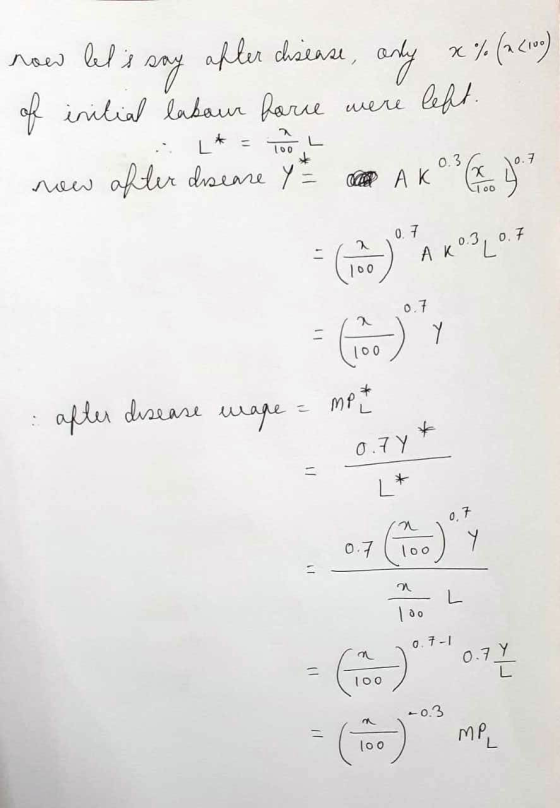
Now theoretically we have, before disease Y=AK0.3L0.7 , Wage=MPL= 0.7(AK0.3L0.7)/L=0.7Y/L
let's say 1/3 of labour died. hence total labour labour left now is 2/3L
hence now our Y will be Y*=AK0.3(2/3 x L)0.7=(2/3)0.7 xAK0.3L0.7=(2/3)0.7Y
and wage will be Wage*=0.7x(2/3)0.7Y divided by 2/3L=0.79 Y/L
hence wage*/wage= 0/79/0.7=1.1285
hence wage will increase by 1.128571429 times if third of the labour dies
I hope you liked the answer. if you have anything to ask regarding the answer comment down I'll get back to you ASAP.
Thanks.
Give good feedback.
Have a great day ahead.
Add Answer to:
please answer part a and part b from the calculations shownin the
last attachment
* 3....
please use the production function shown in the second photo as instructed. * 3. The Black...
 please use the production function shown in the second photo
as instructed.
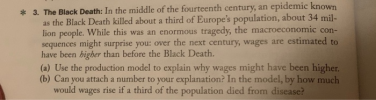
* 3. The Black Death: In the middle of the fourteenth century, an epidemic known as the Black Death killed about a third of Europe's population, about 34 mil- lion people. While this was an enormous tragedy, the macroeconomic con- sequences might surprise you: over the next century, wages are estimated to have been higher than before the Black Death. (a) Use the production model to explain why...
please use the production function shown in the second photo
as instructed.
* 3. The Black Death: In the middle of the fourteenth century, an epidemic known as the Black Death killed about a third of Europe's population, about 34 mil- lion people. While this was an enormous tragedy, the macroeconomic con- sequences might surprise you: over the next century, wages are estimated to have been higher than before the Black Death. (a) Use the production model to explain why...
i need help to understand those two question from discussion in this artical please. 3. Take...
 i need help to understand those two question from discussion
in this artical please.
3. Take a few minutes to re-read the first four paragraphs of the Discussion section. Explain in your own words the "metabolic suppression hypothesis" proposed by the researchers: what is the hypothesis, and why might it be plausible? WRITE YOUR RESPONSE HERE PLEASE (don't forget the in-text citation, as well as quotation marks and a page number if you are quoting in your answer) This study...
i need help to understand those two question from discussion
in this artical please.
3. Take a few minutes to re-read the first four paragraphs of the Discussion section. Explain in your own words the "metabolic suppression hypothesis" proposed by the researchers: what is the hypothesis, and why might it be plausible? WRITE YOUR RESPONSE HERE PLEASE (don't forget the in-text citation, as well as quotation marks and a page number if you are quoting in your answer) This study...
 please use the production function shown in the second photo
as instructed.
* 3. The Black Death: In the middle of the fourteenth century, an epidemic known as the Black Death killed about a third of Europe's population, about 34 mil- lion people. While this was an enormous tragedy, the macroeconomic con- sequences might surprise you: over the next century, wages are estimated to have been higher than before the Black Death. (a) Use the production model to explain why...
please use the production function shown in the second photo
as instructed.
* 3. The Black Death: In the middle of the fourteenth century, an epidemic known as the Black Death killed about a third of Europe's population, about 34 mil- lion people. While this was an enormous tragedy, the macroeconomic con- sequences might surprise you: over the next century, wages are estimated to have been higher than before the Black Death. (a) Use the production model to explain why...
 i need help to understand those two question from discussion
in this artical please.
3. Take a few minutes to re-read the first four paragraphs of the Discussion section. Explain in your own words the "metabolic suppression hypothesis" proposed by the researchers: what is the hypothesis, and why might it be plausible? WRITE YOUR RESPONSE HERE PLEASE (don't forget the in-text citation, as well as quotation marks and a page number if you are quoting in your answer) This study...
i need help to understand those two question from discussion
in this artical please.
3. Take a few minutes to re-read the first four paragraphs of the Discussion section. Explain in your own words the "metabolic suppression hypothesis" proposed by the researchers: what is the hypothesis, and why might it be plausible? WRITE YOUR RESPONSE HERE PLEASE (don't forget the in-text citation, as well as quotation marks and a page number if you are quoting in your answer) This study...
Most questions answered within 3 hours.
-
Where is the error in this code sequence?
String s1 = "Hello";
String s2 = "ello";...
asked 10 months ago -
Financial data for Joel de Paris, Inc., for last year
follow:
Joel de Paris, Inc.
Balance...
asked 10 months ago -
Consider this reaction:
Al2(SO4)3 (aq)+ BaCl3
(aq) Al2Cl6 (aq)- +
3BaSO4(s) . What is the...
asked 10 months ago -
Suppose that Savneet is considering increasing her
recent random sample from 20 car rentals to 40...
asked 10 months ago -
Trucks arrive at an unloading terminal at an average rate of 120
per hour.
Trucks arrive...
asked 10 months ago -
Why are methanol and ethanol completely soluble in water while
octanol is not very little soluble....
asked 10 months ago -
A facilities manager at a university reads in a research report
that the mean amount of...
asked 10 months ago -
When the CuSO4 is rehydrated by adding water to the anhydrous
compound, is this an endothermic...
asked 10 months ago -
A ray of sunlight is passing from diamond into crown glass; the
angle of incidence is...
asked 10 months ago -
A block of mass 0.249 kg is placed on top of a light, vertical
spring of...
asked 10 months ago -
how do the kidneys compensate in the presences of acidosis
a) trigger hyperventilate
b) reserve acid...
asked 10 months ago -
Question 501 pts
The rental rate of capital to the firm increases. Which of the
following...
asked 10 months ago