For a direct-mapped cache design with a 32-bit address, the following bits of the address are...
For a direct-mapped cache design with a 32-bit address, the following bits of the address are used to access the cache.
|
Tag |
Index |
Offset |
|
31-10 |
9-4 |
3-0 |
How many entries does the cache have?
Homework Answers
The index has 6 bits(9-4+1), and therefore the cache has 26= 64 entries.
Block size = 2Nwhere N = (number of offset bits-2) = 4-2 = 2. (Note that the “-2” is due to using 32-bit words and byte-addressed memory.) Block size = 22= 4 words
Alternately, block size = 2(number of offset bits)bytes.
Block size = 24= 16 bytes = 4 words
Add Answer to:
For a direct-mapped cache design with a 32-bit address, the
following bits of the address are...
3- for a direct mapped cache design with a 32 bit address, the following bits of address are used...
 Please answer all parts correctly and show your work
3- for a direct mapped cache design with a 32 bit address, the following bits of address are used to access the cache Tag Index Offset 31-10 9-5 4-0 Starting from power on, the following byte addressed cache reference are recorded. Address 0 16 132 232 160 1024 30 140 3100180 2180 d. How many blocks are replaced e. What is the hit ratio f. List final state of the cache,...
Please answer all parts correctly and show your work
3- for a direct mapped cache design with a 32 bit address, the following bits of address are used to access the cache Tag Index Offset 31-10 9-5 4-0 Starting from power on, the following byte addressed cache reference are recorded. Address 0 16 132 232 160 1024 30 140 3100180 2180 d. How many blocks are replaced e. What is the hit ratio f. List final state of the cache,...
For a direct-mapped cache with a 32-bit address and 32-bit words, the following address bits are...
For a direct-mapped cache with a 32-bit address and 32-bit words, the following address bits are used to access the cache. TAG INDEX OFFSET 31-15 14-8 7-0 a. What is the cache block size (in words)? [13 points] b. How many blocks does the cache have? [12 points]
Please show your work and answer all parts correctly 3- for a direct mapped cache design...
 Please show your work and answer all parts correctly
3- for a direct mapped cache design with a 32 bit address, the following bits of address are used to access the cache Tag Index Offset 31-10 9-5 4-0 a. What is cache block size (in word)? b. How many entries does the cache have? c. What is the ration between total bits required for such a cache implementation one the data storage bits?
Please show your work and answer all parts correctly
3- for a direct mapped cache design with a 32 bit address, the following bits of address are used to access the cache Tag Index Offset 31-10 9-5 4-0 a. What is cache block size (in word)? b. How many entries does the cache have? c. What is the ration between total bits required for such a cache implementation one the data storage bits?
*Need answer for 5.3.6, information is in 5.3* 5.3 For a direct-mapped cache design with a...
 *Need answer for 5.3.6, information is in 5.3*
5.3 For a direct-mapped cache design with a 32-bit address, the following bits of the address are used to access the cache. Tag Index Offset 31-10 9-5 4-0
*Need answer for 5.3.6, information is in 5.3*
5.3 For a direct-mapped cache design with a 32-bit address, the following bits of the address are used to access the cache. Tag Index Offset 31-10 9-5 4-0
Design a 256KB (note the B) direct‐mapped data cache that uses a 32‐bit address and 8...
Design a 256KB (note the B) direct‐mapped data cache that uses a 32‐bit address and 8 words per block. Calculate the following: How many bits are used for the byte offset and why? How many bits are used for the set (index) field? How many bits are used for the tag? What’s the overhead for that cache?
a) Suppose we have a 64 KB, direct-mapped cache with 8-word blocks. Determine how many bits...
a) Suppose we have a 64 KB, direct-mapped cache with 8-word blocks. Determine how many bits are required for the tag, index, and offset fields for a 32-bit memory address. b) If instead, we use a 64 KB, 4-way set-associative cache with 8-word blocks, how many bits will be required for the tag, index, and offset fields for a 32-bit address? c) What type of cache is shown in problem 2? How many bits are required for this cache’s tag,...
A direct-mapped cache holds 64KB of useful data (not including tag or control bits). Assuming that...
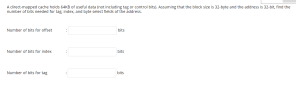 A direct-mapped cache holds 64KB of useful data (not including tag or control bits). Assuming that the block size is 32-byte and the address is 32-bit, find the number of bits needed for tag, index, and byte select fields of the address. Number of bits for offset bits Number of bits for index bits Number of bits for tag bits
Question 17 A direct-mapped cache holds 128KB of useful data (not including tag or control bits)....
 Question 17 A direct-mapped cache holds 128KB of useful data (not including tag or control bits). Assuming that the block size is 32-byte and the address is 32-bit, find the number of bits needed for tag, index, and byte select fields of the address. Number of bits for offset bits Number of bits for index bits Number of bits for tag .. bits
Consider a 32 KiB (not KB) cache in a system where the processor uses 64-bit words....
Consider a 32 KiB (not KB) cache in a system where the processor uses 64-bit words. The system use the byte address of 36-bits. Each cache line (block) stores 256 bits. a) How many bits are used as the byte offset (b)? How many bits are used as the block offset (m)? b) How many index bits are used? How many blocks (lines) are available in the cache? c) Consider the cache being organized as direct-mapped cache. How many bits...
The following figure shows the address that is going from a certain processor to a direct-mapped...
 The following figure shows the address that is going
from a certain processor to a direct-mapped cache. The address is
divided into fields. The index of the first bit and the last bit of
each field is written below it. Calculate the size of the data that
is stored in the cache, in Kibytes, and the total number of bits
within the cache, in Kibits.
TAG = 31 - 16
INDEX = 15 - 6
BLOCK OFFSET = 5 -...
The following figure shows the address that is going
from a certain processor to a direct-mapped cache. The address is
divided into fields. The index of the first bit and the last bit of
each field is written below it. Calculate the size of the data that
is stored in the cache, in Kibytes, and the total number of bits
within the cache, in Kibits.
TAG = 31 - 16
INDEX = 15 - 6
BLOCK OFFSET = 5 -...
 Please answer all parts correctly and show your work
3- for a direct mapped cache design with a 32 bit address, the following bits of address are used to access the cache Tag Index Offset 31-10 9-5 4-0 Starting from power on, the following byte addressed cache reference are recorded. Address 0 16 132 232 160 1024 30 140 3100180 2180 d. How many blocks are replaced e. What is the hit ratio f. List final state of the cache,...
Please answer all parts correctly and show your work
3- for a direct mapped cache design with a 32 bit address, the following bits of address are used to access the cache Tag Index Offset 31-10 9-5 4-0 Starting from power on, the following byte addressed cache reference are recorded. Address 0 16 132 232 160 1024 30 140 3100180 2180 d. How many blocks are replaced e. What is the hit ratio f. List final state of the cache,...
 Please show your work and answer all parts correctly
3- for a direct mapped cache design with a 32 bit address, the following bits of address are used to access the cache Tag Index Offset 31-10 9-5 4-0 a. What is cache block size (in word)? b. How many entries does the cache have? c. What is the ration between total bits required for such a cache implementation one the data storage bits?
Please show your work and answer all parts correctly
3- for a direct mapped cache design with a 32 bit address, the following bits of address are used to access the cache Tag Index Offset 31-10 9-5 4-0 a. What is cache block size (in word)? b. How many entries does the cache have? c. What is the ration between total bits required for such a cache implementation one the data storage bits?
 *Need answer for 5.3.6, information is in 5.3*
5.3 For a direct-mapped cache design with a 32-bit address, the following bits of the address are used to access the cache. Tag Index Offset 31-10 9-5 4-0
*Need answer for 5.3.6, information is in 5.3*
5.3 For a direct-mapped cache design with a 32-bit address, the following bits of the address are used to access the cache. Tag Index Offset 31-10 9-5 4-0
 A direct-mapped cache holds 64KB of useful data (not including tag or control bits). Assuming that the block size is 32-byte and the address is 32-bit, find the number of bits needed for tag, index, and byte select fields of the address. Number of bits for offset bits Number of bits for index bits Number of bits for tag bits
 Question 17 A direct-mapped cache holds 128KB of useful data (not including tag or control bits). Assuming that the block size is 32-byte and the address is 32-bit, find the number of bits needed for tag, index, and byte select fields of the address. Number of bits for offset bits Number of bits for index bits Number of bits for tag .. bits
 The following figure shows the address that is going
from a certain processor to a direct-mapped cache. The address is
divided into fields. The index of the first bit and the last bit of
each field is written below it. Calculate the size of the data that
is stored in the cache, in Kibytes, and the total number of bits
within the cache, in Kibits.
TAG = 31 - 16
INDEX = 15 - 6
BLOCK OFFSET = 5 -...
The following figure shows the address that is going
from a certain processor to a direct-mapped cache. The address is
divided into fields. The index of the first bit and the last bit of
each field is written below it. Calculate the size of the data that
is stored in the cache, in Kibytes, and the total number of bits
within the cache, in Kibits.
TAG = 31 - 16
INDEX = 15 - 6
BLOCK OFFSET = 5 -...
Most questions answered within 3 hours.
-
Where is the error in this code sequence?
String s1 = "Hello";
String s2 = "ello";...
asked 11 months ago -
Financial data for Joel de Paris, Inc., for last year
follow:
Joel de Paris, Inc.
Balance...
asked 11 months ago -
Consider this reaction:
Al2(SO4)3 (aq)+ BaCl3
(aq) Al2Cl6 (aq)- +
3BaSO4(s) . What is the...
asked 11 months ago -
Suppose that Savneet is considering increasing her
recent random sample from 20 car rentals to 40...
asked 11 months ago -
Trucks arrive at an unloading terminal at an average rate of 120
per hour.
Trucks arrive...
asked 11 months ago -
Why are methanol and ethanol completely soluble in water while
octanol is not very little soluble....
asked 11 months ago -
A facilities manager at a university reads in a research report
that the mean amount of...
asked 11 months ago -
When the CuSO4 is rehydrated by adding water to the anhydrous
compound, is this an endothermic...
asked 11 months ago -
A ray of sunlight is passing from diamond into crown glass; the
angle of incidence is...
asked 11 months ago -
A block of mass 0.249 kg is placed on top of a light, vertical
spring of...
asked 11 months ago -
how do the kidneys compensate in the presences of acidosis
a) trigger hyperventilate
b) reserve acid...
asked 11 months ago -
Question 501 pts
The rental rate of capital to the firm increases. Which of the
following...
asked 11 months ago