
Homework Answers
Add Answer to:
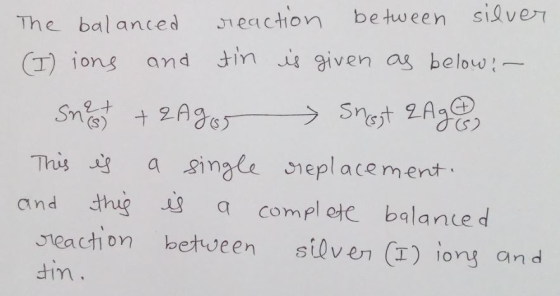
Write the balanced I want to question for the reaction between
silver (I) ions and tin....
16. Write the chemical formula for the following binary com- pounds given their constituent ions. (a)...
 16. Write the chemical formula for the following binary com- pounds given their constituent ions. (a) lithium chloride, Li' and CI (b) silver oxide, Ag" and O (c) chromium(II) iodide, Cr" and I (d) tin(II) nitride, Sm and N 18. Write the chemical formula for the following ternary com- pounds given their constituent ions. (a) sodium acetate, Na and cH.O, (b) aluminum sulfite, Al" and SO () mercury(II) cyanide, Hg and CN (d) chromium(III) hypochlorite, Cr and CIO 22. 5upply...
The following molecular equation represents the reaction that occurs when aqueous solutions of silver(I) nitrate and...
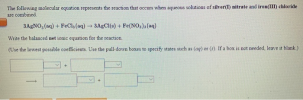 The following molecular equation represents the reaction that occurs when aqueous solutions of silver(I) nitrate and iron(III) chloride are combined 3AgNO3(aq) + FeCl3(aq) → 3AgCl(s) + Fe(NO3), (aq) Write the balanced net ionic equation for the reaction. (Use the lowest possible coefficients. Use the pull down boxes to specify states such as (aq) or ($). If a box is not needed, leave it blank.)
Use solubility rules to determine which product is insoluble for the aqueous reaction between BaI2 and...
Use solubility rules to determine which product is insoluble for the aqueous reaction between BaI2 and Hg(NO3)2. Then, write the balanced molecular (formulas only), complete ionic (split aq into ions), and net ionic equations (eliminate spectators). Include the phase subscripts and coefficients on all substances and ions, as well as the ionic charge on all of the ions.
Write a balanced equation for the double-replacement precipitation reaction described, using the smallest possible integer coefficients....
 Write a balanced equation for
the double-replacement precipitation reaction
described, using the smallest possible integer coefficients.
A precipitate forms when aqueous solutions of silver(I)
nitrate and nickel(II) chloride are
combined.
Use the pull-down boxes to include states such as (s) or
(aq).
Write a balanced equation for the double-replacement precipitation reaction described, using the smallest possible integer coefficients. A precipitate forms when aqueous solutions of silver(I) nitrate and nickel(II) chloride are combined. Use the pull-down boxes to include states such...
Write a balanced equation for
the double-replacement precipitation reaction
described, using the smallest possible integer coefficients.
A precipitate forms when aqueous solutions of silver(I)
nitrate and nickel(II) chloride are
combined.
Use the pull-down boxes to include states such as (s) or
(aq).
Write a balanced equation for the double-replacement precipitation reaction described, using the smallest possible integer coefficients. A precipitate forms when aqueous solutions of silver(I) nitrate and nickel(II) chloride are combined. Use the pull-down boxes to include states such...
2. (a) Write out the balanced chemical equation for the reaction between sulfuric acid and sodium...
 2. (a) Write out the balanced chemical equation for the reaction between sulfuric acid and sodium hydroxide, using smallest whole number stoichiometric coefficients. (b) Write out the net ionic equation for the reaction between hydrochloric acid and sodium hydroxide. (c) Using your results, what is the ratio of AHxn(H2SO.) to AHxx.(HCI)? What should this ratio be? Explain.
The following molecular equation represents the reaction that occurs when aqueous solutions of silver(I) nitrate and...
 The following molecular equation represents the reaction that occurs when aqueous solutions of silver(I) nitrate and potassium bromide are combined. AgNO3(aq) + KBr(aq) + AgBr(s) + KNO, (aq) Write the balanced net ionic equation for the reaction. (Use the lowest possible coefficients. Use the pull-down boxes to specify states such as (aq) or (8) If a box is not needed, leave it blank.) Submit Answer Retry Entire Group 4 more group attempts remaining
Write the balanced chemical equation for the reaction between iodate and bisulfite. Does the order with...
Write the balanced chemical equation for the reaction between iodate and bisulfite. Does the order with respect to each reactant match the stoichiometric coefficients in the balanced reaction? Explain why or why not.
Write a balanced net ionic equation to show why the solubility of Zn(CN)2(s) increases in the pre...
 Write a balanced net ionic equation to show why the solubility
of Zn(CN)2(s) increases in the presence
of a strong acid and calculate the equilibrium constant for the
reaction of this sparingly soluble salt with acid.
I really need help with both because I am on my last attempt and
cannot seem to understand exactly how to solve for K. Thank you for
your help! I will be sure to rate your answer if it is correct.
Write a balanced...
Write a balanced net ionic equation to show why the solubility
of Zn(CN)2(s) increases in the presence
of a strong acid and calculate the equilibrium constant for the
reaction of this sparingly soluble salt with acid.
I really need help with both because I am on my last attempt and
cannot seem to understand exactly how to solve for K. Thank you for
your help! I will be sure to rate your answer if it is correct.
Write a balanced...
35. Write the balanced full ionic equation for the reaction between an aqueous solution of KHCO3(aq)...
 35. Write the balanced full ionic equation for the reaction between an aqueous solution of KHCO3(aq) and an aqueous solution of the strong acid HCl(ag). 36. Write the balanced molcular equation for the reaction between an aqueous solution of LIOH(aq) and an aqueous solution of the strong acid HNO3(aq)
Write the chemical formula for the following binary com- pounds given their constituent ions. (a) lithium...
 Write the chemical formula for the following binary com- pounds given their constituent ions. (a) lithium chloride, Lit and CIS (b) silver oxide, Ag+ and 02- (c) chromium(III) iodide, Cr3+ and I (d) tin(II) nitride, Sn2+ and Nº- 18. Write the chemical formula for the following ternary com- pounds given their constituent ions. (a) sodium acetate, Na+ and C H20,- (b) aluminum sulfite, A13+ and SO, 2- (c) mercury(II) cyanide, Hg2+ and CN (d) chromium(III) hypochlorite, Cr3+ and CIO“ 12....
 16. Write the chemical formula for the following binary com- pounds given their constituent ions. (a) lithium chloride, Li' and CI (b) silver oxide, Ag" and O (c) chromium(II) iodide, Cr" and I (d) tin(II) nitride, Sm and N 18. Write the chemical formula for the following ternary com- pounds given their constituent ions. (a) sodium acetate, Na and cH.O, (b) aluminum sulfite, Al" and SO () mercury(II) cyanide, Hg and CN (d) chromium(III) hypochlorite, Cr and CIO 22. 5upply...
 The following molecular equation represents the reaction that occurs when aqueous solutions of silver(I) nitrate and iron(III) chloride are combined 3AgNO3(aq) + FeCl3(aq) → 3AgCl(s) + Fe(NO3), (aq) Write the balanced net ionic equation for the reaction. (Use the lowest possible coefficients. Use the pull down boxes to specify states such as (aq) or ($). If a box is not needed, leave it blank.)
 Write a balanced equation for
the double-replacement precipitation reaction
described, using the smallest possible integer coefficients.
A precipitate forms when aqueous solutions of silver(I)
nitrate and nickel(II) chloride are
combined.
Use the pull-down boxes to include states such as (s) or
(aq).
Write a balanced equation for the double-replacement precipitation reaction described, using the smallest possible integer coefficients. A precipitate forms when aqueous solutions of silver(I) nitrate and nickel(II) chloride are combined. Use the pull-down boxes to include states such...
Write a balanced equation for
the double-replacement precipitation reaction
described, using the smallest possible integer coefficients.
A precipitate forms when aqueous solutions of silver(I)
nitrate and nickel(II) chloride are
combined.
Use the pull-down boxes to include states such as (s) or
(aq).
Write a balanced equation for the double-replacement precipitation reaction described, using the smallest possible integer coefficients. A precipitate forms when aqueous solutions of silver(I) nitrate and nickel(II) chloride are combined. Use the pull-down boxes to include states such...
 2. (a) Write out the balanced chemical equation for the reaction between sulfuric acid and sodium hydroxide, using smallest whole number stoichiometric coefficients. (b) Write out the net ionic equation for the reaction between hydrochloric acid and sodium hydroxide. (c) Using your results, what is the ratio of AHxn(H2SO.) to AHxx.(HCI)? What should this ratio be? Explain.
 The following molecular equation represents the reaction that occurs when aqueous solutions of silver(I) nitrate and potassium bromide are combined. AgNO3(aq) + KBr(aq) + AgBr(s) + KNO, (aq) Write the balanced net ionic equation for the reaction. (Use the lowest possible coefficients. Use the pull-down boxes to specify states such as (aq) or (8) If a box is not needed, leave it blank.) Submit Answer Retry Entire Group 4 more group attempts remaining
 Write a balanced net ionic equation to show why the solubility
of Zn(CN)2(s) increases in the presence
of a strong acid and calculate the equilibrium constant for the
reaction of this sparingly soluble salt with acid.
I really need help with both because I am on my last attempt and
cannot seem to understand exactly how to solve for K. Thank you for
your help! I will be sure to rate your answer if it is correct.
Write a balanced...
Write a balanced net ionic equation to show why the solubility
of Zn(CN)2(s) increases in the presence
of a strong acid and calculate the equilibrium constant for the
reaction of this sparingly soluble salt with acid.
I really need help with both because I am on my last attempt and
cannot seem to understand exactly how to solve for K. Thank you for
your help! I will be sure to rate your answer if it is correct.
Write a balanced...
 35. Write the balanced full ionic equation for the reaction between an aqueous solution of KHCO3(aq) and an aqueous solution of the strong acid HCl(ag). 36. Write the balanced molcular equation for the reaction between an aqueous solution of LIOH(aq) and an aqueous solution of the strong acid HNO3(aq)
 Write the chemical formula for the following binary com- pounds given their constituent ions. (a) lithium chloride, Lit and CIS (b) silver oxide, Ag+ and 02- (c) chromium(III) iodide, Cr3+ and I (d) tin(II) nitride, Sn2+ and Nº- 18. Write the chemical formula for the following ternary com- pounds given their constituent ions. (a) sodium acetate, Na+ and C H20,- (b) aluminum sulfite, A13+ and SO, 2- (c) mercury(II) cyanide, Hg2+ and CN (d) chromium(III) hypochlorite, Cr3+ and CIO“ 12....
Most questions answered within 3 hours.
-
Where is the error in this code sequence?
String s1 = "Hello";
String s2 = "ello";...
asked 10 months ago -
Financial data for Joel de Paris, Inc., for last year
follow:
Joel de Paris, Inc.
Balance...
asked 10 months ago -
Consider this reaction:
Al2(SO4)3 (aq)+ BaCl3
(aq) Al2Cl6 (aq)- +
3BaSO4(s) . What is the...
asked 10 months ago -
Suppose that Savneet is considering increasing her
recent random sample from 20 car rentals to 40...
asked 10 months ago -
Trucks arrive at an unloading terminal at an average rate of 120
per hour.
Trucks arrive...
asked 10 months ago -
Why are methanol and ethanol completely soluble in water while
octanol is not very little soluble....
asked 10 months ago -
A facilities manager at a university reads in a research report
that the mean amount of...
asked 10 months ago -
When the CuSO4 is rehydrated by adding water to the anhydrous
compound, is this an endothermic...
asked 10 months ago -
A ray of sunlight is passing from diamond into crown glass; the
angle of incidence is...
asked 10 months ago -
A block of mass 0.249 kg is placed on top of a light, vertical
spring of...
asked 10 months ago -
how do the kidneys compensate in the presences of acidosis
a) trigger hyperventilate
b) reserve acid...
asked 10 months ago -
Question 501 pts
The rental rate of capital to the firm increases. Which of the
following...
asked 10 months ago