
Homework Answers
Add Answer to:
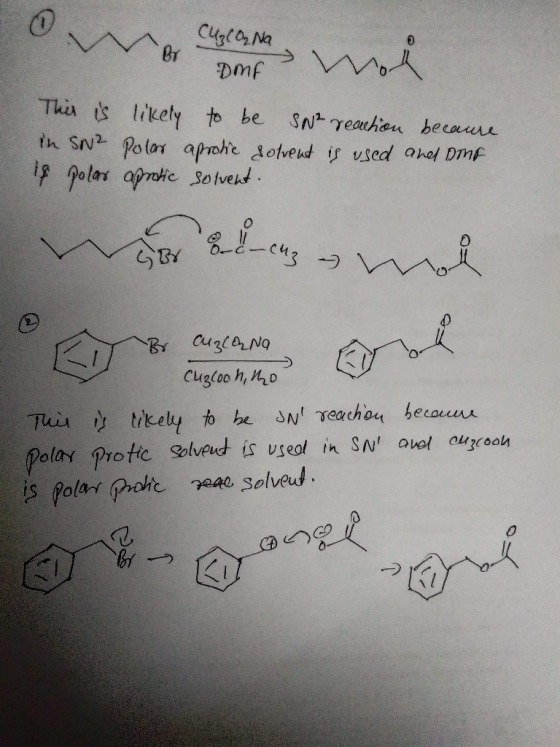
3. (20 points) For the following reactions, predict whether the reaction is likely to be SN1...
1. Predict whether the following reactions are likely to proceed by an E1 or E2 mechanism....
 1. Predict whether the following reactions are likely to proceed
by an E1 or E2 mechanism. PLEASE show the mechanism and product of
the reaction!!!!
2. Explain each prediction.
Predicting mechanisms: E1 or E2? 1. Predict whether the following reactions are likely to proceed by an El or E2 mechanism. 2. Explain each prediction. Br co KOH H2O Br CH,CH,OH Br CH2CH OH CH,0/CH,OH Br
1. Predict whether the following reactions are likely to proceed
by an E1 or E2 mechanism. PLEASE show the mechanism and product of
the reaction!!!!
2. Explain each prediction.
Predicting mechanisms: E1 or E2? 1. Predict whether the following reactions are likely to proceed by an El or E2 mechanism. 2. Explain each prediction. Br co KOH H2O Br CH,CH,OH Br CH2CH OH CH,0/CH,OH Br
4. Predict the products of the following reactions & indicate whether they are most likely to...
 4. Predict the products of the following reactions & indicate whether they are most likely to go through an SN2, SN1, E1, or E2 mechanism. NaCN DMSO NaOH CH3OH heat Only one product is formed in the following E2 elimination reaction. Draw an arrow-pushing mechanism for the reaction and provide the correct product structure. Include a 3-D drawing (chair conformation) displaying proper stereochemistry of the transition state to explain formation of only the major product. CH3 •Br NaOCH3 ~"'CHS
Tell whether each of the following reactions are likely to be Sn1, Sn2, E1, E1CB, or...
 Tell whether each of the following reactions are likely to be
Sn1, Sn2, E1, E1CB, or E2 and provide a mechanism for the
transformation in part a.
Tell whether each of the following reactions is likely to be Sn1, Sn2, E1, E1cB, or E2: кон Ethanol Br нсон H20
Tell whether each of the following reactions are likely to be
Sn1, Sn2, E1, E1CB, or E2 and provide a mechanism for the
transformation in part a.
Tell whether each of the following reactions is likely to be Sn1, Sn2, E1, E1cB, or E2: кон Ethanol Br нсон H20
30. Late papers not accepted. Work Independently. 1. Predict the most likely reaction mechanism (SN1, SN2,...
 30. Late papers not accepted. Work Independently. 1. Predict the most likely reaction mechanism (SN1, SN2, E1, E2) and draw all products. CH₂ Na O=CH₂ Hic Br 2 Draw complete mechanism with arrows for the SNI/E1 mechanism. Check for carbocation rearrangements CH3 + H2O 3. Which is the major product for the following reaction? Y CH + NaOH CH HO HO H₃ CH₂ H₃ HOCH CH₂ H₃ CHE CH₂ CH₂ CH3 CH 4. Name the following including the R/S, E/Z...
3. Shown below are a series of reactions. Predict the major product for each of them....
 3. Shown below are a series of reactions. Predict the major product for each of them. Remember, you will need to first decide whether the reaction occurs by an SN2, SN1, E2, or E1 before you can determine what the product will be. Label each as SN2, SN1, E2, or E1. Hint: First decide whether S2/E2 or S1/E1 is favored, and then decide whether the reaction pathway goes by a substitution or elimination reaction. SN2 / SN1 E2/E1 Na DMSO,rt...
11. For each of the following reactions, predict whether Syl or Sy2 will be the primary...
 11. For each of the following reactions, predict whether Syl or Sy2 will be the primary substitution mechanism. (Circle one) Br Nal in H2O - SN or SN2 CH,OH Sn1 or SN2 NaCN in DMSO Sn1 or S2 12. For the second reaction in question 11 (above), which do you think would react faster--the sec- ondary bromide or a secondary chloride (assuming the same reaction conditions)? (Circle one) Bromide Chloride Neither (rates are the same)
20. Arrange the following molecules based on their reactivity for SN1 mechanism (the most reactive to...
 20. Arrange the following molecules based on their reactivity for SN1 mechanism (the most reactive to the least reactive) [4pts] Br Br CH3Br Br 21. Considering the SN1, SN2, E1, and E2 mechanisms, the energy diagram shown below corresponds to [4Pts] a. only the SN1 mechanism b. only the E1 mechanism c. both the SN2 and E2 mechanisms d. only the SN2 mechanism. e. only the E2 mechanism f. both the SN1 and El mechanisms energy rxn coordinate 22. If...
Predict the most likely reaction mechanism (SN1, SN2, E1, E2) and draw all products. Nato=CH₂ E2 ran Br major 2. Dr...
 Predict the most likely reaction mechanism (SN1, SN2, E1, E2) and draw all products. Nato=CH₂ E2 ran Br major 2. Draw complete mechanism with arrows for the SN1/E1 mechanism. Check for carbocation rearrangements. CH3 SMI 애 + H₂O7
1. For the following Alkyl halide indicate which position will react under SN1 reaction conditions and...
 1. For the following Alkyl halide indicate which position will react under SN1 reaction conditions and under SN2 reaction conditions. Explain your answer. mer 2. Draw the complete mechanism and the products for of the following SN1 reaction paying close attention to stereochemistry. H3C CI CH OH CH2CH3 општироотип солио 3. Provide the product/s for the following reactions. Indicate if the reactions proceed via an SN1, or SN2 mechanism. Indicate proper stereochemistry if it is applicable. Show the mechanisms NaCN...
Q1. Identify the reaction mechanism most likely to take place (E1, SN1, E2, SN2 or a...
 Q1. Identify the reaction mechanism most likely to take place (E1, SN1, E2, SN2 or a combination of these) in each of the following cases. Draw the major product(s), include stereochemistry when relevant. Br -OtBu Br NaCN, DMF → CI Носна 1. Nal/acetone 2. NaCN/DMF NaoMe H2SO4 OH Lyon CN (CH3)2CO CI NaOH →
 1. Predict whether the following reactions are likely to proceed
by an E1 or E2 mechanism. PLEASE show the mechanism and product of
the reaction!!!!
2. Explain each prediction.
Predicting mechanisms: E1 or E2? 1. Predict whether the following reactions are likely to proceed by an El or E2 mechanism. 2. Explain each prediction. Br co KOH H2O Br CH,CH,OH Br CH2CH OH CH,0/CH,OH Br
1. Predict whether the following reactions are likely to proceed
by an E1 or E2 mechanism. PLEASE show the mechanism and product of
the reaction!!!!
2. Explain each prediction.
Predicting mechanisms: E1 or E2? 1. Predict whether the following reactions are likely to proceed by an El or E2 mechanism. 2. Explain each prediction. Br co KOH H2O Br CH,CH,OH Br CH2CH OH CH,0/CH,OH Br
 4. Predict the products of the following reactions & indicate whether they are most likely to go through an SN2, SN1, E1, or E2 mechanism. NaCN DMSO NaOH CH3OH heat Only one product is formed in the following E2 elimination reaction. Draw an arrow-pushing mechanism for the reaction and provide the correct product structure. Include a 3-D drawing (chair conformation) displaying proper stereochemistry of the transition state to explain formation of only the major product. CH3 •Br NaOCH3 ~"'CHS
 Tell whether each of the following reactions are likely to be
Sn1, Sn2, E1, E1CB, or E2 and provide a mechanism for the
transformation in part a.
Tell whether each of the following reactions is likely to be Sn1, Sn2, E1, E1cB, or E2: кон Ethanol Br нсон H20
Tell whether each of the following reactions are likely to be
Sn1, Sn2, E1, E1CB, or E2 and provide a mechanism for the
transformation in part a.
Tell whether each of the following reactions is likely to be Sn1, Sn2, E1, E1cB, or E2: кон Ethanol Br нсон H20
 30. Late papers not accepted. Work Independently. 1. Predict the most likely reaction mechanism (SN1, SN2, E1, E2) and draw all products. CH₂ Na O=CH₂ Hic Br 2 Draw complete mechanism with arrows for the SNI/E1 mechanism. Check for carbocation rearrangements CH3 + H2O 3. Which is the major product for the following reaction? Y CH + NaOH CH HO HO H₃ CH₂ H₃ HOCH CH₂ H₃ CHE CH₂ CH₂ CH3 CH 4. Name the following including the R/S, E/Z...
 3. Shown below are a series of reactions. Predict the major product for each of them. Remember, you will need to first decide whether the reaction occurs by an SN2, SN1, E2, or E1 before you can determine what the product will be. Label each as SN2, SN1, E2, or E1. Hint: First decide whether S2/E2 or S1/E1 is favored, and then decide whether the reaction pathway goes by a substitution or elimination reaction. SN2 / SN1 E2/E1 Na DMSO,rt...
 11. For each of the following reactions, predict whether Syl or Sy2 will be the primary substitution mechanism. (Circle one) Br Nal in H2O - SN or SN2 CH,OH Sn1 or SN2 NaCN in DMSO Sn1 or S2 12. For the second reaction in question 11 (above), which do you think would react faster--the sec- ondary bromide or a secondary chloride (assuming the same reaction conditions)? (Circle one) Bromide Chloride Neither (rates are the same)
 20. Arrange the following molecules based on their reactivity for SN1 mechanism (the most reactive to the least reactive) [4pts] Br Br CH3Br Br 21. Considering the SN1, SN2, E1, and E2 mechanisms, the energy diagram shown below corresponds to [4Pts] a. only the SN1 mechanism b. only the E1 mechanism c. both the SN2 and E2 mechanisms d. only the SN2 mechanism. e. only the E2 mechanism f. both the SN1 and El mechanisms energy rxn coordinate 22. If...
 Predict the most likely reaction mechanism (SN1, SN2, E1, E2) and draw all products. Nato=CH₂ E2 ran Br major 2. Draw complete mechanism with arrows for the SN1/E1 mechanism. Check for carbocation rearrangements. CH3 SMI 애 + H₂O7
 1. For the following Alkyl halide indicate which position will react under SN1 reaction conditions and under SN2 reaction conditions. Explain your answer. mer 2. Draw the complete mechanism and the products for of the following SN1 reaction paying close attention to stereochemistry. H3C CI CH OH CH2CH3 општироотип солио 3. Provide the product/s for the following reactions. Indicate if the reactions proceed via an SN1, or SN2 mechanism. Indicate proper stereochemistry if it is applicable. Show the mechanisms NaCN...
 Q1. Identify the reaction mechanism most likely to take place (E1, SN1, E2, SN2 or a combination of these) in each of the following cases. Draw the major product(s), include stereochemistry when relevant. Br -OtBu Br NaCN, DMF → CI Носна 1. Nal/acetone 2. NaCN/DMF NaoMe H2SO4 OH Lyon CN (CH3)2CO CI NaOH →
Most questions answered within 3 hours.
-
Where is the error in this code sequence?
String s1 = "Hello";
String s2 = "ello";...
asked 10 months ago -
Financial data for Joel de Paris, Inc., for last year
follow:
Joel de Paris, Inc.
Balance...
asked 10 months ago -
Consider this reaction:
Al2(SO4)3 (aq)+ BaCl3
(aq) Al2Cl6 (aq)- +
3BaSO4(s) . What is the...
asked 10 months ago -
Suppose that Savneet is considering increasing her
recent random sample from 20 car rentals to 40...
asked 10 months ago -
Trucks arrive at an unloading terminal at an average rate of 120
per hour.
Trucks arrive...
asked 10 months ago -
Why are methanol and ethanol completely soluble in water while
octanol is not very little soluble....
asked 10 months ago -
A facilities manager at a university reads in a research report
that the mean amount of...
asked 10 months ago -
When the CuSO4 is rehydrated by adding water to the anhydrous
compound, is this an endothermic...
asked 10 months ago -
A ray of sunlight is passing from diamond into crown glass; the
angle of incidence is...
asked 10 months ago -
A block of mass 0.249 kg is placed on top of a light, vertical
spring of...
asked 10 months ago -
how do the kidneys compensate in the presences of acidosis
a) trigger hyperventilate
b) reserve acid...
asked 10 months ago -
Question 501 pts
The rental rate of capital to the firm increases. Which of the
following...
asked 10 months ago