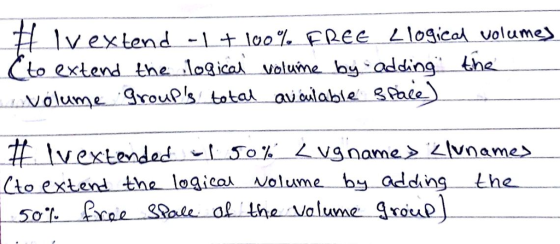
How to extend the logical volume to max.disk space and half of the disk.?
How to extend the logical volume to max.disk space and half of the disk.?
Homework Answers
Add Answer to:
How to extend the logical volume to max.disk space and half of
the disk.?
Consider a file system on a disk that has both logical and physical block sizes of...
Consider a file system on a disk that has both logical and physical block sizes of 512 bytes. Assume that the information about each file is already in memory. For each of the three allocation strategies (contiguous, linked, and indexed), answer these questions: If we are currently at logical block 5 (the last block accessed was blocked 4) and want to access logical block 15, how many physical blocks must be read from the disk?
1 Mark Question Two Consider a file system on a disk that has both logical and...
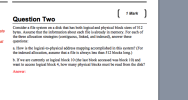 1 Mark Question Two Consider a file system on a disk that has both logical and physical block sizes of 512 tebytes. Assume that the information about each file is already in memory. For each of the three allocation strategies (contiguous, linked, and indexed), answer these at questions: a. How is the logical-to-physical address mapping accomplished in this system? (For the indexed allocation, assume that a file is always less than 512 blocks long.) b. If we are currently at...
You are reviewing disk management basics with a new technician in your department and are currently...
You are reviewing disk management basics with a new technician in your department and are currently discussing dynamic disks. Of the following, what do you say is true about dynamic disks? A. Dynamic disk space is allocated in partitions. B. The number of volumes in a dynamic disk is limited to four. C. A volume can extend to include the available space on any hard disk on the computer. D. Dynamic disk usage began in Windows XP.
How does the logical vs. physical address space affect compilation, linking, and loading?
How does the logical vs. physical address space affect compilation, linking, and loading?
how high would the atmosphere extend if it were of uniform density throughout, equal to half the present density at sea level
how high would the atmosphere extend if it were of uniform density throughout, equal to half the present density at sea level?
an 8 page document consumes 72.5 k of disk space. How many documents of this size...
an 8 page document consumes 72.5 k of disk space. How many documents of this size can fit onto a 1.44MB floppy disk?
Suppose that (X, Y) is uniformly distributed on the following right half disk. This half disk...
 Suppose that (X, Y) is uniformly distributed on the following right half disk. This half disk is the region inside the circle of radius 5 centered at the origin with positive x- coordinate. a) Give the joint probability density function of (x, y). b) Give the conditional probability density function of Y given X=x.
Suppose that (X, Y) is uniformly distributed on the following right half disk. This half disk...
 Suppose that (X, Y) is uniformly distributed on the following right half disk. This half disk is the region inside the circle of radius 5 centered at the origin with positive x- coordinate. a) Give the joint probability density function of (x, y). b) Give the conditional probability density function of Y given X=x.
Suppose that (X, Y) is uniformly distributed on the following right half disk. This half disk...
 Suppose that (X, Y) is uniformly distributed on the following right half disk. This half disk is the region inside the circle of radius 5 centered at the origin with positive x- coordinate. a) Give the joint probability density function of (x, y). b) Give the conditional probability density function of Y given X=x.
Suppose that (X, Y) is uniformly distributed on the following right half disk. This half disk...
 Suppose that (X, Y) is uniformly distributed on the following right half disk. This half disk is the region inside the circle of radius 5 centered at the origin with positive x- coordinate. a) Give the joint probability density function of (x, y). b) Give the conditional probability density function of Y given X=x.
 1 Mark Question Two Consider a file system on a disk that has both logical and physical block sizes of 512 tebytes. Assume that the information about each file is already in memory. For each of the three allocation strategies (contiguous, linked, and indexed), answer these at questions: a. How is the logical-to-physical address mapping accomplished in this system? (For the indexed allocation, assume that a file is always less than 512 blocks long.) b. If we are currently at...
 Suppose that (X, Y) is uniformly distributed on the following right half disk. This half disk is the region inside the circle of radius 5 centered at the origin with positive x- coordinate. a) Give the joint probability density function of (x, y). b) Give the conditional probability density function of Y given X=x.
 Suppose that (X, Y) is uniformly distributed on the following right half disk. This half disk is the region inside the circle of radius 5 centered at the origin with positive x- coordinate. a) Give the joint probability density function of (x, y). b) Give the conditional probability density function of Y given X=x.
 Suppose that (X, Y) is uniformly distributed on the following right half disk. This half disk is the region inside the circle of radius 5 centered at the origin with positive x- coordinate. a) Give the joint probability density function of (x, y). b) Give the conditional probability density function of Y given X=x.
 Suppose that (X, Y) is uniformly distributed on the following right half disk. This half disk is the region inside the circle of radius 5 centered at the origin with positive x- coordinate. a) Give the joint probability density function of (x, y). b) Give the conditional probability density function of Y given X=x.
Most questions answered within 3 hours.
-
Where is the error in this code sequence?
String s1 = "Hello";
String s2 = "ello";...
asked 10 months ago -
Financial data for Joel de Paris, Inc., for last year
follow:
Joel de Paris, Inc.
Balance...
asked 10 months ago -
Consider this reaction:
Al2(SO4)3 (aq)+ BaCl3
(aq) Al2Cl6 (aq)- +
3BaSO4(s) . What is the...
asked 10 months ago -
Suppose that Savneet is considering increasing her
recent random sample from 20 car rentals to 40...
asked 10 months ago -
Trucks arrive at an unloading terminal at an average rate of 120
per hour.
Trucks arrive...
asked 10 months ago -
Why are methanol and ethanol completely soluble in water while
octanol is not very little soluble....
asked 10 months ago -
A facilities manager at a university reads in a research report
that the mean amount of...
asked 10 months ago -
When the CuSO4 is rehydrated by adding water to the anhydrous
compound, is this an endothermic...
asked 10 months ago -
A ray of sunlight is passing from diamond into crown glass; the
angle of incidence is...
asked 10 months ago -
A block of mass 0.249 kg is placed on top of a light, vertical
spring of...
asked 10 months ago -
how do the kidneys compensate in the presences of acidosis
a) trigger hyperventilate
b) reserve acid...
asked 10 months ago -
Question 501 pts
The rental rate of capital to the firm increases. Which of the
following...
asked 10 months ago